
- Skincare glass bottle set design in 2026 is moving from individual SKU buying to complete packaging systems.
- Compatibility between bottle, pump, cap, and closure is now a primary sourcing criterion for beauty packaging.
- Premium visual identity increasingly depends on surface finish, decoration, and set consistency rather than shape alone.
- Functional performance matters: closure integrity, material stability, and shipping resistance must be tested before launch.
- Sustainable packaging claims should be backed by material choices and credible recycling or standards references.
Introduction: The 2026 skincare glass bottle set market is being shaped by premiumization, sustainability pressure, and the need for faster product launches across beauty packaging categories. Glass skincare bottles are still preferred for their chemical inertness and upscale presentation, but winning brands now buy complete sets that include pumps, caps, and coordinated secondary packaging. This shift is practical, not cosmetic: ASTM C1036 explains standard requirements for flat glass substrates, and glass packaging performance is often evaluated alongside transit and closure integrity expectations. For beauty brands, the real question is no longer whether to use glass, but how to build a set that protects the formula, looks cohesive on shelf, and survives real-world logistics.
Why skincare glass bottle set sourcing is changing in 2026
The strongest trend in skincare glass bottle set sourcing is the move from component-level procurement to packaging architecture.
Beauty brands are no longer asking only for a bottle. They want a matched system: glass bottle, pump, collar, cap, and sometimes a jar or outer box that supports the same visual story. That matters because the first consumer touchpoint is often the full set, not the bottle alone. A misty serum bottle with a mismatched pump cap can weaken perceived quality even if the formula is excellent.
For brands building premium skincare lines, the purchase logic is also changing. Procurement teams increasingly compare skincare bottle set options against total launch risk, not just unit price. A slightly higher-cost set can reduce line stoppages, leakage complaints, and redesign costs later in the cycle.
Glass remains attractive because it is inert, rigid, and visually aligned with premium positioning. For formula owners, that is especially useful when the product contains oils, acids, active serums, or fragrance-sensitive ingredients. If the package is only half-compatible, the risk shifts to oxidation, evaporation, and customer dissatisfaction.
What beauty packaging buyers really want from glass skincare bottles
Beauty packaging buyers want a set that is easy to fill, easy to ship, and easy to brand.
That sounds simple, but the decision matrix is dense. A bottle may look elegant in a catalog and still fail in production because the neck finish does not match the pump, the dip tube is too long, or the closure torque is inconsistent. This is why experienced buyers evaluate a glass skincare bottles range by compatibility first and appearance second.
The most common buying criteria include fill volume, glass weight, wall thickness, neck size, surface treatment, and decoration method. For example, a 30 ml serum bottle may be ideal for daily-use prestige skincare, while a 50 ml lotion bottle often suits body care or value-oriented facial products. The exact size depends on the formula viscosity, dispensing method, and target retail price.
According to the ISO 15378:2017 framework for primary packaging materials, quality systems for medicinal packaging emphasize contamination control, traceability, and consistency. Although cosmetic packaging is not pharmaceutical packaging, the same logic is increasingly adopted by beauty buyers who want fewer failures and stronger supplier discipline.
| Buyer priority | Why it matters | Typical decision impact |
|---|---|---|
| Compatibility | Bottle, pump, and cap must match | Reduces leakage and assembly errors |
| Visual cohesion | Set identity drives shelf recognition | Supports premium pricing |
| Transport durability | Glass must survive distribution | Reduces breakage claims |
| Formula stability | Protects active ingredients | Improves product reliability |
Core skincare glass bottle set trends shaping 2026 beauty packaging
The most visible 2026 trend is premium minimalism with functional detail.
Brands want cleaner silhouettes, fewer visual interruptions, and more tactile differentiation through frosted finishes, soft-touch coatings, metallic collars, and precise labeling zones. Instead of overdecorating every surface, many beauty packaging teams are using one strong design cue per set. This creates a more modern, high-end look and simplifies production control.
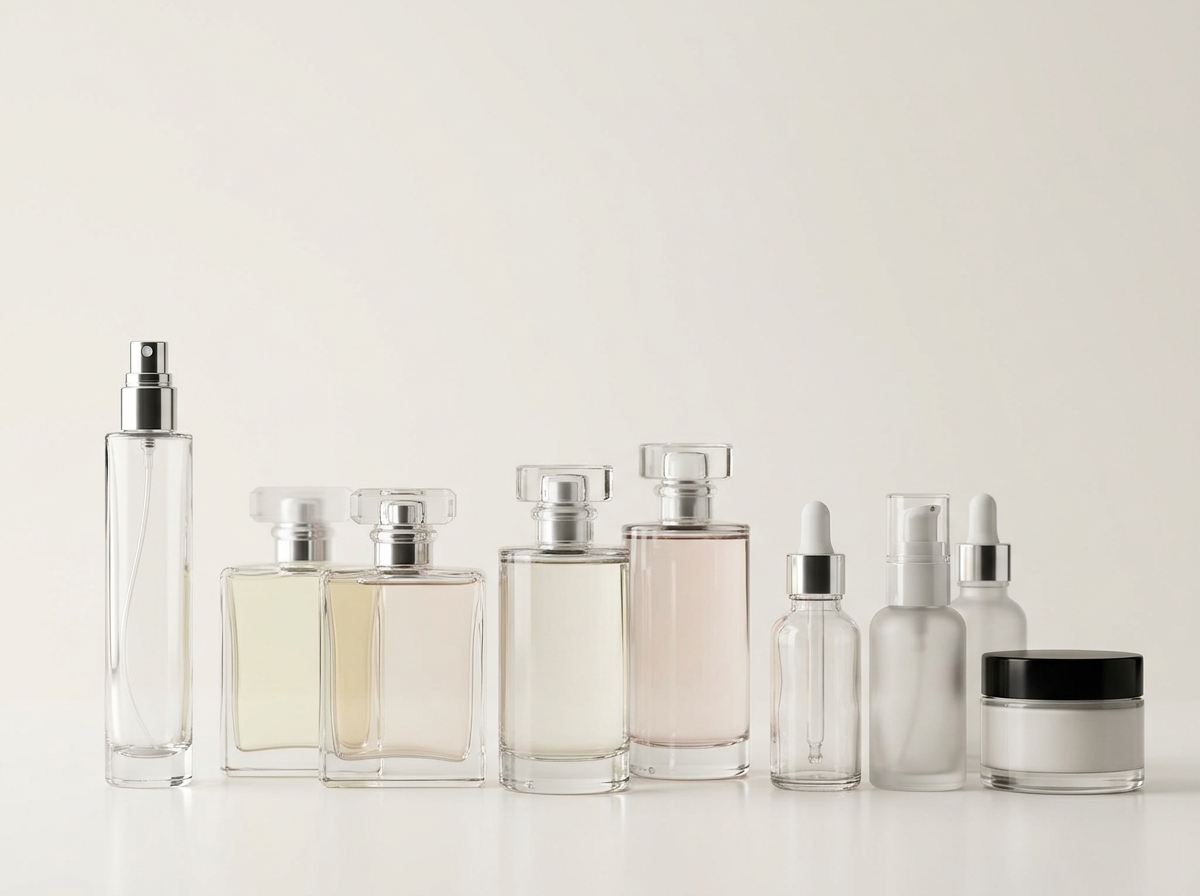
A second trend is the rise of coordinated multi-piece sets. On this skincare bottle set collection, the structure reflects a common sourcing need: one visual language across multiple items. That matters for brand families that launch cleanser, toner, serum, cream, and essence together.
A third trend is functional air management. Airless formats are increasingly used for oxygen-sensitive formulas because they help limit repeated air exposure during dispensing. For sensitive actives such as vitamin C derivatives or retinoid-based systems, packaging design can influence product stability more than many teams expect.
Another trend is the continued use of clear glass. Transparent packaging helps consumers see fill level, color, and texture, which is valuable in skincare where product appearance signals freshness. Clear glass is also easier to photograph for e-commerce and social commerce listings.
| 2026 trend | Typical execution | Brand benefit |
|---|---|---|
| Minimal premium design | Frosted glass, clean label panel, metal accent | Modern shelf presence |
| System packaging | Bottle plus pump plus cap set | Faster launch coordination |
| Airless protection | Airless bottle or pump system | Better formula protection |
| Transparent display | Clear glass with precise fill level | Stronger consumer trust |
How to choose the right glass skincare bottles for different formulas
The right glass skincare bottles depend on formula behavior, not just brand aesthetics.
Water-based essences, serums, lotions, oils, and creams all interact differently with packaging. A low-viscosity serum often needs controlled dispensing, while a thicker cream may work better in a jar or pump-compatible bottle. Oils and fragrance-infused treatments are especially sensitive to closure performance because leakage is more obvious and more expensive to manage.
For serum products, buyers often prioritize dropper precision, reduced headspace, and tight seal performance. For lotions, pump output consistency and bottle stability matter more. For emulsions with active ingredients, packaging should reduce oxygen exchange and enable repeated use without contamination.
In line with the general testing approach used in glass standards, dimensional and surface consistency are crucial. ASTM C1036 specifies requirements for flat glass quality, including dimensions and allowable imperfections for certain applications. While cosmetic bottles are a different product class, the principle is the same: consistency in glass manufacturing supports repeatable downstream performance.
For high-end skincare brands, it is worth comparing airless bottle options against standard pump bottles during the development stage. Airless systems are especially relevant when the formula includes oxidation-sensitive actives or when the brand wants a more technical premium feel.
| Formula type | Recommended package style | Key reason |
|---|---|---|
| Essence | 30-50 ml glass bottle | Controls dosage and premium feel |
| Serum | Dropper or airless bottle | Supports precision and stability |
| Lotion | Pump bottle | Improves repeat dispensing |
| Cream | Jar or wide-mouth set | Easy access for thicker texture |
 Material, performance, and standards that matter in beauty packaging
Material performance matters because packaging failure is usually more expensive than packaging upgrade.
Glass is valued in beauty packaging for its chemical resistance and premium appearance, but the surrounding components determine whether the set actually works. Pumps, gaskets, collars, and caps must be selected with the same rigor as the bottle itself. In practice, a weak closure can undo the benefits of a strong glass container.
For transport, suppliers often look to recognized testing logic such as ASTM D4169, which addresses distribution testing of shipping containers and systems. That matters because glass skincare bottles may look perfect in a warehouse and still fail after vibration, drop, or compression in transit.
Another useful reference is NIST guidance on SI volume units, which reinforces precision in quantity communication. For filling operations, clear volume definitions reduce labeling confusion and help QA teams align on net content. A 30 ml bottle must actually perform as a 30 ml bottle across the supply chain.
In cosmetic manufacturing, reproducibility is the real quality metric. A set that closes properly on sample day but leaks on production day is not a successful design. Buyers should ask for closure torque targets, seal testing, drop testing, and compatibility confirmation before approving a final SKU.
| Test area | What to verify | Why it matters |
|---|---|---|
| Closure fit | Torque, seal, thread alignment | Prevents leakage |
| Transit resistance | Drop, vibration, compression | Reduces breakage |
| Fill accuracy | Net content tolerance | Supports labeling compliance |
| Surface quality | Scratches, bubbles, clarity | Affects premium perception |
How set packaging supports brand identity and shelf performance
A skincare glass bottle set works best when it behaves like a visual system.
Consumers rarely evaluate a serum bottle in isolation. They scan the whole line: cleanser, toner, essence, cream, and sometimes fragrance or body care extensions. If the line shares the same neck finish, finish treatment, and cap family, the brand looks more organized and more trustworthy.
This is why many premium beauty packaging programs use one core geometry across multiple SKUs. The glass body changes by volume, but the visual grammar stays constant. That approach lowers design complexity and creates easier cross-sell opportunities later.
Packaging systems also support brand storytelling. Frosted glass can suggest softness and purity, while clear glass can emphasize transparency and freshness. Metallic components often communicate precision or luxury. The best choice depends on the positioning of the formula and the price tier.
For brands that want coordinated extension across skincare and fragrance, it can be useful to compare perfume bottle design cues with skincare packaging finishes. Many premium brands borrow the same material logic across categories to keep visual identity consistent.
Cost, MOQ, and sourcing strategy for beauty product brands
Smart sourcing decisions are based on total landed value, not unit glass cost alone.
When brands compare suppliers, they should account for decoration, assembly, breakage allowance, freight efficiency, and time to approval. A lower-priced bottle can become expensive if it requires extra manual labor or causes frequent damage during transport.
In 2026, many beauty brands are also factoring in launch speed. Fast-moving product calendars reward suppliers that can coordinate multiple components at once. A packaging partner that can manage bottle, pump, cap, and secondary box together reduces bottlenecks and shortens the path from sample approval to production.
For export-oriented brands, location and logistics also matter. Suppliers near major ports can improve shipment timing and reduce coordination friction, especially when product families are launched in waves. That operational advantage becomes important when a skincare line includes several bottle sizes and multiple finish options.
Brands with seasonal launches often benefit from working through a structured sample-to-production process. It helps catch fit problems early, especially in sets that use special neck finishes or custom decorative effects.
- Define formula type, fill volume, and closure method.
- Confirm bottle material, weight, and surface finish.
- Validate pump, cap, and neck compatibility.
- Request samples and test filling, sealing, and transport.
- Approve decoration and final packaging specifications.
Common mistakes in skincare glass bottle set development
The most common mistake is treating the bottle as the whole project.
Many beauty teams start with shape and color, then discover late that the pump is unavailable, the closure leaks, or the decoration does not survive shipping. That leads to redesigns, delays, and avoidable cost. A better process starts with formula behavior and ends with a fully integrated set.
A second mistake is ignoring secondary packaging. Even if the bottle itself is strong, poor outer packaging can cause visible damage, rattling, or breakage. In export markets, the shipping journey can be long enough that packaging engineering becomes as important as design.
A third mistake is over-specifying premium effects without checking manufacturability. Metallic coatings, complex frosting, and decorative collars can look excellent in renderings but fail to scale if the supplier has inconsistent process control. Beauty packaging teams should request production-representative samples, not only concept samples.
- Do not choose shape before compatibility.
- Do not approve decoration before transit testing.
- Do not assume all pumps fit all necks.
- Do not skip formula compatibility review.
- Do not ignore the outer carton and insert system.
How to evaluate a supplier for 2026 launches
A strong supplier should help you reduce launch risk, not just ship components.
When assessing a packaging partner, look for evidence of system thinking: can they coordinate bottle, pump, cap, and set packaging in one workflow, and can they explain the trade-offs clearly? That is especially important for beauty brands that plan multiple SKUs under one family design.
Review sample turnaround time, customization depth, decoration options, and quality communication. Ask how they handle fit issues, replacement parts, and approval documentation. If a supplier can support set consistency across several bottle types, that usually indicates stronger process maturity.
For premium skincare brands, the ideal partner is one that understands both branding and technical packaging constraints. That balance is what turns a bottle into a launch-ready product system rather than a standalone container.
If your line includes both skincare and fragrance extensions, cosmetic packaging solutions that integrate multiple components can simplify procurement and reduce design fragmentation across categories.
Conclusion: what winning skincare glass bottle sets will look like in 2026
Winning skincare glass bottle set programs in 2026 will combine visual consistency, functional reliability, and scalable sourcing.
Beauty packaging is moving toward complete systems because brands need fewer surprises during filling, shipping, and retail launch. Glass skincare bottles will remain a premium choice, but the real advantage will come from how the bottle interacts with pumps, caps, closures, and outer packaging.
Brands that focus on compatibility, testing, and cohesive design will create packaging that feels higher-end and performs more reliably. In a competitive market, that combination is often what separates an attractive concept from a successful retail product.
FAQ
What is the best skincare glass bottle set for 2026?
The best set is the one that matches your formula, dispensing method, and brand position while passing compatibility and transit testing.
Are glass skincare bottles better than plastic for premium brands?
Glass is often preferred for premium branding because it feels more substantial and is chemically stable, but the final choice depends on formula, weight, and shipping needs.
What should buyers test before approving a bottle set?
Buyers should test closure fit, leakage, pump output, transport resistance, and fill accuracy before production approval.
Why are airless bottles popular in beauty packaging?
Airless bottles help reduce repeated air exposure, which can benefit oxidation-sensitive formulas and improve dispensing control.
How do I choose the right bottle volume?
Choose volume based on product usage rate, price point, customer expectations, and whether the formula is daily use, travel size, or prestige treatment.
What makes a skincare packaging supplier reliable?
A reliable supplier can coordinate multiple components, explain technical trade-offs, provide production-representative samples, and support consistent quality control.
How can brands reduce breakage in glass packaging?
Use proper outer packaging, conduct distribution testing, validate closure fit, and avoid overloading the package with fragile decorative elements.
Post time: Aug-06-2026


