
- Assess the complete packaging system, including bottles, pumps, caps, decoration, and secondary packaging.
- Request traceable samples and compare production samples with approved references before placing a bulk order.
- Evaluate glass quality, closure compatibility, surface finishing, filling performance, and transit protection together.
- Use a written qualification scorecard to reduce quality, delivery, and communication risks.
- Choose a supplier that can support product launch execution rather than only selling individual containers.
Reliable glass bottle manufacturers in China can help beauty brands combine design, scale, and export capability, but supplier selection requires evidence. Regulation (EU) 2025/40, the European Union Packaging and Packaging Waste Regulation, was published in the Official Journal and creates current packaging compliance considerations for brands selling in Europe. This guide explains how to assess China glass packaging suppliers from concept development through shipment.
 Why supplier selection matters in China glass packaging
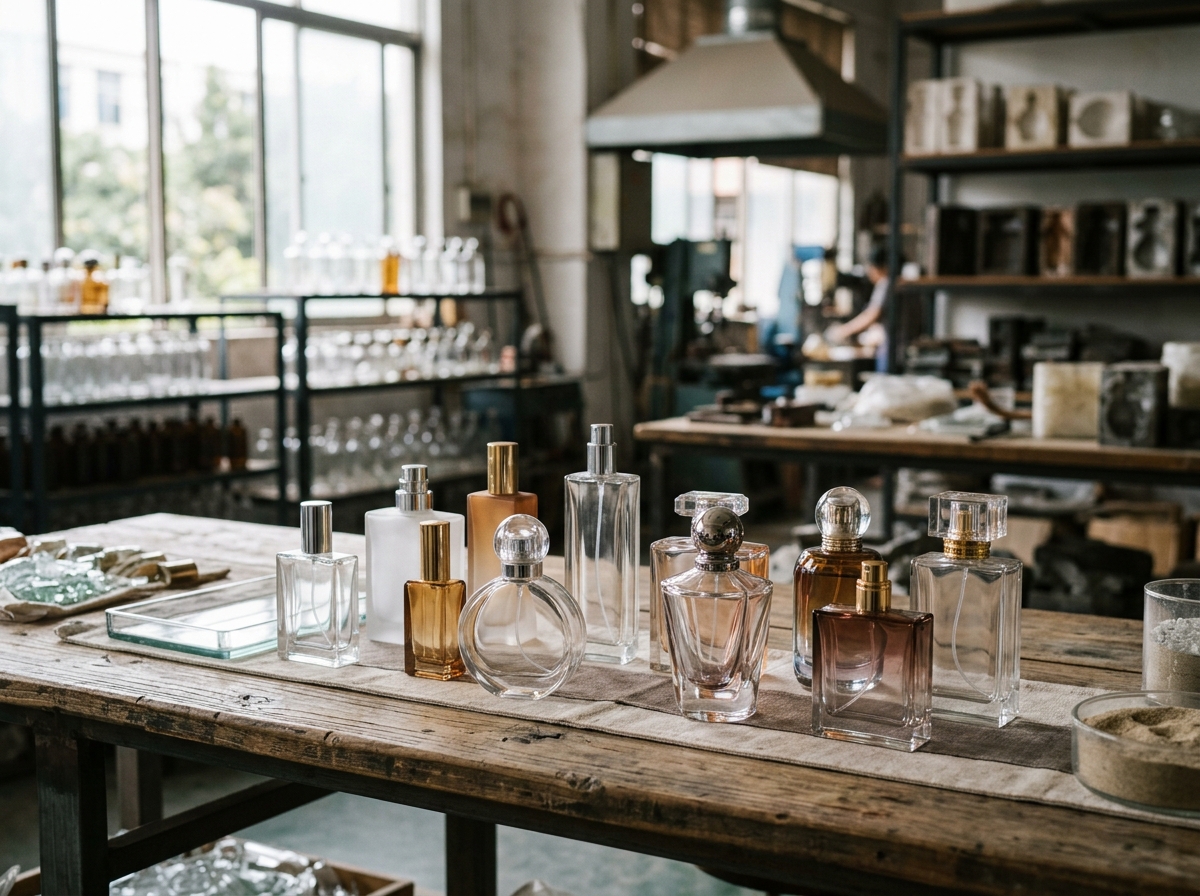
The best cosmetic bottle supplier is the one that can control the entire packaging system, not simply produce an attractive glass shape. A perfume bottle may require a matching atomizer, collar, cap, coating, flocking, label area, and protective carton. A skincare range may need several coordinated bottles and jars with consistent color, shoulder geometry, and shelf presentation.
Packaging failure usually occurs at the interfaces between components. A pump may fit the neck but deliver an unsuitable spray pattern. A cap may look correct but loosen during transportation. A coating may pass an initial visual check but show adhesion problems after contact with alcohol-based fragrance. A supplier qualification process must therefore examine the finished user experience and the manufacturing controls behind it.
Regulatory responsibility also remains with the brand owner and its designated partners. The U.S. Food and Drug Administration guidance on cosmetic packaging and labeling explains why packaging and labeling must not make a cosmetic product unsafe or misleading. For European sales, buyers should also review the official Regulation (EU) 2025/40 text on packaging and packaging waste with their compliance team.
What global beauty brands should verify first
Factory identity and manufacturing scope should be confirmed before discussing price. Ask whether the supplier is a manufacturer, an exporter, a trading company, or a coordinated packaging partner. Each model can be valid, but the buyer should understand who controls tooling, glass production, decoration, assembly, inspection, and shipment.
Product scope is a practical indicator of project fit. A supplier serving perfume, skincare, essential oil, airless, jar, and spray applications may be better positioned to coordinate a complete range, provided it can demonstrate control over each category. Product breadth alone is not proof of quality; buyers should request samples and production evidence for the exact package type under consideration.
Location and logistics capability should be evaluated as part of the commercial model. A Ningbo-based export partner may provide useful access to regional manufacturing networks and international freight routes, but the buyer still needs written lead times, carton dimensions, loading plans, shipping documentation, and a defined process for handling breakage or shortages.
Supplier qualification checklist
- Request the legal company name, factory or partner structure, production location, and export contact.
- Ask for technical drawings showing neck finish, dimensions, tolerance information, material, and decoration areas.
- Confirm which components are made in-house and which are sourced from approved partners.
- Request a sample approval procedure covering bottle, pump, cap, color, coating, and assembled pack.
- Review inspection records, packing specifications, carton markings, and claim-handling procedures.
How to compare glass bottle manufacturers
A structured scorecard makes supplier comparison more reliable than informal impressions. The following is a buyer-created evaluation framework, not an industry benchmark or market statistic. It uses a zero-to-five evidence score so that several suppliers can be compared against the same requirements.
| Evaluation area | Evidence to request | Buyer score | Risk if unclear |
|---|---|---|---|
| Glass forming capability | Relevant samples, drawings, inspection method, tooling ownership | 0-5 | Shape variation or unstable supply |
| Closure compatibility | Pump, cap, collar, neck, crimp, and fit test records | 0-5 | Leakage, loose caps, poor dispensing |
| Decoration control | Coating, frosting, printing, metallization, flocking, or color samples | 0-5 | Visual inconsistency or coating failure |
| Assembly capability | Finished-set samples and assembly work instructions | 0-5 | Component mismatch or manual errors |
| Export execution | Carton specification, loading photos, documents, and claims process | 0-5 | Transit damage or delivery disruption |
The score should be supported by evidence rather than promises. A supplier receiving a high score for product development should provide drawings, samples, revision control, and a clear method for recording changes. A supplier receiving a high logistics score should explain how fragile glass is separated, cushioned, labeled, palletized, and inspected before dispatch.
Technical questions for a cosmetic bottle supplier
Neck finish and closure compatibility should be treated as critical technical requirements. The neck must match the pump, sprayer, dropper, or cap in dimensions and function. Buyers should ask for the complete component drawing rather than relying on a product photograph or a general neck-size description.
Dispensing performance depends on more than the glass bottle. Formula viscosity, dip-tube length, actuator design, pump output, crimping or screw fit, and filling conditions can all affect the result. For a perfume project, request spray-pattern and leakage checks using a representative liquid. For an essential oil or serum project, check dropper control, seal integrity, and compatibility with the intended formula.
Surface decoration requires a defined approval standard. Terms such as luxury, high-end, velvet, metallic, or frosted describe an appearance but do not define acceptable variation. The buyer should specify color references, gloss or texture expectations, decoration position, logo dimensions, and the conditions used for adhesion or abrasion testing.
Material and formula compatibility should be assessed with the finished pack. Glass is often selected for its chemical resistance and premium appearance, but the pump, liner, adhesive, coating, ink, and elastomer may interact with the product. The brand should provide a representative formula or an agreed substitute for compatibility screening and retain approved reference samples.
| Package type | Primary buyer concern | Required evidence | Typical application |
|---|---|---|---|
| Perfume bottle | Spray performance and visual finish | Assembled spray sample, cap fit, decoration reference | Fine fragrance and body mist |
| Airless bottle | Formula protection and dispensing consistency | Actuator test, refill or pump behavior, compatibility review | Serum and premium skincare |
| Dropper bottle | Controlled dosing and seal integrity | Dropper fit, bulb performance, leakage check | Essential oil and facial oil |
| Skincare set | Range consistency and coordinated components | Complete set sample, color approval, carton layout | Cleanser, toner, cream, and serum ranges |
| Spray bottle | Actuation and formula delivery | Spray pattern, dip-tube fit, closure test | Haircare, cleansing, and setting products |
How to manage samples, tooling, and mass production
The approved sample should become the commercial reference for every later stage. Record the bottle drawing, component list, decoration file, color reference, packaging method, and approval date. If a supplier changes a component or process, the change should require written approval before mass production.
Tooling ownership and revision control should be clarified in the quotation stage. Ask who pays for the mold, where it is stored, how it is maintained, and what happens if the design is revised. A custom perfume bottle can involve substantial development coordination, so the commercial agreement should separate development, sampling, tooling, decoration, assembly, and shipping responsibilities.
Pre-production approval should include a complete assembled pack rather than a bottle alone. The buyer should inspect the bottle, pump, cap, collar, label area, outer box, inserts, and protective packaging together. This is especially important for premium sets where a small mismatch in color or height can be visible across the entire shelf display.
Inspection criteria should be written in measurable or clearly observable terms. Instead of saying “premium quality,” define acceptable conditions for bubbles, scratches, black points, mold marks, coating defects, logo position, component fit, carton damage, and quantity variance. If the buyer uses an external inspection company, the inspection scope should match the approved reference and purchase order.
How to reduce breakage and delivery risk
Transport protection is a design requirement, not an afterthought. Glass packaging should be tested as a packed system because the bottle, component, carton divider, inner box, master carton, pallet, and loading method work together.
Ask the supplier for packaging drawings and photographs of the actual packing method. Confirm whether bottles are individually separated, whether caps and pumps are protected from impact, and whether cartons are labeled for product identification and handling. Buyers should also agree on the evidence required for a damage claim, including photographs, carton counts, lot information, and notification timing.
International buyers should review freight and dangerous-goods responsibilities when the filled product contains alcohol, essential oils, aerosols, or other regulated contents. Empty glass packaging may have different transport considerations from filled cosmetics, so the brand should confirm the correct requirements with its forwarder and destination authorities. The International Safe Transit Association test procedure resources can help buyers understand why packaged products should be evaluated for distribution hazards rather than judged only by factory appearance.
Common mistakes when choosing a China packaging partner
The lowest quotation is rarely a complete comparison because suppliers may be quoting different glass weights, decoration processes, component grades, packing methods, or commercial terms.
- Choosing from photos only: Request physical samples and an assembled reference pack.
- Approving the bottle before the pump: Test the complete dispensing system with a representative formula.
- Ignoring decoration variation: Define color, texture, position, and visual acceptance criteria.
- Leaving packaging protection vague: Approve the inner and master-carton configuration before production.
- Using one supplier for every formula without validation: Confirm compatibility for each product and component combination.
- Failing to document changes: Require written approval for revised tooling, materials, suppliers, or decoration.
A practical sourcing sequence for global beauty brands
The most efficient sourcing process moves from commercial fit to technical validation and then to controlled production.
- Define the product format, target market, formula behavior, desired visual language, and launch schedule.
- Create a technical brief covering dimensions, closure, decoration, materials, accessories, quantity, and packing.
- Shortlist suppliers with relevant perfume, skincare, oil, airless, jar, or spray experience.
- Compare samples using the same checklist and test the complete assembled package.
- Approve drawings, decoration references, tooling terms, inspection criteria, and packaging specifications.
- Run a pre-production review before mass manufacturing and retain signed reference samples.
- Confirm shipment documents, loading evidence, inspection results, and post-delivery claim procedures.
FAQ
How do I verify whether a Chinese glass bottle supplier is a factory?
Ask for the legal company details, production location, manufacturing scope, tooling process, and evidence of relevant production. A video audit, third-party factory inspection, and comparison of sample markings with commercial documents can provide additional confidence.
What should I request before ordering custom perfume bottles?
Request drawings, physical samples, closure specifications, decoration references, tooling terms, minimum order information, lead-time assumptions, inspection criteria, and protective-packaging details. Approve the complete bottle, sprayer, collar, and cap together.
Are glass bottles suitable for every cosmetic formula?
Glass is widely used for fragrance, skincare, oils, and other beauty products, but suitability depends on the formula and all components that contact it. Validate the glass, pump, liner, adhesive, coating, and closure with a representative formula.
How can I reduce cosmetic packaging breakage during shipping?
Use a tested packed system with appropriate separation, cushioning, carton strength, palletization, and loading controls. Request actual packing photographs and define the evidence and timing required for damage claims.
Should I buy bottles and pumps from the same supplier?
One coordinated supplier can simplify compatibility, assembly, and accountability, but it does not remove the need for testing. Confirm the source and specification of every component and approve the assembled package before production.
What is more important: price or minimum order quantity?
Neither should be evaluated alone. Compare total delivered cost, tooling, decoration, component quality, inspection, packaging, freight risk, lead time, and the cost of correcting a failed batch or delayed launch.
How early should a beauty brand contact a packaging supplier?
Contact suppliers as soon as the formula direction, product format, and visual concept are sufficiently defined. Early coordination helps identify closure constraints, decoration limitations, tooling decisions, sample revisions, and shipping requirements before the launch schedule becomes inflexible.
About Lemuel Packaging
Lemuel Packaging supports cosmetic and fragrance brands with coordinated packaging solutions rather than isolated containers. Its range includes perfume bottles, skincare sets, essential oil bottles, airless packaging, jars, spray components, caps, and decorative accessories. The Ningbo-based team focuses on design coordination, component matching, customization, sampling, and export-oriented execution for brands developing premium product lines. Explore the packaging portfolio or contact the team to discuss a complete project brief.
Post time: Aug-28-2026


