
- Luxury beauty packaging should be developed as a system, not as a single bottle.
- Design decisions must account for formula stability, closure compatibility, and production yield.
- Decoration, materials, and logistics can change both brand perception and unit economics.
- Qualified suppliers should support sampling, tooling, decoration, and export-ready packing.
Custom glass packaging for luxury beauty brands succeeds when creativity is backed by measurable engineering discipline: for example, glass container dimensions, finish geometry, and process control must align with packaging standards such as ISO 15378:2017 for primary packaging quality systems, while dimensional and aesthetic decisions should support consistent filling and retail presentation. This is especially important for premium fragrance and skincare programs that depend on repeatable bottle production, elegant surface effects, and reliable compatibility with pumps, caps, and droppers. For many teams, the real challenge is not designing a beautiful bottle, but building a packaging line that can be sampled, approved, and scaled without losing quality.
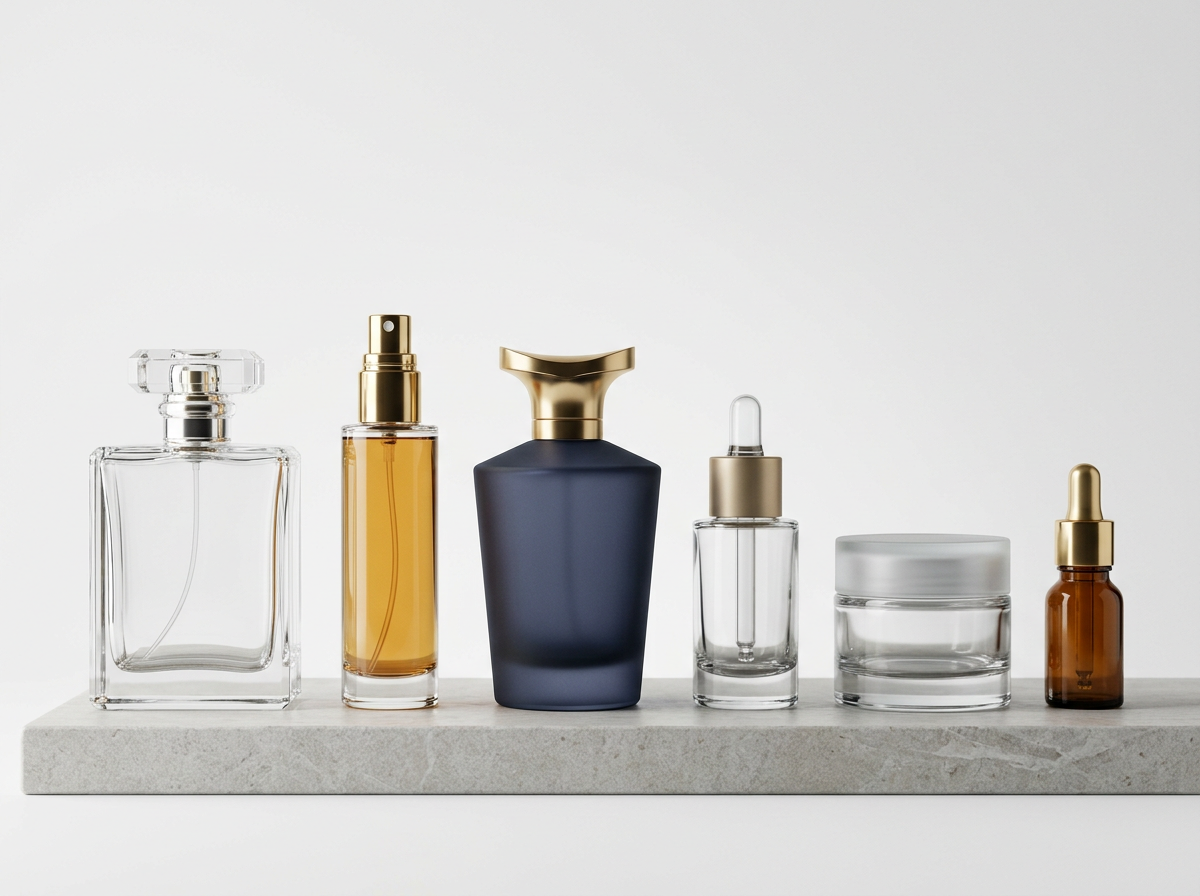 Why Custom Glass Packaging Matters in Luxury Beauty Packaging
Luxury beauty packaging is a brand signal, a functional barrier, and a manufacturing process all at once.
High-end skincare and fragrance customers judge packaging in seconds, but procurement teams judge it across dozens of variables. The bottle must look premium on shelf, protect the formula, fit filling equipment, and survive global transit. If one of those factors fails, the packaging concept is no longer viable.
Glass remains central because it supports clarity, weight, chemical resistance, and a premium tactile impression. In fragrance, glass also helps preserve scent integrity by reducing permeability compared with many plastics. In skincare, glass is often selected for perception value and compatibility with higher-end formulations.
From a commercial perspective, custom glass packaging also creates differentiation that off-the-shelf stock bottles cannot match. That differentiation can come from a silhouette, a heavy base, frosting, spraying, flocking, metallized accents, or a bespoke closure system. For brands competing in crowded beauty categories, visual distinction is often the first step toward conversion.
For buyers sourcing from perfume bottles, airless bottles, or essential oil bottles, the best packaging decisions usually happen before decoration is added. The base bottle, neck finish, and functional accessory compatibility determine whether the final package can be scaled efficiently.
From Design Brief to Glass Bottle Production
The shortest path to a successful project is a structured brief that connects brand goals to manufacturing limits.
A strong custom glass packaging brief should include target capacity, fill product, closure type, decoration direction, target markets, freight constraints, and expected annual volume. Without these inputs, a supplier may create a beautiful prototype that is costly or unstable in production.
Most fragrance and skincare packaging projects move through five practical stages: concept, structural design, sampling, validation, and mass production. Each stage reduces uncertainty. Concept defines the brand language. Structural design confirms whether the shape can be made. Sampling tests fit and finish. Validation checks decoration, leakage, and transport risk. Mass production locks in repeatability.
At the design stage, teams should define more than appearance. They should specify neck finish standards, closure torque targets, label area, secondary packaging needs, and whether the bottle must fit an existing filling line. These are the details that determine whether a premium package is launch-ready.
| Development Stage | Main Output | Typical Risk Controlled | Decision Gate |
|---|---|---|---|
| Concept | Sketch, mood board, target capacity | Brand mismatch | Visual direction approved |
| Structural design | CAD, mold feasibility review | Unmoldable geometry | Tooling ready |
| Sampling | Prototype bottle and closure fit | Leakage, mismatch | Sample approval |
| Validation | Decoration and transport tests | Scratches, breakage | Pre-production signoff |
| Mass production | Stable batch output | Yield loss | Shipment release |
Technical Factors That Decide Luxury Glass Bottle Quality
Glass bottle quality is determined by measurable manufacturing characteristics, not by appearance alone.
Wall thickness consistency affects strength, weight balance, and filling stability. Neck finish precision affects closure fit and leak risk. Surface uniformity affects how well spray coating, frosting, or metallization appears under retail lighting. A luxury bottle can look perfect in a photo and still fail in production if one of these variables drifts.
For high-end packaging, buyers should also ask how the bottle will behave under real logistics. International beauty shipments can face vibration, drop impact, temperature change, and pallet compression. A glass bottle that survives shelf display but fails in export transit is a cost liability, not a premium asset.
Functional compatibility is equally important. A bottle intended for fragrance should work with atomizers and crimp or screw systems depending on the closure design. A skincare bottle should coordinate with pumps or droppers, while an airless system should maintain formula isolation and dispensing consistency. That is why spray pumps, caps, and cosmetic jars should be specified together, not selected separately.
| Specification | Why It Matters | Typical Buyer Check | Production Impact |
|---|---|---|---|
| Neck finish | Closure compatibility | Fit and torque test | Leak prevention |
| Wall thickness | Strength and feel | Cross-section measurement | Breakage reduction |
| Surface finish | Decoration quality | Visual inspection under light | Luxury perception |
| Mass consistency | Handling and packing | Weight sampling | Shipping stability |
Standards, Tolerances, and Testing in Glass Packaging
Packaging approval becomes easier when the supplier can speak in standards, not just samples.
For dimensional measurement and repeatability, many teams use test methods aligned with metrology practice so that sample-to-production comparisons remain valid. In manufacturing, tolerance control is especially important because even small deviations can affect cap fit, pump alignment, and label positioning. For contract packers, the goal is not absolute perfection in every dimension; it is process capability within a defined operating window.
Quality systems also matter. ISO 15378:2017 addresses primary packaging materials for medicinal products, and while cosmetic packaging is a different sector, the standard is widely referenced for disciplined supplier quality systems and contamination control logic. For brands that sell into premium retail channels, that kind of process discipline often translates into fewer packaging defects and smoother audits.
Material and safety verification can also draw on public testing references. For example, the U.S. National Institute of Standards and Technology documents metrology resources that help manufacturers think about measurement accuracy and calibration discipline; see NIST Physical Measurement Laboratory. For transport risk, ASTM impact and packaging test frameworks are commonly used to simulate real-world handling. The important point is that luxury packaging should be validated with repeatable methods, not visual opinion alone.
| Test Area | What It Checks | Common Method | Decision Rule |
|---|---|---|---|
| Leak test | Seal integrity | Pressure or inversion test | No visible leakage |
| Drop test | Transit resistance | Controlled impact | No bottle fracture |
| Torque test | Cap retention | Rotational measurement | Stable closure fit |
| Decoration check | Surface consistency | Lightbox inspection | No scratches or misprint |
Choosing Materials and Decoration for Premium Perception
Decoration often creates the first premium impression, but it must be matched to the product story.
Frosted glass communicates softness and restraint. Clear glass communicates purity and formula visibility. Heavy-base glass communicates luxury weight and shelf presence. Soft-touch coatings, flocking, metallic collars, and zinc alloy accents can all elevate a package, but each one adds process complexity and cost.
Material selection should start with the formula and end with the shelf. For fragrance, bottle clarity and atomization compatibility matter. For skincare, airless systems and jar options may better suit oxygen-sensitive or high-viscosity products. For facial oils, droppers and small-volume bottles support controlled dispensing and a more artisanal image.
Environmental positioning is also changing buyer preferences. Glass is recyclable, and many premium brands now want packaging that looks luxurious while supporting sustainability claims. In that context, a package using recyclable glass with carefully chosen secondary materials can be more persuasive than a heavily overdecorated design that is difficult to recycle.
When evaluating airless bottles or skincare packaging sets, brands should consider whether the decoration strategy is durable enough to survive filling, shipping, and retail handling. A beautiful finish that scratches in transit damages both the product and the brand story.
How Luxury Brands Should Compare Packaging Options
The best packaging choice is the one that balances brand value and operational risk.
Many beauty teams compare stock bottles, semi-custom formats, and fully custom glass packaging. Stock bottles are fastest and cheapest, but they offer limited differentiation. Semi-custom formats reduce tooling burden while allowing some branding flexibility. Fully custom bottles provide the highest identity value, but they require more time, more capital, and stronger production discipline.
For launch planning, the right choice depends on the category. A prestige fragrance line often benefits from a fully custom silhouette because the bottle is part of the brand signature. A skincare line launching in multiple SKU sizes may prefer a modular system with shared neck finishes and coordinated closures. That approach simplifies procurement and reduces complexity across variants.
There is also a timing question. If a brand needs rapid market entry, a semi-custom route may make sense for the first batch while tooling for a proprietary bottle is developed in parallel. That is often a smarter commercial path than waiting for a perfect bottle that misses the launch window.
| Option | Lead Time | Tooling Investment | Differentiation | Best Use Case |
|---|---|---|---|---|
| Stock bottle | Shortest | Low | Low | Fast test market |
| Semi-custom | Medium | Moderate | Medium | Regional launch |
| Fully custom | Longest | High | High | Hero fragrance or flagship skincare |
Mass Production: What Actually Breaks at Scale
Mass production exposes weaknesses that prototypes often hide.
At scale, small defects become expensive. A bottle that looks consistent in a 50-piece sample may reveal variation in weight, finish, or decoration when produced in thousands. This is why production readiness must include clear incoming material checks, in-process inspection, and final packaging audits.
Common failure points include misaligned pumps, chipped necks, label shift, coating inconsistency, and carton damage during shipment. For export-heavy beauty programs, the packaging supplier should understand how master cartons, dividers, pallet configuration, and moisture protection affect breakage rates. Good design is not only about the bottle; it is also about the route to market.
In practical sourcing, suppliers near major ports can reduce transit friction. A Ningbo-based packaging partner can be strategically helpful for brands shipping through East Asia, Europe, or North America because ocean freight coordination and container planning are easier when export logistics are part of the operating model. That does not replace quality, but it can shorten the path from approved sample to delivered order.
For brands building broader assortments, sourcing integrated components from perfume bottles, glass jars, and packaging accessories can reduce interface problems between the bottle, the closure, and the secondary pack.
Typical Questions Luxury Beauty Teams Should Ask Suppliers
The right supplier questions expose whether a packaging partner can truly support launch success.
- Can the supplier show the neck finish, closure compatibility, and sample approval workflow?
- Which decoration methods are available, and how do they affect lead time and defect risk?
- What are the accepted tolerances for weight, finish, and surface appearance?
- How are breakage, leakage, and transit damage tested before shipment?
- Can the supplier integrate bottle, pump, cap, and set packaging into one coordinated project?
These questions matter because luxury beauty packaging is a systems business. A bottle that cannot be filled smoothly or shipped safely is not premium, regardless of how elegant it looks online.
For buyers looking at custom perfume bottles or skincare packaging sets, the supplier’s ability to coordinate sampling and production often determines whether the project finishes on time.
How to Build a More Reliable Custom Glass Packaging Program
A reliable packaging program is built on specification discipline, not last-minute corrections.
Start with the formula and the market, then define the bottle family, the closure family, and the decorative system. Keep one or two neck finishes across an assortment whenever possible so pumps and caps can be shared. That reduces procurement complexity and simplifies forecasting.
Next, insist on measurable sample acceptance criteria. Visual approval matters, but it should sit alongside dimensional checks, fit testing, and transit validation. The goal is to avoid subjective approvals that later fail in filling or export.
Finally, think in collections. Luxury beauty buyers often respond more strongly to a coherent packaging system than to isolated hero products. A coordinated bottle, jar, and accessory language reinforces brand recognition and supports upselling across categories.
This is where integrated categories such as essential oil bottles, spray pumps, and caps become strategically useful. They allow the brand to move from one-off packaging decisions to a repeatable launch architecture.
FAQ
What is the difference between custom glass packaging and stock packaging?
Custom glass packaging is designed around a specific brand identity, product format, and production workflow, while stock packaging is pre-made and limited in shape and differentiation. Custom packaging usually offers stronger shelf impact and better system fit.
How do I choose the right bottle for luxury beauty packaging?
Choose based on formula compatibility, target price point, closure type, fill volume, and logistics risk. A visually strong bottle still needs to work with pumps, caps, and shipping conditions.
What should I check before approving a glass bottle sample?
Check finish quality, neck compatibility, weight consistency, decoration durability, and whether the sample can survive basic drop and leakage testing. Sample approval should always include functional checks, not just visual review.
Are airless bottles better for skincare?
Airless bottles are often a strong choice for oxygen-sensitive formulas, premium serums, and controlled dispensing. They are not the only option, but they can improve product protection and user experience.
Which decoration methods are most common for luxury glass packaging?
Common methods include frosting, spraying, silk screening, hot stamping, metallization, flocking, and metallic accessories. The best method depends on the desired brand image, budget, and production durability.
How long does custom glass bottle production usually take?
Lead time depends on mold complexity, sampling cycles, decoration, and order size. Fully custom programs take longer than stock or semi-custom options because they require structural development and production validation.
Why is integrated packaging sourcing better than buying components separately?
Integrated sourcing reduces compatibility risk between bottle, pump, cap, and secondary packaging. It also simplifies communication, sampling, and mass-production coordination for beauty launches.
Post time: Aug-18-2026


