
- Premium glass packaging should be selected as a complete system rather than as an isolated bottle.
- Airless bottles, droppers, pumps, and jars serve different formula, dosing, and protection requirements.
- A unified skincare set improves shelf recognition and makes product-line expansion easier.
- Decoration, closure materials, transport protection, and sample approval should be planned together.
Custom glass packaging gives skincare brands a way to combine product protection, tactile quality, and visual consistency before launch. The U.S. Environmental Protection Agency reports that 12.3 million tons of glass containers were generated in 2018, while 3.1 million tons were recycled, representing a 31.3% recycling rate; the figures show why material selection and end-of-life communication deserve a place in packaging decisions. This guide explains how to build practical skincare packaging solutions around premium glass bottles without overlooking compatibility, dispensing, logistics, or compliance.
Why custom glass packaging matters for premium skincare launches
Premium skincare packaging is a brand experience as well as a protective container. When a customer picks up a serum bottle, the perceived value comes from several connected details: glass weight, transparency, shoulder shape, closure fit, actuator feel, decoration quality, and the way the item sits inside its carton.
Custom development is most valuable when the brand has a clear reason to differ from standard stock packaging. That reason may be a distinctive silhouette, a coordinated product family, a specific dispensing experience, or a packaging format that supports a concentrated formula. A custom bottle can also help a new product appear intentional when it is displayed beside established competitors.
Packaging claims must remain separate from aesthetic promises. The U.S. Food and Drug Administration explains that cosmetic packaging and labeling must follow applicable requirements for information presented to consumers; brands should review the official FDA packaging and labeling guidance before final artwork approval.
Build skincare packaging solutions around the formula
The formula and dispensing method should determine the primary package before visual customization begins. A beautiful bottle is not a successful solution if the pump cannot deliver the viscosity, the dropper produces inconsistent doses, or the closure allows leakage during transport.
Airless bottles for sensitive or oxidation-prone formulas
Airless packaging is useful when a brand wants to reduce repeated exposure of the formula to air during dispensing. It is commonly considered for serums, creams, lotions, and other products where controlled delivery and a clean user experience matter. The final choice still requires compatibility testing because the formula, piston, dip tube configuration, gasket, and actuator all influence performance.
Dropper bottles for concentrated liquids
Dropper packaging suits low-viscosity products such as facial oils, treatment serums, and essential oil blends that are marketed around measured application. The dropper should be evaluated for bulb recovery, pipette fit, leakage resistance, and the amount dispensed per use. A premium appearance does not replace the need to test the actual formula under expected storage and handling conditions.
Pumps, sprays, and cream jars
Pumps support convenient dosing for lotions and fluid treatments, while fine-mist sprayers are better suited to products designed for even surface application. Cream jars offer broad access for thicker formulas but create a different hygiene and usage experience from a pump or airless system. The package should match the way the customer is expected to apply the product, not merely the appearance shown in a reference image.
| Format | Typical product direction | Primary evaluation point | Numerical design input |
|---|---|---|---|
| Airless bottle | Serum, lotion, cream | Formula compatibility and dispensing consistency | 1 complete system test |
| Dropper bottle | Facial oil, active serum | Dose control and closure sealing | 1 dropper and bottle pairing |
| Pump bottle | Emulsion, cleanser, body care | Actuator response and output repeatability | 1 pump and bottle pairing |
| Glass jar | Rich cream, balm, mask | Opening experience and product access | 1 jar and closure pairing |
The numerical design inputs in this table are minimum package-pairing recommendations for early evaluation, not performance guarantees. Production approval should be based on testing with the final formula, closure, decoration, and shipping configuration.
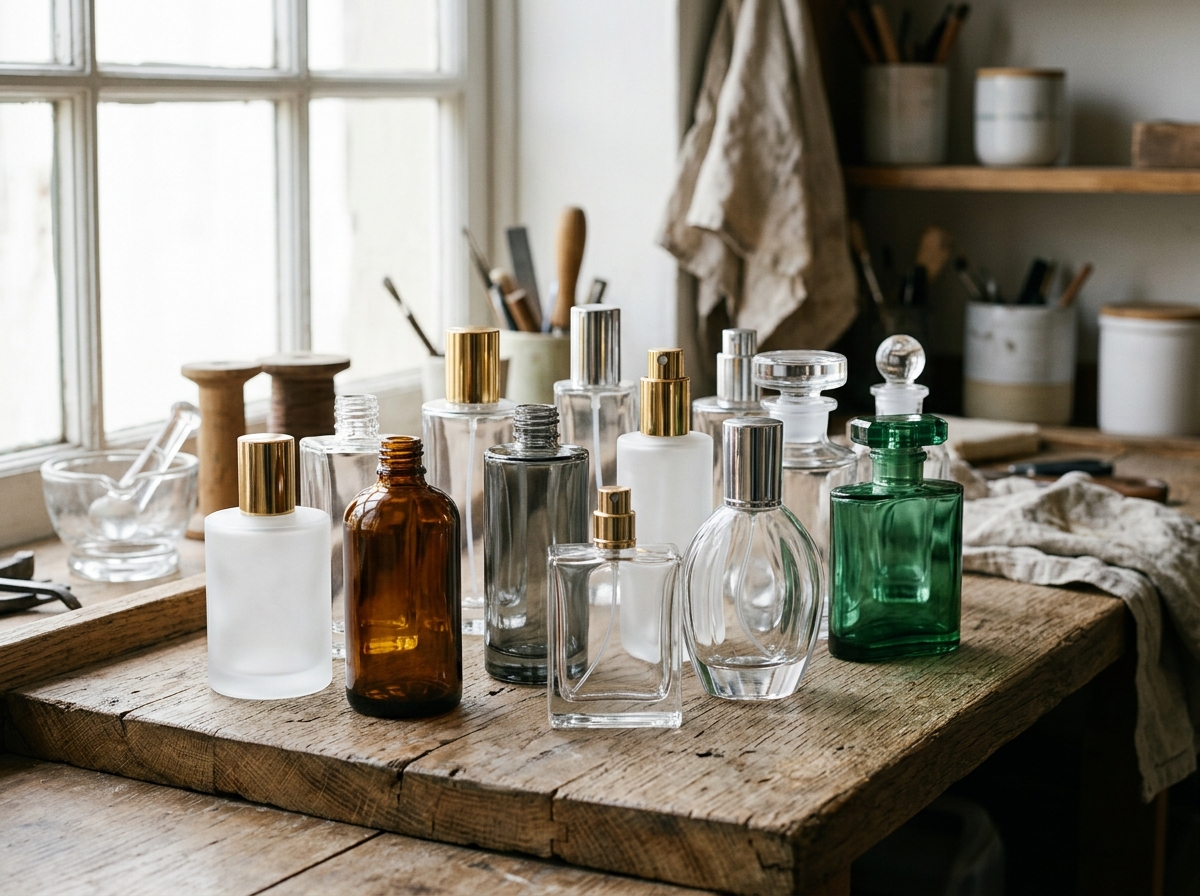 Design a premium glass bottle collection, not a single SKU
A coordinated collection is usually more valuable than a one-off custom bottle because it creates a recognizable visual language across cleansers, toners, serums, creams, and oils. The family may share a shoulder profile, glass color, closure finish, label position, or carton architecture while using different capacities and dispensing systems.
Transparent glass is effective when the formula color and fill level are part of the brand story. Frosted or coated surfaces create a softer tactile impression and can help differentiate a treatment line from a mass-market product. Metallic closures, zinc-alloy details, flocking, and velvet finishes can add contrast, but they should be selected with a clear relationship to the brand positioning and target price.
For a launch collection, define the visual rules before approving individual components:
- Set a common silhouette or proportion so the range reads as one family.
- Choose a limited finish hierarchy for bottle, closure, label, and carton.
- Reserve distinctive decoration for the products that need the strongest shelf or e-commerce impact.
- Confirm that the same visual system works across transparent, tinted, and opaque formulas.
- Document color, finish, artwork, and assembly references for future replenishment.
Material, decoration, and sustainability decisions
Glass offers a rigid, high-quality surface and allows customers to see many formulas directly, but it also requires careful planning for weight, breakage protection, and transport cost. A sustainability statement should describe the actual material and recovery context rather than imply that any glass package is automatically low impact.
The EPA glass material data page reports 2018 U.S. figures of 12.3 million tons generated, 3.1 million tons recycled, and a 31.3% recycling rate. These figures are national material-flow data, not a claim about the recycling outcome of a specific bottle or market. Brands should therefore use precise language about glass content, recyclability, coatings, mixed materials, and local collection systems. See the EPA glass material-specific data for the source context.
| EPA glass-container measure | 2018 value | Unit | How a brand should use it |
|---|---|---|---|
| Glass containers generated | 12.3 | Million tons | Use as national context, not a package-level forecast |
| Glass containers recycled | 3.1 | Million tons | Discuss recovery as a system outcome |
| Recycling rate | 31.3 | Percent | Avoid presenting it as a universal global rate |
Decoration can also affect recovery and processing. Coatings, metallic elements, labels, adhesives, pumps, and mixed-material closures may require separate consideration. A responsible packaging brief should identify which parts are glass, plastic, metal, elastomer, coating, or paper so the brand can communicate accurately and make informed trade-offs.
How to manage the custom packaging development process
A controlled approval process reduces late-stage changes because every component is reviewed against the same commercial and technical brief.
- Define the launch brief. Record product type, viscosity, fill requirement, dispensing method, target positioning, sales channel, decoration concept, and expected order quantity.
- Select the package architecture. Compare stock components and custom forms, then decide whether the project needs a bottle, jar, airless system, dropper, pump, or spray.
- Review compatibility and usability. Test the formula with the bottle, closure, gasket, pump, dip tube, and decoration. Evaluate leakage, dispensing, appearance, and user handling.
- Approve the visual sample. Check color, transparency, coating, print registration, closure finish, assembly, and carton fit using production-relevant references.
- Confirm the supply plan. Align tooling, component sourcing, quality checkpoints, packaging protection, shipping documentation, and reorder expectations before production.
The best supplier conversation is specific. Instead of asking only for a premium bottle, provide the formula type, desired dispensing behavior, product family references, target market, decoration preferences, and packaging quantity. This allows the supplier to recommend a complete solution rather than return a list of disconnected containers.
What international skincare buyers should verify
International procurement depends on more than appearance because a successful launch requires repeatable communication and predictable delivery. Ask for drawings or technical references where available, component compatibility information, sample conditions, decoration options, carton configuration, and the process for resolving defects.
Transport planning deserves early attention for glass. Inner separation, cushioning, carton strength, pallet configuration, moisture exposure, and handling marks can influence whether products arrive ready for filling or retail presentation. The correct packaging protection depends on the selected bottle, closure, decoration, order configuration, and shipping route, so generic claims about breakage reduction should be avoided unless supported by test results.
A Ningbo-based packaging partner may be relevant to overseas buyers because the region supports export-oriented manufacturing and access to major logistics channels. However, buyers should evaluate actual lead times, sample responsiveness, quality records, production capacity, and documentation rather than relying on location alone.
When to choose stock components or a fully custom bottle
Stock packaging is usually the faster route when a brand needs a proven format, limited decoration, or a short development window. Fully custom packaging is more appropriate when the bottle silhouette is central to brand recognition, when the product line needs a unique family system, or when the package must support a distinctive closure and secondary pack.
| Decision factor | Stock component approach | Custom development approach | Recommended review stage |
|---|---|---|---|
| Launch speed | Usually simpler to sample | Requires design and tooling coordination | 1 |
| Brand differentiation | Depends mainly on decoration | Can include shape, closure, and proportion | 2 |
| Investment exposure | Generally lower tooling commitment | May require tooling and development approval | 3 |
| Product-family consistency | Depends on available matching components | Can be planned as a coordinated range | 4 |
| Future scalability | Depends on continued component availability | Requires a documented replenishment plan | 5 |
The review-stage numbers are a practical decision sequence created for project planning, not supplier performance data. A brand should choose the route that best balances differentiation, timing, technical risk, and expected repeat orders.
Common mistakes in premium skincare packaging
The most common packaging failures happen when visual design is approved before the formula, dispensing system, and logistics are understood.
- Choosing a closure for appearance without testing its seal and fit.
- Approving a coating or print color from a screen image rather than a physical reference.
- Using different bottle proportions across a product line without a clear design reason.
- Assuming a premium glass bottle automatically communicates sustainability.
- Leaving carton fit, breakage protection, and export handling until after the primary package is finalized.
- Requesting a sample without specifying the formula, fill level, dispensing expectation, or decoration.
These mistakes are avoidable when the project is managed as an integrated packaging system. The supplier should understand the intended customer experience, while the brand remains responsible for formula validation, market requirements, artwork approval, and final claims.
FAQ
What makes glass packaging look premium?
Premium perception usually comes from the combination of proportion, glass clarity or color, surface treatment, closure quality, decoration precision, and coordinated secondary packaging. Weight alone is not a reliable measure of quality.
Which glass format is best for a facial serum?
Dropper bottles and pump or airless bottles are common starting points. The best option depends on viscosity, sensitivity to air, desired dose, application behavior, and compatibility with the formula.
Is an airless bottle always better than a standard pump?
No. Airless construction may suit formulas that benefit from controlled dispensing and reduced air exposure, but it can add system complexity. The final package should be selected after formula and component testing.
Can one design be used for a complete skincare collection?
Often, yes. Brands can use a shared visual language across different formats, but the pump, dropper, jar, or airless mechanism may need to change according to each formula and use case.
What should be included in a custom packaging brief?
Include the product type, formula characteristics, target market, preferred capacity, dispensing method, decoration concept, product-line references, order expectations, shipping destination, and required sample criteria.
How should brands discuss glass recyclability?
Use market-specific and material-specific language. Identify the glass component and any mixed materials, then verify local collection conditions. Do not convert national recycling data into a guaranteed outcome for an individual package.
How can an overseas buyer reduce packaging development risk?
Use a written technical brief, request representative samples, test the final formula, approve physical decoration references, clarify quality checkpoints, and confirm shipping protection and reorder procedures before production.
Lemuel Packaging develops cosmetic and fragrance packaging as integrated brand systems rather than isolated containers. Its product scope includes premium glass bottles, skincare sets, airless bottles, essential oil packaging, pumps, sprays, jars, and coordinated closures. For brands preparing a new line, the practical next step is to compare suitable formats, define the product brief, and request a packaging discussion through the company website.
Post time: Sep-24-2026


