
- Custom serum bottle projects should be designed around formula compatibility, dispensing performance, and brand presentation.
- Premium skincare packaging usually requires coordinated parts: bottle, closure, pump, cap, and sometimes a full set system.
- Material choice matters: glass supports luxury positioning, while PET and airless formats can improve practicality and product protection.
- Specification clarity reduces sourcing risk: capacity, neck finish, tolerance, decoration method, and MOQ should be confirmed before sampling.
- A strong skincare packaging set strategy can improve launch consistency across multiple products.
Custom serum bottle development is now a core part of premium skincare packaging, especially for brands launching actives, essence serums, and treatment oils that need both visual differentiation and reliable dispensing; for example, ISO 22716:2007 sets out Good Manufacturing Practices for cosmetics, and that quality discipline matters as much for packaging consistency as it does for the formula itself. A well-specified serum bottle manufacturer should help you align capacity, closure fit, decoration, and shipping durability with your launch goals, rather than treating the bottle as a standalone item.
Why custom serum bottle packaging matters for skincare brands
The bottle is often the first physical proof of your brand promise.
In skincare, consumers infer product quality from packaging cues before they ever test texture or scent. A frosted glass bottle, a precision dropper, or a clean airless pump can signal different value levels, usage occasions, and ingredient sensitivity. That is why custom serum bottle decisions affect not only aesthetics but also conversion, repeat purchase, and retail credibility.
For brands building a premium line, packaging also has to work at scale. Serum bottles are commonly used for vitamin C, peptides, retinoids, niacinamide blends, and botanical concentrates. Some of those formulas oxidize quickly, while others need controlled dispensing to reduce contamination. An airless bottle collection can be a better fit when minimizing air exposure and dose waste is part of the product story.
There is also a supply chain angle. Cross-border skincare launches often fail because bottle, pump, insert, and outer carton are developed separately. That creates neck-finish mismatch, leakage risk, and expensive delay. A manufacturer that offers coordinated packaging is more valuable than a seller that ships a single component in isolation.
Custom serum bottle options: materials, closures, and formats
The best serum bottle specification starts with the formula, not the decoration.
Below is a practical comparison of common packaging routes for skincare brands:
| Packaging format | Typical capacity | Main advantage | Common use case | Packaging risk |
|---|---|---|---|---|
| Glass serum bottle | 15 mL to 50 mL | Premium look, strong shelf presence | Luxury serums, prestige skincare | Higher breakage if shipping is not tested |
| Airless bottle | 15 mL to 50 mL | Reduced air exposure and cleaner dosing | Actives, sensitive emulsions, high-value formulas | Pump compatibility and fill accuracy must be validated |
| Dropper bottle | 20 mL to 60 mL | Controlled application and clear ritual cue | Facial oils, ampoules, concentrated serums | Dropper viscosity match is critical |
| PET serum bottle | 30 mL to 100 mL | Lightweight, lower transit risk | Travel sets, mass-premium products | Lower luxury perception than glass |
For many skincare brands, the decision is less about one format being universally better and more about whether the packaging matches the product function. If your formula is oxygen-sensitive, an airless system deserves serious consideration. If your brand story is built on ritual and sensorial presentation, a glass bottle with a refined cap may be more effective. You can also combine bottle and outer packaging into a coordinated skincare container system for a unified shelf appearance.
Closure selection is equally important. Pumps, droppers, screw caps, and custom overcaps each create a different user experience. A mismatched closure can cause dispensing inconsistency, leakage, or a cheap-feeling finish, even if the bottle itself looks excellent.
How to choose a serum bottle manufacturer for premium packaging
The right manufacturer should be able to prove packaging fit, not just show product photos.
When sourcing a serum bottle manufacturer, the main evaluation criteria should include tooling capability, closure compatibility, decoration options, quality control process, and packaging system integration. A premium supplier is expected to support sampling, color matching, and transport testing so you can validate the full solution before mass production.
The practical checklist below is useful during supplier comparison:
- Confirm bottle capacity, neck finish, and pump compatibility before approving samples.
- Ask for decoration options such as frosting, spraying, hot stamping, silk screening, or metallized finishes.
- Request information on leakage testing, drop testing, and carton protection for export.
- Check whether the supplier can provide related items such as pumps and dispensers, caps, and secondary packaging.
- Verify MOQ, lead time, and replacement policy for defective components.
Packaging performance should be discussed in measurable terms. For example, liquid filling systems often operate around standardized container dimensions and tolerances, and in packaging engineering, consistency matters because even small dimensional variation can affect torque, seal integrity, and line speed. On the cosmetics side, the U.S. FDA cosmetics labeling guidance is also relevant for exported products, because the packaging architecture must support accurate labeling and product identity across markets.
A serious supplier will also help you define the commercial version of the project. That means answering questions like whether you need a pilot run for e-commerce, a prestige package for retail, or a wholesale format for regional distribution.
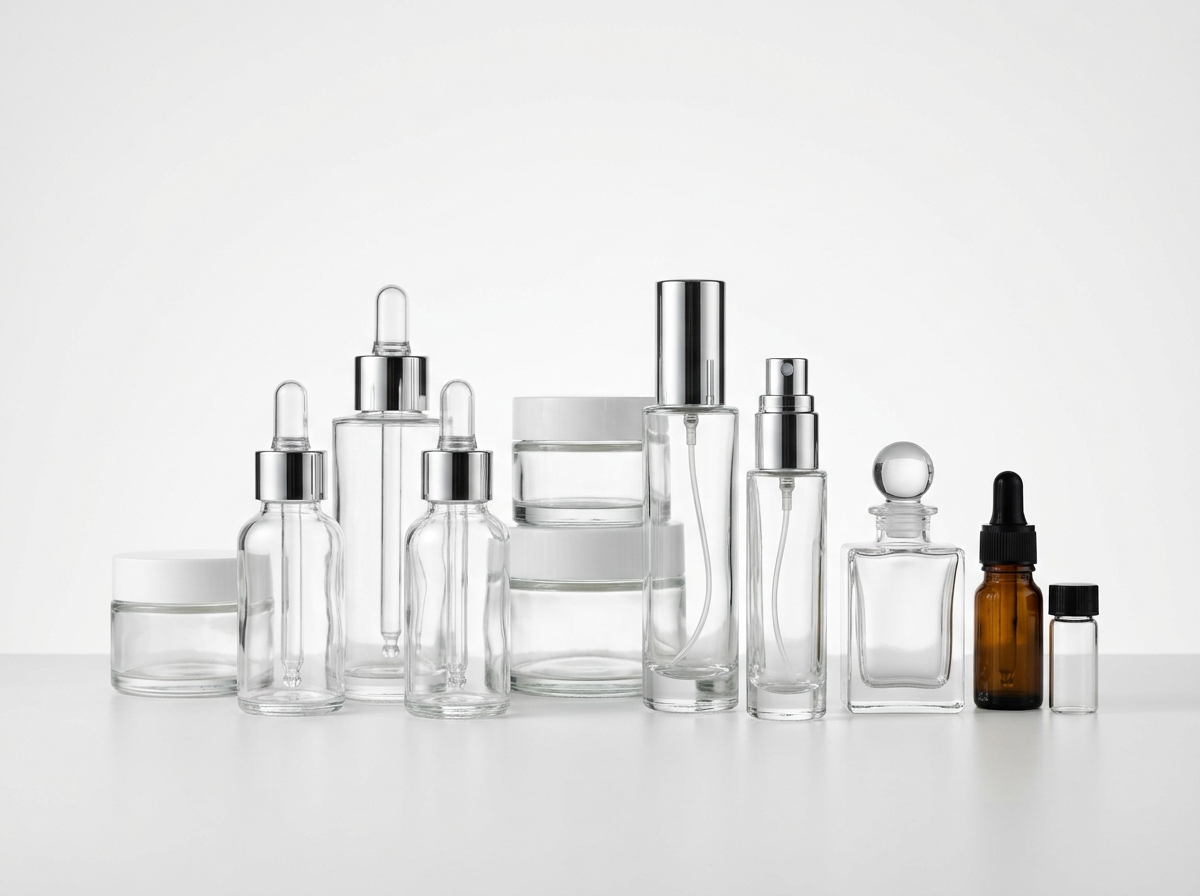 Premium skincare packaging design for brand differentiation
Premium packaging is built from consistency, not excess.
Many brands try to add value through too many visual elements. In practice, premium serum bottle design usually works better when it is disciplined: one clear silhouette, one controlled finish, one strong closure statement, and one recognizable color language across the line.
For skincare packaging, visual system consistency is especially important when the line includes serum, cream, eye care, and mist products. That is why many brands use a multi-piece system rather than isolated SKUs. A coordinated skincare packaging set can make a product family look intentional and premium even before the customer reads the label.
Decoration choice affects perceived value more than many sourcing teams expect. Frosted glass usually suggests purity and minimalism. Gloss coatings feel more commercial and vivid. Metallic accents increase luxury perception but can also raise printing complexity. Soft-touch and velvet-like finishes can create a stronger tactile memory, especially in gift-focused or high-end cosmetic channels.
Packaging also needs to support merchandising. Retail buyers often care whether the bottle line photographs well under studio light, stacks cleanly in a shelf planogram, and remains visually coherent across different capacities. If your brand plans to introduce more than one serum, the bottle family should be designed as a system from the start.
Technical data that skincare buyers should verify before ordering
Technical confirmation is the fastest way to reduce packaging failures.
The table below summarizes the core data points that should be locked before mass production:
| Specification | Why it matters | Typical buyer question | Validation method |
|---|---|---|---|
| Capacity | Impacts fill volume, shipping weight, and price tier | Is this a 30 mL or 50 mL retail SKU? | Sample fill test with actual formula |
| Neck finish | Determines closure and pump compatibility | Will the dropper fit without leakage? | Torque and seal verification |
| Decoration method | Affects durability and brand presentation | Will the print survive alcohol wipe-down? | Rub test and visual inspection |
| Transit strength | Controls breakage and loss rate | Can the packaging survive export shipment? | Drop and carton compression testing |
In packaging engineering, tolerance control is not a small detail. Even when the bottle looks perfect, poor fit between bottle and closure can trigger leakage, misalignment, or customer complaints. That is why premium serum packaging is usually developed as an integrated structure rather than a collection of separate parts.
For brands selling into regulated or quality-conscious channels, process control also matters. ASTM D4169 is widely used for shipping container performance testing, while NIST guidance on SI units helps standardize dimensional communication across suppliers and quality teams. Those references are useful when your packaging project spans different factories or export markets.
Common procurement mistakes in custom serum bottle projects
Most packaging delays come from specification gaps, not manufacturing magic.
One common mistake is approving the sample bottle without testing it with the real formula. Viscosity, acidity, solvent content, and pigment load all affect compatibility. A bottle that looks fine with water may fail with a more active serum.
Another frequent problem is treating the outer look as the only priority. If the pump dose is inconsistent or the dropper pulls air, the user experience degrades immediately. In premium skincare, that kind of friction is enough to damage repeat purchase intent.
A third error is underestimating logistics. Glass bottles need stronger transit protection, and decorative finishes may need extra care to avoid abrasion. Brands that ship internationally should ask for carton tests and palletization advice before launching.
- Do not approve samples before fill, storage, and transport tests.
- Do not assume all pumps fit all neck finishes.
- Do not design the bottle before defining the formula stability needs.
- Do not separate bottle sourcing from outer packaging planning.
Why integrated packaging is better than single-component sourcing
Integrated sourcing lowers failure risk and improves brand consistency.
Lemuel’s business model is relevant here because skincare and fragrance packaging is more than a bottle catalogue; it is a coordinated packaging solution. When bottle, pump, cap, and set packaging are planned together, the result is easier to sample, easier to approve, and easier to scale.
That matters for brands launching seasonal sets, hero serums, and premium bundles. If one component changes late in development, the whole visual language can break. A packaging partner with a broader catalog also helps when you need related items like a premium bottle family for fragrance extensions or a secondary skincare line.
From a business standpoint, integrated packaging can shorten the path from concept to market. It simplifies communication, reduces the number of suppliers, and makes quality responsibility easier to assign. For international buyers, that is often the difference between a smooth launch and a six-week delay.
How to evaluate a sample before mass production
The sample is a functional test, not a beauty contest.
When your custom serum bottle sample arrives, check it in three stages. First, inspect dimensional accuracy and surface quality. Second, test the closure and dispensing behavior with the actual formula. Third, simulate storage and transit conditions to see whether leakage or finish damage appears.
- Measure the bottle and closure fit with the intended filling line setup.
- Run a short fill test using the real serum viscosity.
- Store samples upright and inverted for a defined period.
- Check for seepage, pump failure, or residue at the neck finish.
- Review how the packaging looks under natural and retail lighting.
For premium brands, the sample should also be reviewed from a consumer lens. Does it feel stable in the hand? Does the cap open smoothly? Does the dropper or pump give a controlled dose? A high-end package must communicate quality through interaction, not just appearance.
Custom serum bottle trends in premium skincare packaging
The most successful packaging trends combine sensorial design with functional clarity.
Current premium skincare packaging trends favor clean silhouettes, recyclable material narratives, and higher compatibility between bottle format and formula type. Many brands are moving toward simpler bottle forms paired with elevated closure details so that the formula and the brand story feel more credible.
Environmental messaging is also gaining importance. Recyclable PET, reusable glass, and reduced-component packaging are increasingly used to support sustainability claims. If your brand wants to align packaging with ESG messaging, the material story needs to be supported by the actual component mix and not only by marketing language.
In the U.S., the broader cosmetics market remains large and competitive, and the Bureau of Economic Analysis data on industry output can be useful context when planning premium product launches. Meanwhile, packaging teams should remember that the bottle still has to earn its place through usability and quality control.
FAQ about custom serum bottle and skincare packaging
What is the best material for a custom serum bottle?
Glass is usually best for premium positioning, while PET or airless formats are often better for lightweight transport and formula protection.
Should I choose a dropper or a pump for serum packaging?
Droppers work well for oils and concentrated serums, while pumps and airless systems are better for hygienic dosing and oxygen-sensitive formulas.
What information should I give a serum bottle manufacturer?
Share the target capacity, formula type, neck finish, closure preference, decoration method, MOQ, and export destination before sampling.
How do I make skincare packaging look premium?
Use one clear bottle silhouette, consistent finish, coordinated closure design, and a coherent family structure across all SKUs.
Why is an airless bottle useful for skincare?
An airless system can reduce air exposure and support cleaner dispensing, which is helpful for actives and sensitive emulsions.
How do I avoid leakage in custom serum bottle projects?
Test the real formula with the real closure, then run upright, inverted, and transit simulations before production approval.
What is the difference between a bottle supplier and a packaging solution provider?
A supplier sells components, while a packaging solution provider helps coordinate bottle, closure, decoration, and secondary packaging into one launch-ready system.
Post time: Aug-17-2026


