
- Choose a manufacturer that can supply the full packaging stack, not only the container.
- Check tolerances, decoration methods, and closure compatibility before approving samples.
- For launch projects, lead time, breakage risk, and repeatability matter as much as design.
- Use standards-based testing to reduce costly post-launch packaging failures.
When beauty brands evaluate custom glass packaging, the real question is whether the supplier can support a launch with consistent cosmetic glass bottles, matching closures, and production discipline; for example, ISO 9001:2015 defines a quality management framework that helps suppliers control repeatability, while glass containers for perfumery and skincare often need tight dimensional control and decoration consistency to protect brand presentation and fit. A strong glass packaging manufacturer should therefore be judged by system compatibility, sample turnaround, and export reliability, not just by a catalog of bottle shapes.
How beauty brands evaluate a custom glass packaging manufacturer for launch readiness
The best manufacturer for a new launch is the one that can reduce packaging risk before the first production run.
In a beauty launch, packaging failure is rarely only about glass quality; it can also come from a cap that leaks, a pump that does not mate cleanly, a decoration that fails after transit, or a bottle finish that cannot be repeated at scale.
That is why serious buyers assess the supplier as a packaging system partner. For brands planning perfume, skincare, or essential-oil launches, the right supplier should be able to coordinate skincare bottle sets, airless bottles, perfume bottles, and accessories with the same visual and technical logic.
From a launch perspective, the most important question is simple: can the supplier deliver the same bottle, same closure fit, and same decoration quality on the second order as on the sample order?
Custom glass packaging and the hidden decision factors buyers miss
Custom glass packaging decisions usually fail when buyers focus on aesthetics first and functional fit second.
Beauty brands often start with color, shape, and luxury perception, but launch performance depends on a longer list of technical variables. Those variables include neck finish, wall thickness, capacity tolerance, compatibility with pumps and droppers, surface treatment, and packaging protection during shipping.
For example, glass bottle tolerances are usually specified by the supplier drawing and should be checked against the closure system. In regulated industrial glass, dimensional control is often tightly managed because the interface determines sealing performance. In packaging procurement, the same logic applies even when the product is cosmetic rather than pharmaceutical.
That is also why many brands prefer a supplier that offers dropper bottle options, cosmetic jars, and sprayer components in one sourcing process. The fewer interface handoffs, the lower the launch risk.
Table 1: Launch evaluation checklist for a glass packaging supplier
| Evaluation factor | What to verify | Typical target |
|---|---|---|
| Dimensional fit | Neck finish, closure match, filling line fit | Match to approved drawing |
| Decoration stability | Coating, printing, metallization, flocking | No visible defect after transit testing |
| Capacity control | Net fill volume and overflow margin | Aligned with label claim and line loss allowance |
| Sample repeatability | Second and third sample consistency | Same color, same finish, same fit |
| Supply coordination | Bottle, cap, pump, carton timing | Single launch schedule |
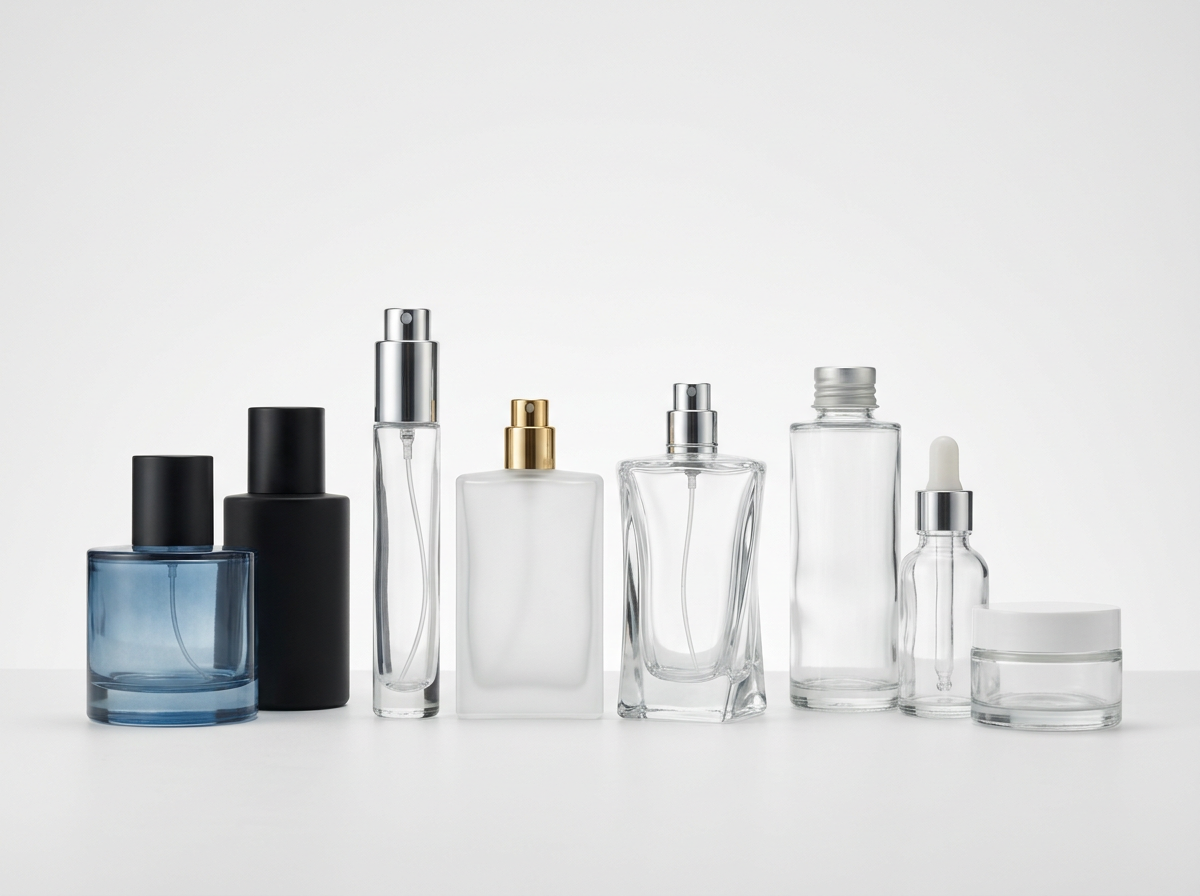
Why cosmetic glass bottles must match both brand design and filling reality
A beautiful bottle is useless if it cannot run smoothly on the filling line.
For beauty launches, packaging teams need to balance three requirements at once: brand image, production stability, and consumer usability. That balance is especially important for cosmetic glass bottles, because the bottle must work with filling equipment, survive transport, and still look premium on shelf.
In practical terms, a bottle that looks perfect in a render can still fail if the shoulder geometry blocks label placement, the finish is incompatible with the chosen pump, or the base footprint is unstable in cartons. Beauty brands should therefore request drawings, closure samples, and transit-tested mockups before approving mass production.
The logic is even more important for fragrance and skincare launches that rely on series consistency. A brand may need one design language across essential oil bottles, serum bottles, and cream jars, while keeping the same visual identity across multiple capacities.
That is where a manufacturer with a packaging-system mindset becomes valuable: it can coordinate container, accessory, and outer packaging instead of treating each item as an isolated SKU.
Table 2: Glass packaging formats and launch use cases
| Packaging format | Common capacity range | Best use case | Main risk |
|---|---|---|---|
| Perfume bottle | 30 mL to 100 mL | Fragrance launches | Spray fit and visual defects |
| Serum bottle | 15 mL to 50 mL | Skincare actives | Dropper compatibility |
| Airless bottle | 15 mL to 100 mL | Oxidation-sensitive formulas | Pump performance drift |
| Cream jar | 15 g to 100 g | Moisturizers and balms | Lid seal and torque mismatch |
| Essential oil bottle | 5 mL to 30 mL | Aromatherapy and concentrates | Orifice and leakage control |
Standards, testing, and quantitative checks that reduce launch risk
Launch-ready packaging should be tested, not assumed.
For a cosmetic or fragrance launch, quantitative verification gives the buyer leverage and reduces post-launch surprises. A useful starting point is ISO 15378:2017, which addresses primary packaging materials for medicinal products and is often used as a quality reference point for controlled packaging processes. While beauty packaging is not the same as pharma packaging, the discipline around traceability, contamination control, and process consistency is still highly relevant.
For labeling and residual contamination concerns, buyers can also refer to ASTM D3078, which is a common leak test method for flexible packages and useful as a conceptual reference when a brand wants a simple, observable seal check during pre-shipment validation.
On the logistics side, transport testing matters because the best-looking bottle can still fail after vibration, compression, or impact. The U.S. Department of Transportation provides guidance on hazmat packaging integrity and shipment safety at PHMSA, and those handling principles are useful for export-oriented beauty packaging programs as well.
Quantitatively, many launch teams define acceptance around measurable checks such as fill-volume consistency, closure torque, drop-test survival, and visual defect rate. Even if the exact target comes from the buyer’s spec sheet, the important point is that the target must be measurable and repeatable.
Table 3: Common quantitative checks used in packaging approval
| Check | What it measures | Why it matters | Typical launch action |
|---|---|---|---|
| Dimensional tolerance | Fit between bottle and closure | Prevents leakage and assembly failure | Approve against signed drawing |
| Closure torque | How tightly the cap seals | Affects leakage and user experience | Validate on sample sets |
| Transit integrity | Resistance to shipping damage | Controls breakage cost | Test before first shipment |
| Visual defect rate | Scratches, bubbles, uneven coating | Protects shelf appeal | Set inspection threshold |
| Line compatibility | Fill and capping behavior | Prevents production stoppage | Run pilot line trial |
How material choice changes performance, sustainability, and brand perception
Glass remains a premium material because it signals purity, stability, and recyclability.
For beauty brands, glass is often chosen when the formula needs oxygen protection, shelf presence, or a luxury feel. But material choice is not only about glass versus plastic. It also involves closure materials, decoration layers, and secondary packaging design.
The homepage language around recyclable materials and premium packaging is relevant here. A brand can use clear glass, frosted glass, colored glass, or coated glass to create different sensory signals. A velvet finish or metallized cap can elevate perception, while still requiring careful attention to compatibility and transit protection.
If sustainability is a launch requirement, buyers should request data on packaging mass, recyclability claims, and component separation. The U.S. EPA recycling guidance is a useful public reference for understanding how material separation affects recyclability in real-world systems.
In practice, the best glass packaging choice is the one that aligns formula sensitivity, shelf presentation, and logistical cost. For a brand launching a premium serum, a small structural change in the bottle may have more commercial impact than a minor change in label design.
What a launch team should ask before placing a custom glass packaging order
The right questions reveal whether the supplier can actually deliver a launch, not just a quote.
Before approving a new supplier, beauty teams should ask for five things: a technical drawing, a decoration reference, closure compatibility confirmation, a lead-time plan, and a sample approval process. This is especially important when the launch includes multiple SKUs, because one weak component can delay the entire range.
Brands sourcing through spray bottle options or complete skincare sets should also ask whether the supplier can match the same finish across different capacities. Series consistency is often what makes a beauty line look premium on shelf.
For international buyers, communication speed matters too. A supplier near major shipping hubs can reduce export friction, but only if it also has disciplined documentation and packing control.
- Request a signed technical drawing before sample approval.
- Confirm bottle, cap, and pump compatibility as one system.
- Test transit protection before launch shipment.
- Align decoration method with the target shelf image.
- Lock the revision history so samples do not drift.
Why series packaging often wins in fragrance and skincare launches
Series packaging helps a launch look coherent across multiple product sizes and formats.
Beauty brands rarely launch only one SKU. A fragrance brand may need a bottle, a travel spray, and a gift set; a skincare brand may need a serum bottle, a cream jar, and a lotion bottle. That is why manufacturers with experience in coordinated packaging systems are often preferred over vendors that only sell isolated components.
For example, a collection built around skincare set packaging can support a stronger shelf story than standalone containers. If the bottle finishes, caps, and cartons all speak the same visual language, the consumer reads the line as more trustworthy and more premium.
From a procurement standpoint, series packaging also helps reduce approval complexity. Once the core design language is locked, extension SKUs can be developed faster, with fewer revisions and fewer fit surprises.
How to compare manufacturers without falling for low-price traps
The cheapest quote is rarely the lowest-risk choice for a launch.
Low-price sourcing often hides costs in defect rate, rework, freight damage, or delayed launch timing. A supplier that quotes aggressively but cannot hold decoration quality or closure fit may end up costing more than a higher-priced, disciplined partner.
The better comparison method is total launch cost. That includes sample iterations, mold or tooling changes, freight breakage, inspection labor, and the cost of a delayed market entry. For launches with strict timing, one week of delay can be more expensive than a small unit-price difference.
Beauty buyers should therefore compare suppliers using a scorecard, not a single price line. The scorecard should include design execution, process control, documentation quality, response speed, and post-sale problem handling.
Table 4: Supplier comparison scorecard for new launches
System packaging support20%9/105/10
| Criteria | Weight | Supplier A | Supplier B |
|---|---|---|---|
| Technical fit | 30% | 8/10 | 6/10 |
| Decoration consistency | 20% | 9/10 | 7/10 |
| Lead-time control | 20% | 7/10 | 8/10 |
| Communication speed | 10% | 8/10 | 6/10 |
FAQ
1. What should beauty brands look for in a custom glass packaging manufacturer?
They should look for technical fit, decoration consistency, closure compatibility, sample control, and export readiness.
2. Why is packaging system support more important than bottle price?
Because a launch depends on the container, pump, cap, and carton working together, not on the bottle alone.
3. How do cosmetic glass bottles reduce product-launch risk?
They can improve shelf appeal, support formula stability, and create a premium brand impression when the fit and finish are controlled.
4. Which packaging formats are most common for skincare launches?
Airless bottles, serum bottles, cream jars, and coordinated skincare sets are common because they support multiple formulas and sizes.
5. What tests should be done before mass production?
Brands should verify drawing fit, seal behavior, transit integrity, decoration stability, and filling-line compatibility.
6. How can brands judge whether a supplier is launch-ready?
They can ask for documentation, sample repeatability, revised drawings, and a clear production timeline.
7. Why do fragrance and skincare brands often choose coordinated packaging sets?
Because series packaging improves shelf coherence, speeds extension SKUs, and strengthens brand identity.
Post time: Aug-11-2026


