
- Custom glass bottles help new fragrance launches stand out through shape, finish, and decoration, not just volume.
- Launch risk drops when bottle, pump, cap, and carton are engineered as one system.
- Technical details such as neck finish, glass quality, and leak performance matter as much as visual design.
- Premium fragrance packaging often depends on consistency across the full custom bottles program and not on the bottle alone.
- For global launches, suppliers with integrated packaging capability reduce coordination errors and speed up sample-to-production approval.
Custom glass bottles are often the fastest way to create a premium first impression for a fragrance product launch, especially when the packaging must communicate luxury, stability, and brand identity at the same time. In practical terms, fragrance packaging decisions are not cosmetic only: ISO 1116 glass classification, ASTM leakage and closure testing practices, and pump compatibility requirements all affect whether a launch can move from concept to shelf without rework. For premium perfume projects, the bottle, sprayer, cap, and carton should be selected as a system, not as separate parts.
Why Custom Glass Bottles Matter in a Fragrance Product Launch
Custom glass bottles influence launch success because they affect brand recognition, consumer trust, and operational reliability in one step.
In fragrance, visual identity is often the first purchase driver, but packaging performance decides whether the product survives transport and daily use. A 30 ml or 50 ml perfume may look simple on the shelf, yet the project can fail if the neck finish does not match the pump, if the atomizer sprays inconsistently, or if the closure loosens during distribution. That is why experienced buyers work with a glass bottle category that can support both design and engineering requirements.
Glass remains the preferred substrate for fine fragrance because it is chemically stable, visually clear, and compatible with alcohol-based formulas. That stability matters when a scent contains volatile solvents and fragrance oils. It also supports premium decoration methods such as frosting, spraying, silk screening, hot stamping, and metallized finishes, which are frequently used to create a distinct launch identity.
One useful reference point is ISO 1219? No, for fragrance packaging the more relevant idea is tolerance discipline, because a bottle’s decorative appeal means little if the closure system is inconsistent. Packaging engineers often specify dimensional controls around the neck and shoulder so the bottle can accept the intended sprayer and cap without leakage or tilt. For general engineering context, the International Organization for Standardization publishes glass container and dimensional standards, while closure and leakage validation is typically handled through supplier testing protocols and brand-specific quality plans.
For procurement teams, the real question is not whether a bottle is pretty. The real question is whether it can be launched, filled, shipped, displayed, and repeated at scale.
What a Perfume Bottle Supplier Must Solve Before Launch
A reliable perfume bottle supplier must solve compatibility, consistency, and scaling issues before the launch date.
The supplier role is larger than manufacturing a bottle. A launch-ready partner has to match the bottle neck, pump, and cap, manage decoration repeatability, and provide samples that accurately represent mass production. This is especially important in fragrance, where brand owners often need a tight visual identity across multiple SKUs, such as 30 ml, 50 ml, and 100 ml versions.
At the component level, the launch package usually includes:
- Glass bottle shape and capacity
- Neck finish and closure fit
- Atomizer or spray pump
- Cap material and weight balance
- Surface treatment and logo decoration
- Outer box or set packaging
When these elements are planned together, the project becomes easier to scale. Lemuel’s product structure reflects this integrated approach through spray bottle options, perfume bottles, and packaging accessories that can be combined into a full launch kit.
This matters because fragrance buyers frequently source from multiple teams: brand, design, operations, and logistics. A single packaging mismatch can create cascading delays, including extra sample rounds, fill-line adjustments, and revised carton sizing. In a launch timeline, those delays are expensive because they compress retail booking, influencer seeding, and distributor coordination.
Key Technical Factors That Shape Custom Glass Bottles
Technical detail determines whether a custom bottle feels premium or becomes a production problem.
Below is a practical comparison of the most important bottle variables for fragrance launches.
| Factor | Why It Matters | Typical Launch Impact |
|---|---|---|
| Capacity | Aligns with market positioning and refill strategy | 30 ml, 50 ml, and 100 ml are common retail formats |
| Neck finish | Determines pump and cap compatibility | Reduces leakage and assembly errors |
| Glass thickness | Affects weight, premium feel, and break resistance | Heavier bottles often support luxury positioning |
| Decoration method | Creates shelf distinction | Frosting, coating, and printing influence brand recall |
| Closure system | Controls user experience and sealing performance | Spray quality affects first-use satisfaction |
For dimensional and quality thinking, many packaging teams borrow the discipline used in precision manufacturing: tight repeatability, sample validation, and documented tolerances. In engineering terms, even a small mismatch can matter because a threaded or crimped closure relies on consistent geometry to maintain function. If the bottle is intended for an atomizer-based formula, the supplier must verify that the pump delivers a uniform spray pattern and does not clog or leak under normal handling.
Material choice also matters. For fragrance, soda-lime glass is common because it is cost-effective and suitable for decorative finishing. For more premium positioning, higher clarity and heavier wall designs are often selected to create a luxury feel. The bottle surface should also be compatible with the intended decoration process; some coatings perform better under hot stamping, while others require tighter curing control to avoid abrasion.
When reviewing supplier options, buyers often compare a standard item against a custom bottle program to determine whether the launch deserves a unique mold or a faster, lower-risk adaptation of an existing shape.
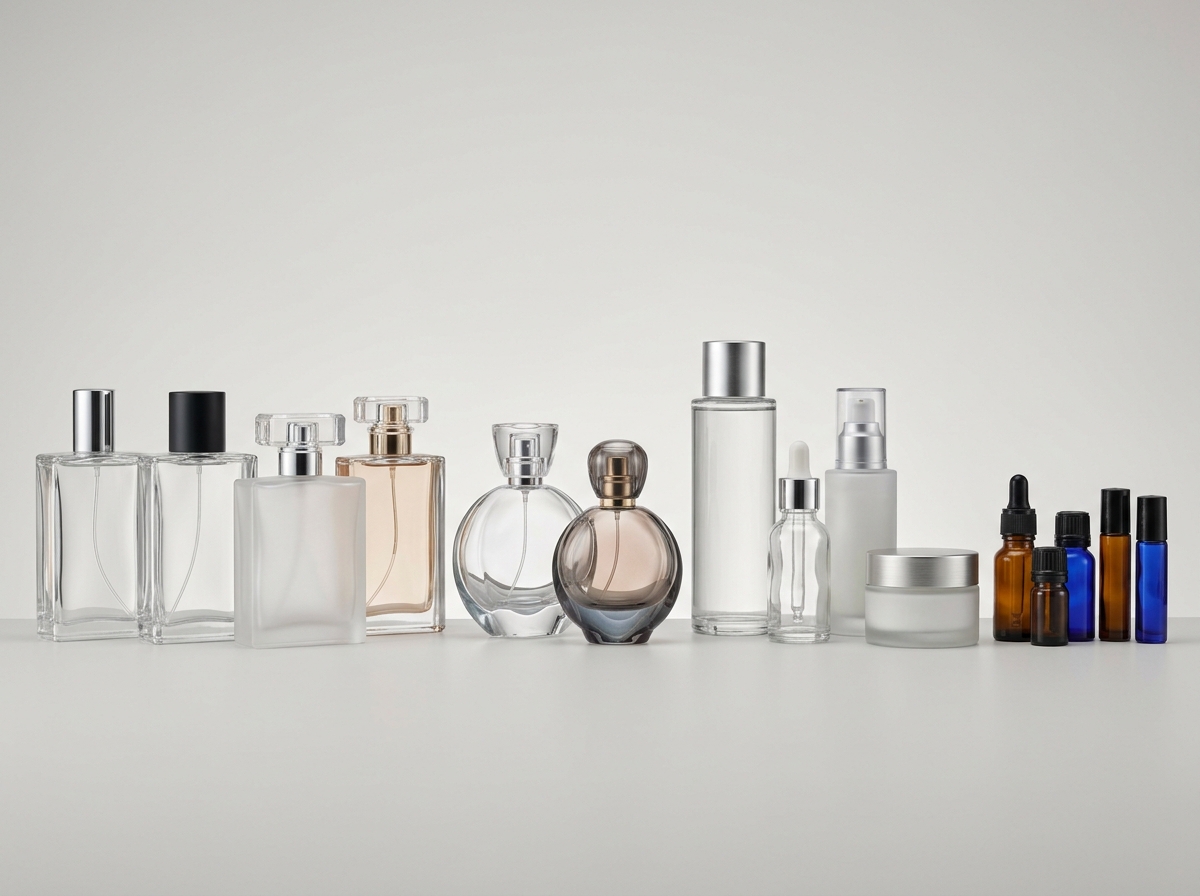 Launch Planning: Bottle, Pump, Cap, and Carton as One System
The highest-performing fragrance launches treat packaging as a complete system, not a set of disconnected components.
This systems approach reduces the most common failure points. A beautiful bottle with the wrong sprayer creates a poor consumer experience. A premium cap with poor fit creates wobble and leakage. A well-designed carton with the wrong insert can allow bottle movement during shipping. Each part affects the others, which is why fragrance teams increasingly request integrated packaging support from one supplier.
The most common launch sequence looks like this:
- Define target retail format and user experience.
- Select bottle shape, volume, and neck finish.
- Match the pump and cap system.
- Confirm decoration method and print placement.
- Build samples for fill testing and transport testing.
- Approve production color, finish, and carton fit.
That sequence is especially important for new fragrance brands because launch calendars are typically compressed. Retailers, distributors, and e-commerce teams want final product images early, which means packaging decisions often happen before final formula lock. A bottle that supports pre-production photography, final fill validation, and shelf-ready shipping can save weeks.
For brands expanding into gift sets or seasonal collections, the packaging system also needs visual consistency across SKUs. Lemuel’s broader catalog, including skincare packaging, shows how a brand can keep design language coherent across multiple product lines rather than treating each launch as an isolated project.
Quantitative Benchmarks Buyers Can Use When Evaluating Fragrance Packaging
Clear numbers make supplier evaluation faster and more objective.
Although each brand has its own specifications, fragrance launches often use common benchmark values during development and quality review.
| Benchmark Area | Reference Value | Why It Matters |
|---|---|---|
| Retail fragrance sizes | 30 ml, 50 ml, 100 ml | Supports core market segmentation |
| Filling tolerance | Typically controlled within a narrow process window | Protects weight consistency and label compliance |
| Spray testing | Repeated actuation during sample approval | Confirms atomization and user experience |
| Leak validation | Checked after packing and transport simulation | Reduces failure in transit and returns |
| Decoration stability | Assessed after abrasion and handling | Protects shelf appearance through distribution |
For standards context, ISO publishes a large body of glass container and packaging-related documents, and suppliers often align internal checks with relevant ISO or ASTM methods even when the brand itself sets final acceptance criteria. For example, the U.S. National Institute of Standards and Technology provides widely used measurement and calibration references at NIST, which is useful when teams want repeatable testing language across different vendors. ASTM also maintains packaging and materials testing standards at ASTM International, including methods used to evaluate closure integrity, material behavior, and container performance.
In launch projects, numbers are not just technical details. They are the language that keeps design teams, sourcing teams, and factories aligned.
Material and Sustainability Choices in Custom Glass Bottles
Sustainability is becoming a functional requirement in fragrance packaging, not just a branding message.
Many buyers now ask for recyclable glass, reduced plastic content, and packaging structures that support easier sorting after use. Glass already has a strong sustainability narrative because it is widely recyclable, and it supports premium refill concepts when the bottle design allows reuse. That is especially relevant in fragrance, where consumers increasingly expect long-lasting, display-worthy packaging rather than disposable design.
Material selection is also tied to logistics. Heavier glass improves luxury perception but can increase freight cost and breakage risk. Lighter glass reduces shipping weight but may feel less premium. The right choice depends on channel strategy. For direct-to-consumer fragrance launches, a slightly lighter bottle may improve shipping economics. For boutique retail, a heavier bottle may support shelf impact.
When environmental positioning is part of the launch story, suppliers that can work with recyclable materials and efficient package structures become more valuable. Lemuel’s content emphasis on product categories and launch-ready packaging aligns well with this kind of brand story, especially for fragrance lines that need both visual appeal and practical distribution performance.
How to Evaluate a Perfume Bottle Supplier Before Signing Off a Launch
A good supplier evaluation process reduces delays more effectively than last-minute troubleshooting.
Buyers should review the supplier across five checkpoints:
- Can they provide stable sample-to-production consistency?
- Do they support multiple closure and decoration options?
- Are they able to align bottle, pump, and cap as one package?
- Do they understand export packing and transit protection?
- Can they respond quickly during design revisions and artwork changes?
For fragrance launches, communication speed is often as important as unit price. A supplier that can confirm technical details early may save the brand from expensive tooling changes later. This is where integrated packaging houses have an advantage over single-item vendors: they can coordinate more moving parts in fewer rounds of revision.
The best procurement teams ask for sample evidence, fit checks, decoration proofs, and packing photos before moving to mass production. They also request a clear approval timeline, because fragrance launches are usually tied to media calendars, seasonal retail windows, or distributor commitments. A small delay in packaging can push the entire launch into the next quarter.
That is why a perfume bottle supplier should be assessed on system capability, not just bottle appearance.
Common Mistakes in Fragrance Product Launch Packaging
Most fragrance packaging failures come from ignoring compatibility or timing.
Below are the most common mistakes teams make when using custom glass bottles for a launch:
- Choosing the bottle before confirming pump and cap fit.
- Approving decoration before sample filling and transport checks.
- Underestimating the need for multiple sizes in one series.
- Ignoring shipping protection for glass breakage risk.
- Using separate vendors for bottle, closure, and carton without one technical owner.
These errors are avoidable when the packaging strategy is built around the launch timeline. A fragrance brand that wants fast market entry should prioritize repeatable components, clear technical drawings, and a supplier who can manage the whole packaging stack.
Teams often discover too late that packaging artwork, neck finish, and filling equipment have to work together. When they do not, the “launch problem” becomes a manufacturing problem, then a logistics problem, then a sales problem. Integrated planning prevents that chain reaction.
Case-Based Scenario: From Concept Bottle to Market-Ready Fragrance
A launch-ready fragrance bottle usually goes through more than one design and approval cycle.
Consider a premium 50 ml fragrance concept with a clear glass bottle, metallic cap, and sprayed finish. The brand wants a luxury feel, fast retail rollout, and a product that can be photographed before final filling. The supplier first confirms bottle geometry, then suggests a matching atomizer and cap set. The sample is checked for visual balance, spray quality, and packing stability. After that, decoration tests validate whether the finish survives handling and carton insertion.
This is where integrated packaging capability matters most. A supplier that understands the complete set, including packaging accessories, can help the brand avoid mismatched components and reduce back-and-forth. The outcome is not just a bottle that looks good. It is a bottle that can be filled, packed, photographed, and delivered on schedule.
For fragrance startups, this approach can be the difference between a smooth launch and a costly delay. For established brands, it supports faster seasonal refreshes and more consistent retail execution.
FAQ: Custom Glass Bottles for Fragrance Product Launches
1. Why are custom glass bottles important for a fragrance product launch?
Custom glass bottles matter because they shape brand identity, consumer perception, and packaging performance at the same time. They help a new fragrance stand out while still supporting filling, shipping, and retail display requirements.
2. What should I check before choosing a perfume bottle supplier?
You should check bottle quality, neck finish compatibility, decoration consistency, sample accuracy, and whether the supplier can coordinate pumps, caps, and cartons as one system.
3. Which bottle sizes are most common for fragrance launches?
Common retail fragrance sizes are 30 ml, 50 ml, and 100 ml. These sizes cover entry-level, core, and premium positioning for many perfume brands.
4. How do bottle, pump, and cap compatibility affect launch success?
Compatibility affects leakage, atomization, assembly speed, and consumer experience. If one component does not fit correctly, the launch can face rework or shipping issues.
5. What decoration methods are common for custom glass bottles?
Common methods include frosting, spraying, silk screening, hot stamping, and metallized finishes. The right method depends on brand positioning and abrasion resistance needs.
6. How can a fragrance brand reduce packaging delays?
A brand can reduce delays by approving the bottle, pump, cap, and carton as one package early in the project and by requesting fit samples before final production.
7. Are custom glass bottles suitable for sustainable fragrance packaging?
Yes. Glass supports recyclability, refill concepts, and premium reuse narratives. The most sustainable option usually balances weight, protection, and material efficiency.
Post time: Aug-21-2026


