
- Frosted finishes improve perceived luxury by reducing reflectivity and creating a softer visual profile.
- Packaging consistency matters: bottle, pump, cap, and secondary box should read as one system.
- Material choice affects both premium appearance and formula protection, especially for light-sensitive skincare.
- Luxury skincare packaging works best when aesthetics are backed by functional details such as compatibility, stability, and fill efficiency.
Frosted cosmetic bottles are a high-impact choice for luxury skincare packaging because they combine brand elegance with practical performance. In glass packaging, surface finish influences how consumers judge value within seconds, and that matters in categories where texture, purity, and ritual are part of the purchase decision. For context, ISO 15378 covers primary packaging materials for medicinal products and reflects how seriously surface quality, cleanliness, and process control are treated in sensitive packaging environments, while precision and dimensional control are often evaluated under standards such as ISO 230-1:2022 in related manufacturing contexts. For brands building a premium line, frosted glass cosmetic bottles are most effective when integrated into a full packaging architecture, such as skincare bottle set, airless bottle, and cream jar systems.
Why frosted cosmetic bottles signal luxury skincare packaging
Frosted cosmetic bottles signal premium positioning because they compress visual noise and elevate tactile expectation.
Luxury skincare packaging depends on first impression economics. A frosted surface diffuses light instead of reflecting it sharply, which makes the bottle appear softer, more controlled, and more expensive. That visual effect is especially useful for facial serums, essences, and ampoules, where consumers often associate clarity, calmness, and clinical sophistication with trust. In premium skincare, the package must do more than hold product; it must reinforce the brand’s promise of efficacy, care, and consistency.
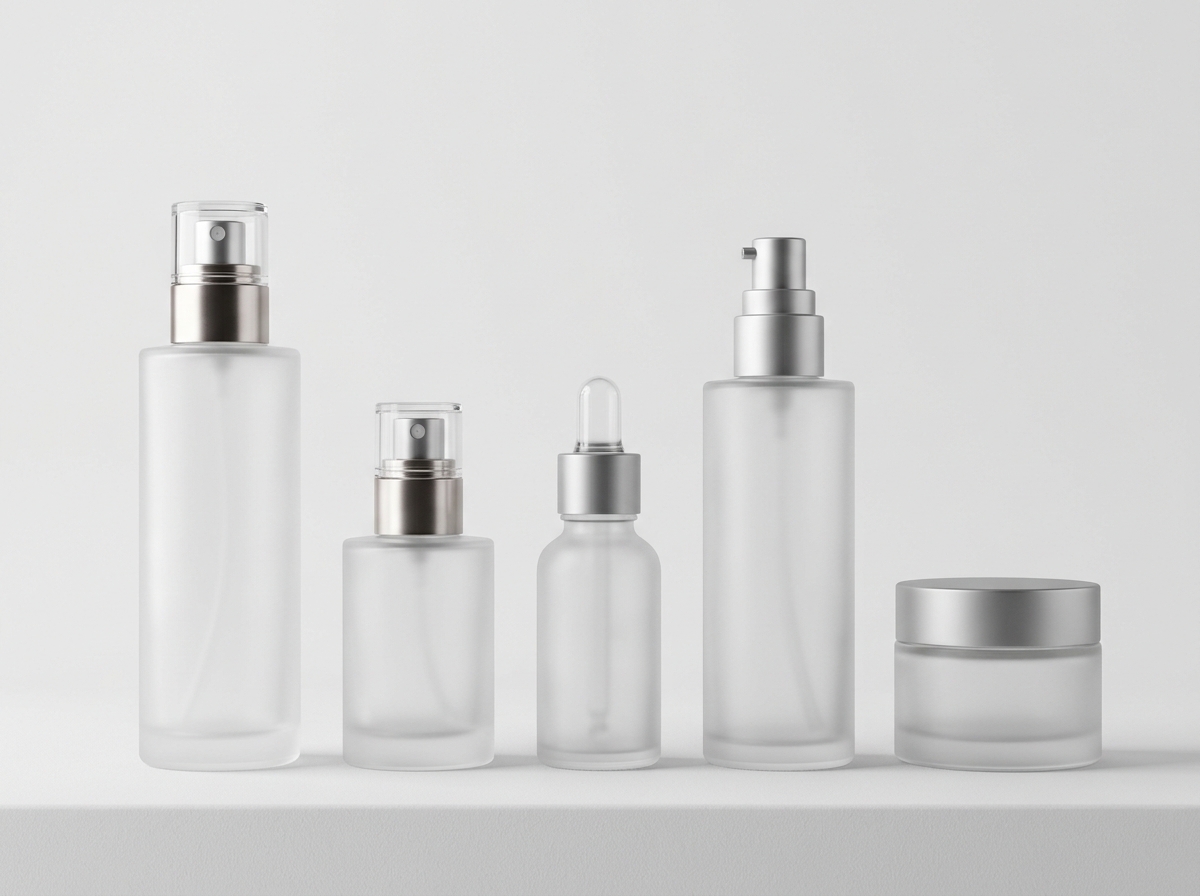
This is one reason many brand teams pair frosted finishes with understated decoration rather than aggressive graphics. Minimal labels, restrained color palettes, and precise linework allow the bottle shape and surface to carry the premium message. When combined with matched closures and applicators, the result is a packaging family that feels coherent across SKU tiers. A coordinated set can include a treatment bottle, a cream jar, and a secondary display box, which helps the line look intentionally designed rather than assembled item by item.
The demand for coherent systems is visible across product categories on perfume bottle and cosmetic pumps pages, where closure style and visual finish are treated as part of the product value, not just accessories. For skincare, that same logic applies even more strongly because treatment products are often purchased through trust, not impulse alone.
How frosted glass cosmetic bottles improve perceived value and shelf differentiation
Frosted glass cosmetic bottles improve shelf differentiation by making a product line look unified while still allowing individual SKU distinction.
On a crowded shelf or in a digital catalog, the packaging must be instantly readable. Frosted finishes create a visual identity that is recognizable across angles, lighting conditions, and backgrounds. Unlike fully transparent bottles, frosted glass dampens reflections that can obscure labeling or cheapen the appearance of the package under harsh retail lighting. That matters in e-commerce photography too, where specular highlights can distort how a bottle looks on screen.
Perceived value is also strongly shaped by touch. A matte or satin exterior often feels more deliberate than a glossy one, particularly when paired with a heavy base or a finely finished shoulder. In practical brand terms, the package becomes part of the ritual. The consumer is not only buying a serum; they are buying the experience of opening, holding, dispensing, and displaying it.
Luxury skincare packaging also benefits from the psychological association between restraint and quality. Over-decorated bottles can read as promotional or mass market. Frosted cosmetic bottles, by contrast, tend to communicate refinement. They work well for brands that want to project efficacy, botanical purity, dermatologist-adjacent credibility, or spa-grade calm without visual clutter.
| Packaging choice | Visual effect | Best use case | Common premium cue |
|---|---|---|---|
| Clear glass | High product visibility | Color-sensitive serums and oils | Transparency |
| Frosted glass | Soft, diffused finish | Luxury skincare and gift sets | Restraint |
| Opaque coated glass | Maximum concealment | Light-sensitive formulas | Protection |
| Metalized surface | High reflectivity | Fragrance-led or festive editions | Drama |
Frosted cosmetic bottles and formula protection in skincare packaging
Frosted cosmetic bottles can support formula protection, but the finish itself is not a substitute for proper barrier design.
Many skincare formulas contain actives that are sensitive to light, oxygen, or repeated exposure during use. Vitamin C derivatives, retinoids, and some botanical extracts can degrade if packaging is poorly chosen. Frosted glass reduces light transmission visually, but the actual protective performance depends on the glass composition, wall thickness, closure integrity, liner quality, and whether the format is airless or open-dispense.
This is where packaging engineering becomes essential. A premium-looking bottle must still be matched to the product chemistry. Airless packaging is often preferred for unstable or oxidation-prone formulas because it reduces headspace exposure and helps maintain dose consistency. For richer creams, a well-sealed jar may be acceptable if the formulation and preservation system are designed for repeated consumer opening. For treatment lotions and essences, pump compatibility matters because dosage repeatability directly affects user experience.
Industry testing and handling standards help brands avoid false assumptions. The United States Pharmacopeia has long emphasized packaging compatibility and container performance in relation to product safety, while NIST SI unit guidance is useful when specifying fill volumes, dimensional tolerances, and lab verification workflows. When a packaging supplier supports a full system, the decision is easier because bottle, pump, and cap can be matched early, not patched together late in development.
| Functional factor | Why it matters | Typical packaging response |
|---|---|---|
| Light exposure | Can degrade sensitive actives | Frosted or opaque glass |
| Oxygen exposure | Can oxidize certain formulas | Airless bottle |
| Repeated opening | Can affect hygiene and stability | Pump or airless dispensing |
| Fill consistency | Impacts dosing and user trust | Controlled neck finish and closure fit |
Design details that make luxury skincare packaging feel complete
Luxury skincare packaging feels complete when every visible component supports the same design language.
One of the most common mistakes is treating the bottle as the only design element. In reality, the cap profile, pump color, overcap height, label finish, and carton structure all influence how the package is read. A frosted cosmetic bottle paired with a low-cost glossy pump can lose most of its premium effect. Likewise, a beautifully finished bottle can still feel unfinished if the secondary packaging is generic or the labeling is inconsistent.
A better approach is to design the packaging family as a system. That means defining the finish hierarchy early: bottle surface, closure material, actuator shape, and decorative method. Frosted glass works especially well with soft-touch caps, brushed metal accents, or matte-coated aluminum parts because the textures complement each other rather than compete. The package then feels designed for calm, ritual, and precision.
For brands developing multiple SKU sizes, series consistency is critical. The same visual language should carry across 15 ml, 30 ml, 50 ml, and 100 ml formats where possible. This is one reason skincare set programs are attractive: they help brands maintain a coordinated shelf story while giving each formula a role in the routine. When the line includes jars, droppers, and airless bottles, the value is not just in the items themselves but in how they display together.
- Define the hero finish before selecting decoration.
- Match closure texture to bottle surface.
- Keep label typography consistent across sizes.
- Verify pump and neck compatibility before artwork approval.
- Test the full set under retail lighting and e-commerce photography conditions.
 Quantitative selection criteria for frosted cosmetic bottles
Technical selection should be based on measurable criteria, not just aesthetics.
For luxury skincare packaging, brands should compare capacity range, neck finish, wall thickness, closure fit, and line compatibility. Glass bottles are often selected in standard sizes such as 15 ml, 30 ml, 50 ml, and 100 ml because these volumes align with treatment, serum, and lotion use cases. Airless formats can also be specified in similar capacities, but the internal mechanism changes the usable fill behavior and product evacuation pattern.
Dimensional precision matters because even a beautiful bottle becomes a problem if pumps leak or caps wobble. In controlled manufacturing, tolerance management is what keeps the customer experience consistent across large production runs. For packaging and component planning, many technical teams set internal acceptance limits around neck finish fit, fill volume variance, and cosmetic defect thresholds. While exact limits depend on the supplier and product type, the principle is straightforward: premium packaging should behave predictably at scale.
Real-world procurement also involves lead time and logistics. A supplier located near major ports can reduce export friction for international beauty brands, particularly when custom parts, matching accessories, and secondary packaging must all arrive together. That is why integrated packaging partners are often preferred over single-item vendors: fewer handoffs usually mean fewer compatibility issues.
| Selection criterion | Why it matters | Practical target | Risk if ignored |
|---|---|---|---|
| Capacity | Sets product positioning | 15-100 ml | Wrong usage perception |
| Closure fit | Affects leakage and feel | Verified during sampling | Pump failure or looseness |
| Surface finish | Drives premium perception | Frosted, satin, or matte | Generic appearance |
| Set compatibility | Supports line consistency | Bottle, cap, jar, carton | Broken brand system |
Industry standards and testing that support premium packaging decisions
Luxury packaging becomes more trustworthy when it is tied to recognized standards and test logic.
Although cosmetics packaging is not regulated the same way as pharmaceutical packaging, the same discipline is useful. ISO 8317 addresses child-resistant packaging, while ISO 22716 provides Good Manufacturing Practices guidance for cosmetics. For dimensions and metrology, precision verification commonly relies on standardized measurement practices, and packaging teams often use controlled test methods to check leakage, drop resistance, and closure integrity before production sign-off.
For material and environmental claims, brands should be careful and specific. If a packaging line uses recycled content or recyclable materials, those claims should be supported by the applicable local recycling framework and supplier documentation. In the United States, the EPA recycling guidance is a useful reference point for broad terminology, though actual recyclability still depends on local infrastructure. For U.S. cosmetics labels and packaging considerations, the FDA cosmetics labeling regulations page is another practical source for compliance awareness.
Testing should also reflect use conditions. A frosted cosmetic bottle may look luxurious in a studio, but it still has to survive shipping vibration, filling line contact, consumer handling, and storage in warm retail environments. Premium brands reduce risk by asking for sample validation, fit checks, and compatibility confirmation before mass production. That process is less glamorous than the finish itself, but it is what keeps the finish looking luxurious after launch.
- Check bottle and closure compatibility at sample stage.
- Verify fill volume and headspace using controlled measurements.
- Test transit durability before final carton approval.
- Confirm label adhesion on frosted surfaces.
- Document material and compliance claims from suppliers.
Where frosted cosmetic bottles fit best in skincare portfolios
Frosted cosmetic bottles perform best in portfolios where premium positioning and routine building matter.
They are especially effective for facial serums, boosters, essence lotions, eye treatments, and boutique moisturizers. These are categories where the consumer often expects a carefully designed package that feels calm, clinical, and credible. Frosted finishes also work well for limited editions, spa collections, and gifting lines because they elevate perceived value without requiring loud graphics.
For brands with a broader portfolio, the bottle should still be matched to product behavior. A water-light serum may suit a dropper or treatment pump, while a richer lotion may need a higher-viscosity pump or airless bottle. Creams often benefit from a coordinated jar format, which is why integrated product families such as cosmetic jar and bottle sets are useful in line planning. The goal is not to force one finish across every formula, but to create a family resemblance across the range.
This is where packaging strategy becomes a brand strategy. If the bottles, pumps, and jars all share the same surface language, the consumer remembers the brand more easily. If each item looks unrelated, the range can feel fragmented even when the formulas are strong. For luxury skincare packaging, continuity often matters more than ornament.
Common mistakes when choosing frosted glass cosmetic bottles
The most common mistakes come from prioritizing appearance over system compatibility.
One mistake is choosing a frosted finish without checking how it interacts with labels, inks, or hot-stamp decoration. Some finishes make small typography difficult to read if contrast is weak. Another mistake is pairing a premium bottle with a generic closure that breaks the visual rhythm. A third is selecting frosted glass for a formula that actually needs stronger oxygen or light protection than the bottle can provide on its own.
Brands also underestimate the importance of sampling under realistic conditions. A bottle can look excellent in a catalog image but underperform when filled, capped, and packed in a carton. That is why teams should test the complete set, not just the bottle body. The cap, neck, pump, and carton all influence consumer perception and shipping reliability.
Finally, some buyers assume frosted glass automatically means higher quality. It does not. The premium signal only works when finish quality is even, surface defects are controlled, and the broader packaging system supports the promise the bottle is making.
- Do not ignore closure quality.
- Do not assume frosted glass protects every formula equally.
- Do not approve artwork before label readability is tested.
- Do not evaluate bottle samples outside real lighting conditions.
FAQ about frosted cosmetic bottles and luxury skincare packaging
Are frosted cosmetic bottles better than clear glass cosmetic bottles for luxury skincare packaging?
Frosted cosmetic bottles are usually better when the goal is softness, restraint, and premium differentiation, while clear glass is better when formula visibility is part of the brand story. The best choice depends on whether the product should feel clinical, botanical, or visually transparent.
Do frosted cosmetic bottles protect skincare formulas from light?
They reduce light visibility but are not a complete protection system by themselves. For sensitive formulas, brands should consider glass composition, wall thickness, closure integrity, and possibly airless formats or opaque finishes.
What sizes work best for frosted glass cosmetic bottles?
Common premium skincare sizes include 15 ml, 30 ml, 50 ml, and 100 ml. Smaller sizes suit serums and treatments, while larger sizes are often used for lotions or refill formats.
Can frosted cosmetic bottles be used with pumps and droppers?
Yes. They work well with pumps, droppers, and airless systems as long as neck finish compatibility and dispensing performance are verified during sampling.
Why do luxury skincare brands use frosted packaging so often?
Because frosted packaging communicates calm, quality, and design discipline. It helps brands look premium without relying on bright colors or heavy decoration.
How should a brand choose between a frosted bottle and an airless bottle?
Choose frosted glass when brand image and shelf presence are the priority, and choose airless when formula protection, dose control, and oxygen reduction are the main concerns. Many premium brands use both across different SKUs.
What should be checked before ordering frosted cosmetic bottles in bulk?
Check surface quality, label adhesion, closure fit, fill compatibility, transit durability, and whether the full set supports your visual and functional requirements. Bulk ordering should follow sample approval, not precede it.

Post time: Aug-26-2026


