
- Custom glass bottles are chosen for premium perceived value, design freedom, and compatibility with luxury branding.
- China glass bottle manufacturers are strongest when they offer complete cosmetic packaging systems, not only empty containers.
- Technical sourcing decisions depend on neck finish, glass type, decoration method, closure fit, and filling-line compatibility.
- Quality control should reference measurable standards, including dimensional checks, thermal shock, and transport protection.
Custom glass bottles are a core part of luxury cosmetic packaging because they shape both shelf appeal and filling stability, and premium packaging decisions are often made on measurable criteria such as dimensional tolerance, decoration durability, and leakage control. In precision manufacturing, ISO 230-1:2022 defines how machine-tool positioning accuracy is evaluated, with errors reported in micrometers, which is a useful reminder that packaging consistency should also be treated as a controlled technical variable rather than a purely visual one; see ISO 230-1:2022. For brands building fragrance, skincare, or serum lines, the packaging supplier must support coordinated bottle, pump, cap, and outer-box development. That is why many buyers prefer a China glass bottle manufacturer with integrated cosmetic packaging capability, such as perfume bottles, airless bottles, and cosmetic jars.
Why Custom Glass Bottles Matter in Luxury Beauty Packaging
Custom glass bottles are not just containers; they are part of the brand identity system.
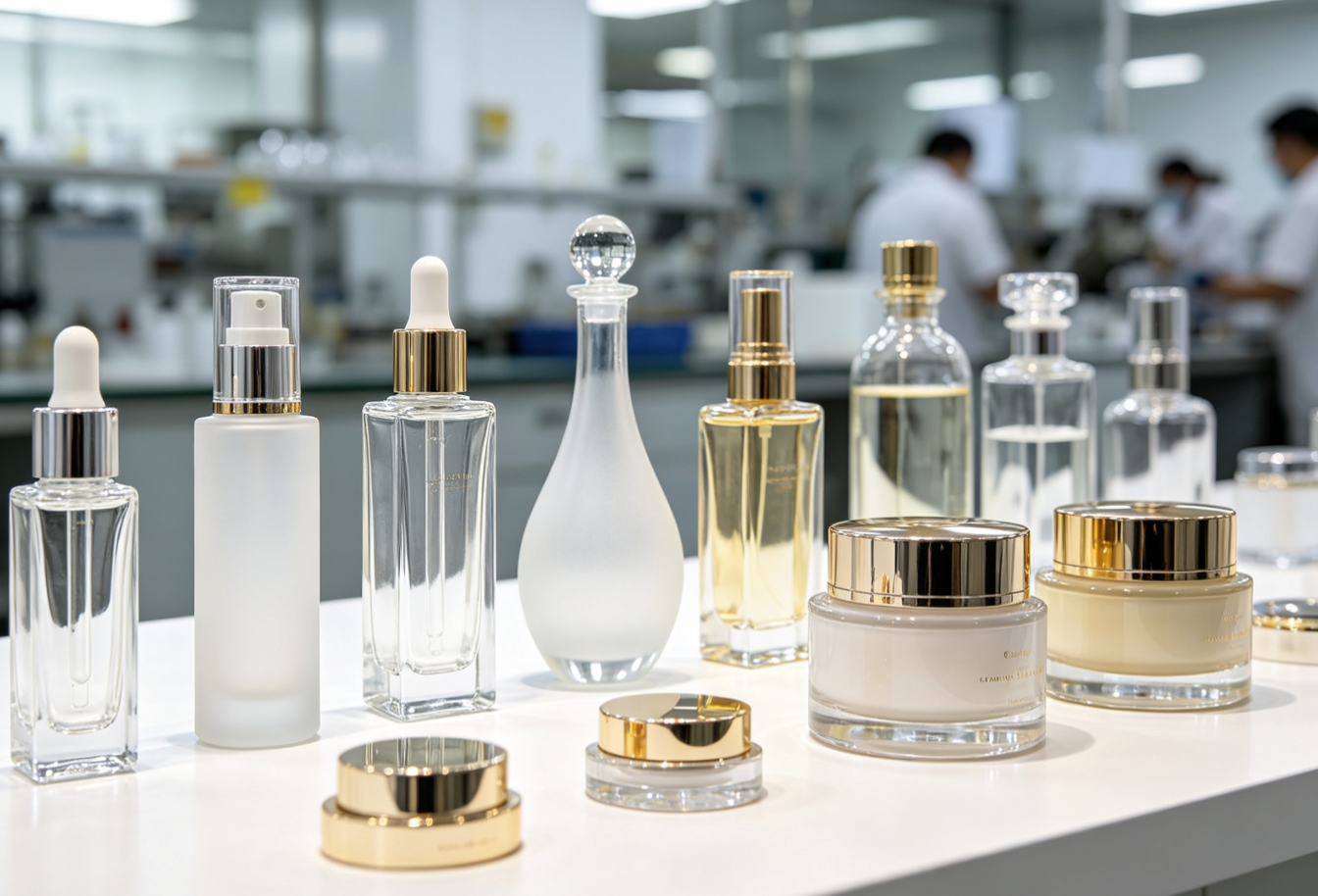
Luxury beauty brands use packaging to signal formula quality, pricing tier, and design coherence before the customer ever opens the product. A heavy-walled perfume bottle, a clean serum vial, or a sculpted cream jar immediately communicates category position. In fragrance, the bottle often becomes the product in the customer’s mind. In skincare, the bottle and closure system influence both user trust and dosing behavior. For this reason, custom glass bottles are usually specified together with surface finish, closure style, and decoration method.
From a sourcing perspective, the smartest buyers start with use case, not decoration. A mist spray bottle for facial toner has different constraints than a thick-base perfume bottle or an airless serum container. The first question is always whether the packaging matches the formula, the filling process, and the distribution channel. The second question is whether the packaging can be manufactured repeatably at scale without visible variation. The third question is whether the full set looks like one brand family across SKUs.
For a premium line, that family effect matters more than one isolated hero SKU. A fragrance launch may include a standard spray bottle, a flocking-finish edition, and a gift set with a metal cap. A skincare launch may require a bottle set across 30 ml, 50 ml, and 100 ml sizes. In that context, skincare set packaging and custom perfume bottles help brands maintain visual continuity across a product ladder.
How a China Glass Bottle Manufacturer Supports Premium Brand Development
A strong China glass bottle manufacturer reduces complexity by handling packaging as a system.
International buyers usually need more than a bottle source. They need a partner that can align bottle design, neck finish, pump compatibility, cap geometry, printing, coating, and carton presentation. When those elements are sourced separately, tolerances stack up and the final product can look inconsistent or fail at filling. A manufacturer with broad packaging capability helps avoid that risk by engineering the bottle around the closure and the production line from the start.
Ningbo-based suppliers are especially attractive for export-oriented buyers because of logistics access. Ningbo Port is one of the world’s busiest container ports, and the Port of Los Angeles handled 8,635,526 TEUs in 2023, according to the official port statistics at Port of Los Angeles Container Statistics. That matters for beauty brands because packaging often ships in high-volume, mixed-SKU cartons, and port efficiency directly affects replenishment timing. For U.S.-bound or Europe-bound orders, a supplier with strong export coordination can simplify lead times and minimize split shipments.
Another advantage of integrated packaging sourcing is compatibility management. A lotion pump, mist sprayer, and dropper all require different neck finishes and sealing assumptions. If the supplier understands the full package stack, they can recommend the correct bottle mouth, gasket material, and overcap structure before sampling begins. That saves time and reduces the risk of retooling.
| Buying Priority | Why It Matters | Typical Risk If Ignored |
|---|---|---|
| Neck finish compatibility | Ensures pump and cap fit | Leakage or loose assembly |
| Decoration stability | Protects luxury appearance | Logo wear or color inconsistency |
| Volume accuracy | Supports filling and labeling | Overfill, underfill, compliance issues |
| Transit resistance | Prevents breakage in export shipping | Cracking, chipping, high claims rate |
What to Check Before Ordering Custom Glass Bottles
Custom glass bottles should be reviewed as a technical specification, not as a mood board.
The most common procurement mistake is approving a beautiful sample before checking whether it will actually work on the filling line. Buyers should confirm capacity, bottle height, shoulder shape, neck size, glass weight, and closure interface. For luxury cosmetic packaging, small differences in glass thickness or neck tolerance can affect pump sealing, label placement, and carton fit. That is especially important for premium skincare and fragrance products where shelf consistency is visible across dozens or hundreds of units.
Material choice matters too. Most beauty packaging uses soda-lime glass because it balances clarity, cost, and manufacturing efficiency. For special projects, tinted glass can help with light protection and brand differentiation. If the formula is sensitive to oxidation or UV exposure, the packaging brief should include barrier requirements and storage expectations. A clear bottle may be visually appealing, but it may not be the best choice for all actives.
Buyers should also define the decoration method early. Screen printing, hot stamping, spraying, frosting, metallization, and flocking each create a different tactile and visual effect. The best option depends on the brand position, minimum order quantity, and abrasion risk. For example, a velvet or flocked perfume bottle may create strong shelf impact, but it requires careful handling and packaging during transit.
| Specification | Common Premium Range | Commercial Impact |
|---|---|---|
| Perfume bottle capacity | 30 ml, 50 ml, 100 ml | Supports retail and gift formats |
| Airless packaging size | 15 ml, 30 ml, 50 ml | Protects oxygen-sensitive formulas |
| Glass finish | Clear, frosted, colored | Changes visual depth and UV behavior |
| Closure types | Spray pump, dropper, screw cap | Determines dosing and fit |
For brands evaluating packaging families, spray bottles, dropper bottles, and cream jars are useful reference categories because they show how the same design language can be extended across multiple formats.
Quality Standards and Test Methods Buyers Should Ask For
Quality control is the difference between a luxury package and a costly recall.
Professional buyers should ask manufacturers to document testing instead of relying on visual approval alone. Common checks include dimensional inspection, closure torque, leakage testing, thermal shock resistance, and transport simulation. When a supplier can explain these tests clearly, it is usually a sign that they understand both manufacturing and export packaging risk.
One useful reference for packaging performance is ASTM D4169, which is the standard practice for performance testing of shipping containers and systems; the full standard listing is available at ASTM D4169. This matters for luxury beauty brands because breakage often happens not during production, but during shipment and last-mile handling. A supplier that applies realistic distribution testing can reduce claims and preserve retail appearance.
For material safety, many brands also want alignment with the U.S. Food and Drug Administration’s cosmetic labeling and ingredient framework, especially for exported products. The FDA’s cosmetics overview is published at FDA Cosmetics. While packaging suppliers do not control the formula, they influence labeling space, applicator behavior, and whether the final pack supports compliant presentation.
- Ask for dimensional drawings with neck finish details and tolerance notes.
- Request closure-fit samples before approving decoration.
- Confirm whether the bottle can survive transport and pallet vibration.
- Check print adhesion and coating resistance after handling tests.
- Verify carton counts, insert protection, and breakage rate expectations.
In high-value packaging, even a small defect rate becomes expensive when multiplied across large orders. That is why luxury cosmetic packaging buyers should require pre-production samples, first-article confirmation, and a written QC checklist before mass manufacturing begins.
 Luxury Cosmetic Packaging Trends That Influence Sourcing Decisions
Luxury cosmetic packaging is moving toward systems, not standalone components.
Brands increasingly want packaging that works as a product architecture: refillable bottles, coordinated sets, and texture-driven finishes that create an instantly recognizable range. This is one reason set packaging, multi-piece skincare collections, and premium fragrance families are growing in importance. A strong packaging supplier can help a brand move from one hero SKU to a full launch system without redesigning every part from scratch.
Sustainability is also becoming a serious buying criterion. Recyclable glass remains attractive because it supports premium positioning and circularity messaging. At the same time, brands are asking for reduced overpackaging, lighter carton structures, and materials that support easier post-consumer sorting. A supplier that understands these tradeoffs can suggest practical alternatives without sacrificing shelf appeal.
Another trend is tactile differentiation. Surface treatments such as matte spraying, soft-touch coating, metallic caps, and flocking can make a bottle feel more expensive without changing the base geometry. However, every finish should be evaluated against durability, cost, and production yield. An elegant package that scratches easily is not a good luxury package.
| Trend | Buyer Goal | Packaging Response |
|---|---|---|
| Refillability | Reduce waste | Reusable glass bottle with replaceable component |
| Brand systems | Consistent shelf identity | Shared shape language across SKUs |
| Tactile luxury | Higher perceived value | Frosting, flocking, metallic closures |
| Export efficiency | Lower logistics friction | Optimized carton and pallet design |
How to Evaluate a China Glass Bottle Manufacturer for Luxury Beauty Projects
The best supplier is the one that can turn a concept into a stable production plan.
When evaluating a China glass bottle manufacturer, buyers should look for development speed, sampling discipline, packaging integration, and communication clarity. A good supplier should be able to explain which parts are standard, which are customizable, and which require tooling. They should also be able to tell you where risk sits in the project: decoration complexity, closure sourcing, or shipping protection.
It helps to compare suppliers on a structured scorecard. For example, one supplier may offer beautiful samples but weak logistics support. Another may deliver fast but have limited finish options. A luxury project usually needs both design flexibility and dependable execution. This is where integrated packaging businesses are stronger than single-component sellers.
Buyers should also ask about sample timeline, tooling lead time, and MOQ by finish. Even if the exact numbers vary by project, a supplier who can define process stages clearly is easier to work with. If a bottle line includes perfume bottles, airless bottles, and jars, a unified supplier can also reduce color drift and finish mismatch across the launch.
- Confirm the product category and formula sensitivity.
- Define bottle capacity, closure type, and neck finish.
- Choose a decoration method that matches the brand tier.
- Approve samples after fit, finish, and transit checks.
- Lock QC criteria before mass production.
For buyers building a multi-category line, the ability to source perfume packaging, skincare sets, and essential oil bottles from one partner is a practical advantage because it keeps the brand story coherent across fragrance, skincare, and treatment products.
Common Mistakes Luxury Beauty Brands Make When Buying Custom Glass Bottles
The most expensive packaging mistakes usually happen before production starts.
One common mistake is choosing a bottle by image alone. A beautiful render does not reveal whether the pump fits, whether the cap closes tightly, or whether the package survives freight. Another mistake is treating bottle sourcing and outer-box sourcing as unrelated projects. In reality, they affect each other through dimensions, protection needs, and unboxing design.
Another frequent error is underestimating decoration risk. Very complex coatings, metallic effects, or tactile finishes can raise scrap rates if the supplier does not control process temperature, curing, or surface preparation carefully. For luxury beauty brands, scrap is not just a factory problem; it affects launch timing and stock availability.
Finally, some buyers forget the channel. A bottle that looks perfect in a boutique may be too fragile or too heavy for e-commerce. A bottle intended for retail display may need stronger carton protection than a wholesale refill format. Packaging decisions should always reflect where and how the product will be sold.
- Do not approve design before checking fit and fill-line compatibility.
- Do not separate bottle selection from closure selection.
- Do not ignore shipping protection for glass-based luxury packaging.
- Do not choose a finish that cannot survive handling and storage.
FAQ About Custom Glass Bottles and Luxury Cosmetic Packaging
What makes custom glass bottles better for luxury beauty brands?
Custom glass bottles offer stronger brand differentiation, better perceived value, and more control over shape, weight, and decoration than generic stock packaging.
How do I choose a China glass bottle manufacturer?
Choose a manufacturer that can handle bottle design, closures, decoration, QC, and export logistics as one integrated project.
Which packaging formats are most common in premium skincare?
Airless bottles, cream jars, dropper bottles, and coordinated skincare sets are among the most common formats because they support stability and a premium shelf presentation.
What should I check before approving a sample?
Check capacity, neck finish, pump fit, decoration durability, carton protection, and whether the package matches the intended filling line.
Are glass bottles suitable for all cosmetic formulas?
Glass is suitable for many formulas, but sensitive products may require tinted glass, airless systems, or additional barrier protection.
How important is testing for shipping safety?
Very important, because breakage often occurs during transit rather than during manufacturing, which is why standards such as ASTM D4169 are relevant.
Why do many brands buy bottles, pumps, and caps from the same supplier?
Because integrated sourcing reduces compatibility problems, shortens development cycles, and improves the consistency of the final luxury cosmetic package.
Post time: Aug-19-2026


