
- Custom glass packaging should be selected as a brand system, not a single bottle.
- Compatibility between formula, neck finish, pump, and closure is as important as aesthetics.
- Verified standards such as ISO 15378, NIST SI Units, and 21 CFR Part 211 help reduce risk in cosmetic packaging programs.
- Skincare brands should compare suppliers on sampling speed, decoration methods, MOQ flexibility, and export readiness.
- Series consistency matters because packaging often functions as a visual identity system across the entire product line.
For skincare brands evaluating custom glass packaging, the right skincare packaging manufacturer should solve more than a container problem: it should protect the formula, support brand storytelling, and reduce supply-chain risk. In packaging engineering, small details matter because glass is often specified in millimeters, not estimates; for example, dimensional control, closure fit, and line compatibility depend on measurable standards and traceable units defined by the International System of Units. If your line includes bottles, jars, pumps, and outer boxes, a supplier that coordinates multiple components can shorten launch time and lower mismatch risk. For brands building a full range, categories such as skincare packaging sets, airless bottles, and cream jars are often more useful than single-item sourcing.
What custom glass packaging means for skincare brands
Custom glass packaging means the packaging is designed around your formula, brand positioning, and filling line requirements, not selected only for appearance. That matters because skincare products vary widely in viscosity, oxygen sensitivity, light sensitivity, and dosing behavior. A serum may need an air-restricted system, while a cream may need a jar with a wide-mouth profile and a secure liner. The packaging decision should start with product chemistry and customer use, then move to aesthetics.
In practical terms, the best glass bottle supplier should help you choose capacity, neck finish, decoration, and closure type as a connected set. For example, a 30 mL serum bottle may work well with a dropper, a fine mist bottle may need a spray pump, and a rich cream may require a jar with a stable sealing surface. When you compare suppliers, ask whether they can provide a full packaging family such as glass bottles, lotion bottles, and pump components in a unified visual language.
| Skincare product type | Common package format | Typical capacity range | Main risk if poorly matched |
|---|---|---|---|
| Serum | Dropper bottle or airless bottle | 15-50 mL | Oxidation, dosing inconsistency |
| Cream | Cream jar | 30-100 g | Contamination, poor user experience |
| Mist or toner | Spray bottle | 50-200 mL | Leakage, spray failure |
| Oil treatment | Oil bottle with dropper | 10-30 mL | Over-dispensing, product waste |
How to evaluate a skincare packaging manufacturer by formula compatibility
Formula compatibility is the first technical filter because packaging that looks premium can still fail in contact with the product. Skincare formulas may contain acids, essential oils, solvents, UV-sensitive actives, or high-viscosity emulsions, and each chemistry profile creates different packaging demands. Glass is often chosen because it offers excellent barrier performance and chemical resistance, but the closure system, lining material, and decoration still need to be checked.
When reviewing a skincare packaging manufacturer, ask for compatibility information on the following points: glass composition, surface treatment, cap liner material, pump spring contact, and whether the decoration layer resists the product’s pH or oil phase. For formulations that need oxygen protection, airless packaging can improve product stability by limiting repeated air exposure after dispensing. For fragrant or specialty oils, essential oil bottles with matched droppers often provide better dose control than generic closures.
Industry documentation also shows why this matters. ISO 15378 applies GMP principles to primary packaging materials for medicinal products, and while skincare is not pharmaceutical, the standard is a useful reference point for documentation discipline, traceability, and contamination control in high-requirement packaging programs. In other words, a supplier that can speak in specifications, not only style terms, is usually safer for scale-up.
| Compatibility check | Why it matters | What to request from supplier |
|---|---|---|
| pH resistance | Prevents surface damage and label issues | Material and coating data |
| Oil resistance | Reduces seal failure and swelling | Closure and liner test result |
| Light sensitivity | Protects active ingredients | Amber, coated, or secondary pack options |
| Oxygen exposure | Improves shelf life for sensitive formulas | Airless or low-headspace options |
What to ask a glass bottle supplier before you request samples
The fastest way to separate a strong supplier from a weak one is to ask about the details that affect production, not just the catalog name. Before sampling, request the exact capacity, neck finish, tolerance range, decoration method, and minimum order quantity. If you are planning a launch, the supplier’s ability to explain these items clearly is often a better signal than a polished product photo.
In modern packaging sourcing, the most common mistakes happen when brands only compare outer appearance. A bottle with elegant curves may still be hard to fill, unstable in transit, or incompatible with your pump. For that reason, ask whether the supplier can provide a complete system such as cosmetic pumps, cosmetic caps, and cosmetic bottles with the same decoration language.
Real-world procurement teams often use a short technical checklist to prevent rework.
- Confirm bottle volume in mL or g, not only in marketing names.
- Verify neck finish compatibility with the exact pump or cap model.
- Ask for decoration samples under natural light and retail lighting.
- Check whether the supplier can support revisions after first sampling.
- Confirm packaging for shipping, especially if the route includes export transits.
| Supplier question | Good answer includes | Red flag |
|---|---|---|
| What is the neck finish? | Exact finish code and closure match | “Standard fit” only |
| What is the MOQ? | Clear minimum by item and decoration type | MOQ unclear or changed later |
| Can you support OEM/ODM? | Sample, mold, finish, and packaging coordination | Only catalog items |
| How is breakage controlled? | Carton, divider, and pallet method explained | No transit plan |
 How decoration and material choices influence premium skincare packaging
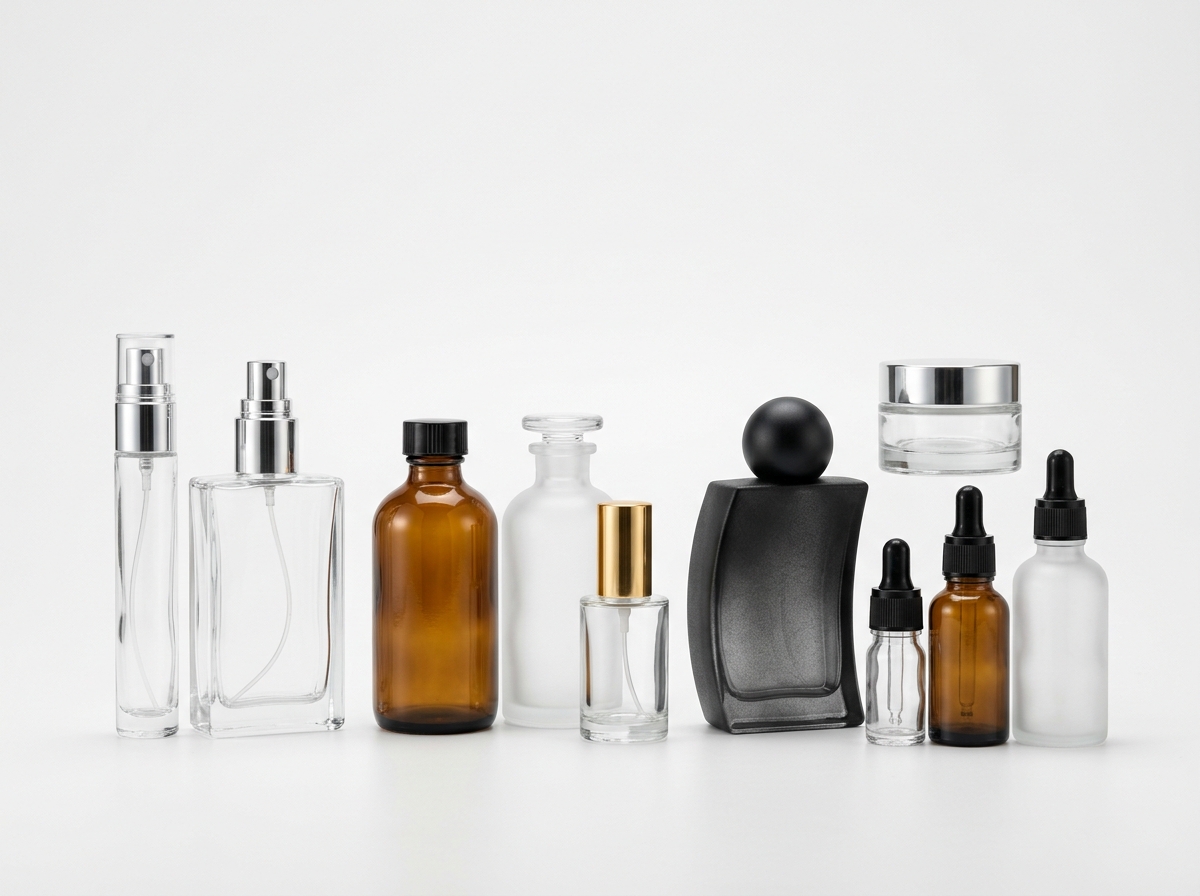
Decoration is not cosmetic fluff; it directly affects brand positioning, shelf impact, and perceived value. In skincare, the difference between a standard bottle and a premium one is often created through surface treatment, color control, metallization, frosting, silk-screen printing, or tactile finishes. A well-chosen decoration method can make the same base bottle feel dramatically more luxurious without changing the functional structure.
For brands selling in a premium or giftable segment, the packaging system may include flocking, metallic caps, or textured coatings. This is where a broader supplier portfolio matters because a single bottle is usually not enough. If your product line includes fragrance-adjacent or sensory-focused items, a coordinated look across perfume bottles, perfume caps, and oil bottles can support a stronger brand architecture.
From a technical perspective, decoration also changes operational risk. High-opacity coatings can hide defects but may make inspection harder; frosting improves visual softness but can be vulnerable to abrasion; metallic decoration can raise perceived value but requires tighter handling in packing and transport. That is why a supplier should show decoration samples, not only digital renders.
| Decoration method | Typical brand effect | Operational consideration | Best use case |
|---|---|---|---|
| Frosting | Soft, premium, clean | Scratch sensitivity | Serums and creams |
| Silk-screen printing | Clear branding | Color matching needed | Logo-heavy skincare lines |
| Metallic finish | High-end appearance | Higher handling care | Luxury gift sets |
| Tactile coating | Distinctive sensory feel | Testing needed for wear | Limited editions |
Quality control benchmarks that matter in glass packaging
Quality control is where packaging promises become shipment-ready reality. Even if the bottle design is attractive, a brand should still ask how the supplier checks dimensional accuracy, cosmetic defects, leakage, and transit durability. In cosmetics, packaging failures rarely appear immediately; they show up later as pump jams, leaks, broken closures, or inconsistent consumer perception.
For reference, packaging and manufacturing programs often align with documented quality systems rather than informal checks. The U.S. FDA’s cosmetic manufacturing guidance and current good manufacturing practice resources at FDA Cosmetics Good Manufacturing Practices are useful starting points for understanding hygiene, process control, and recordkeeping. If your packaging supplier cannot describe incoming inspection, in-process checks, and final packing controls, that is a risk signal.
Ask for testing against common failure modes: drop impact, leakage under pressure, closure torque retention, pump actuation stability, and label adhesion under storage conditions. A strong supplier should be able to explain the test method, the pass/fail criteria, and what happens when a defect is found. For export brands, consistency matters as much as design because one late defect can affect an entire retail rollout.
Typical quality checkpoints include the following.
- Visual inspection for bubbles, scratches, and contamination.
- Dimensional verification for height, neck finish, and wall thickness.
- Closure fit and torque testing for caps and pumps.
- Leak testing after assembly and after transport simulation.
- Final carton inspection and pallet stability review.
How to compare suppliers for MOQ, lead time, and launch flexibility
The right supplier is the one that matches your launch plan, not only your sample expectation. For skincare brands, MOQ and lead time often determine whether a design can actually enter the market on schedule. A beautifully engineered bottle is not helpful if the supplier cannot accommodate first-run quantities, sample revisions, or seasonal replenishment.
Many founders underestimate how much launch risk is tied to packaging logistics. A supplier with export experience, strong packing practices, and organized documentation can be especially valuable for overseas brands. If you are planning a multi-SKU line, look for a partner that can manage a family approach through skincare packaging, lotion bottles, and cosmetic jars so your product family launches with one consistent visual identity.
| Comparison factor | Starter brand | Scaling brand | Why it matters |
|---|---|---|---|
| MOQ flexibility | Lower, mixed-SKU friendly | Higher, stable reorders | Matches launch stage |
| Sampling cycle | Fast revisions | Controlled approvals | Reduces rework cost |
| Lead time | Short and predictable | Capacity-secure | Supports launch windows |
| Packaging scope | Single SKU or small set | Full system package | Improves brand consistency |
Why export capability matters for global skincare brands
Export readiness is a real procurement advantage because skincare packaging is often sold across markets, not just within one country. A supplier located near major logistics channels can better support container consolidation, faster dispatch, and more efficient communication with international customers. For brands selling into North America, Europe, the Middle East, or Southeast Asia, documentation, packing consistency, and communication speed matter as much as the packaging itself.
Brands should also consider material and sustainability narratives. Glass is recyclable, and many cosmetic brands now want packaging stories that support reduced plastic use or easier recycling behavior. If your product strategy includes refill systems or premium sets, it can help to choose a supplier that offers a consistent family of cosmetic bottles, caps, and secondary packaging that aligns with sustainability claims.
From an operations standpoint, export-ready suppliers should understand carton strength, pallet stacking, breakage reduction, and customs documentation basics. That is not glamorous, but it often decides whether a brand receives acceptable landed goods or costly rework. For international skincare brands, supplier stability is part of product quality.
A practical selection framework for skincare founders and procurement teams
The most reliable way to choose a custom glass packaging manufacturer is to score suppliers on product fit, not just price. A simple scoring model helps founders avoid overpaying for visual appeal or underbuying on quality control. Use a weighted review that includes technical compatibility, decoration quality, sampling responsiveness, production stability, and export support.
A useful selection method is to rank each supplier across five areas and compare total risk, not just unit cost. This works especially well when your lineup spans several formats like jars, droppers, sprays, and airless containers. For brands with multiple launch SKUs, a supplier that can unify the look of cream jars, airless bottles, and glass bottles will usually simplify brand management.
- Define the product chemistry and packaging function first.
- Shortlist suppliers that can match the exact format and closure.
- Request samples with decoration and assembly, not bare components only.
- Test for leakage, dispensing feel, and visual consistency.
- Compare landed cost, not only factory price.
In summary, the best supplier is the one that reduces launch risk while improving shelf impact. For skincare brands, that means choosing a partner who can coordinate formula compatibility, packaging engineering, decorative quality, and export logistics in one workflow.
Frequently asked questions about custom glass packaging for skincare brands
What should a skincare brand ask first when choosing a packaging supplier?
Start with formula compatibility, neck finish, MOQ, sampling speed, and whether the supplier can provide a complete bottle-cap-pump system.
Is glass always better than plastic for skincare packaging?
No. Glass is often preferred for premium positioning and barrier performance, but some formulas and channels work better with plastic or airless systems.
What is the biggest mistake brands make when buying custom glass packaging?
The most common mistake is choosing based on appearance alone and ignoring closure fit, transit protection, and filling-line compatibility.
How do I know if a bottle is suitable for a serum or oil?
Check the dosing method, seal quality, and whether the package supports controlled dispensing without excessive air exposure.
Why are airless bottles useful for skincare?
They help limit repeated air exposure after opening, which is valuable for oxygen-sensitive formulas and premium product positioning.
What documentation should I request from a packaging manufacturer?
Ask for product specifications, material information, decoration process details, packing method, and quality inspection criteria.
How can a brand reduce breakage during shipping?
Use proper carton design, dividers, palletization, and route-tested packaging methods, especially for export shipments.
Post time: Aug-14-2026


