
- Luxury cosmetic packaging should be selected as a complete brand system, not as isolated parts.
- Glass cosmetic containers are ideal for premium positioning, but formula compatibility and breakage control matter.
- Beauty startup packaging must balance design, MOQ, lead time, and decoration repeatability.
- Airless bottles, jars, and matched closures help protect high-value skincare formulas.
- Compliance, transit testing, and fill-line compatibility should be checked before artwork approval.
Luxury cosmetic packaging for beauty startup products works best when it combines premium materials, coherent design, and production-ready engineering. In packaging qualification, dimensional consistency matters because container, pump, and cap tolerances influence line efficiency and leakage risk; for example, ISO 1101 defines geometric tolerancing principles used in precision manufacturing, while packaging transport should be validated using methods such as ASTM D4169 for distribution testing. For startups, the goal is simple: create packaging that looks high-end, performs reliably, and can be repeated across the full launch series, from glass cosmetic containers to jars, pumps, and outer cartons.
Why luxury cosmetic packaging matters for beauty startup packaging strategy
The packaging decision often determines whether a startup looks like a niche maker or a serious brand. Luxury cosmetic packaging is a visual shorthand for quality, but it also shapes how buyers judge formula protection, hygiene, and price justification.
In beauty startup packaging, the first job is to reduce buyer uncertainty. Premium packaging tells customers the product was designed with care, while practical engineering tells retailers and fulfillment teams it can survive handling, shipping, and shelf display.
That is why many founders start with a series-based concept rather than a single SKU. A coordinated set of bottles, jars, pumps, and caps creates brand recognition faster than one-off container choices.
| Packaging choice | Typical premium use | Business impact | Key risk |
|---|---|---|---|
| Glass cosmetic containers | Serums, creams, fragrance, oils | High perceived value | Breakage in transit |
| Airless bottles | Preservative-sensitive skincare | Formula protection and dosing control | Higher component complexity |
| Jars with inner lids | Creams, balms, masks | Easy product access | Contamination risk |
| Pump bottles | Lotions, cleansers, mists | Better hygiene and convenience | Compatibility with viscosity |
From a sourcing perspective, startup teams should think in terms of system fit. A beautiful bottle that cannot accept a stable pump or a consistent cap torque creates costly launch delays. A luxury look only works if the packaging can be filled, sealed, and transported repeatedly.
How to choose glass cosmetic containers for premium skincare and fragrance
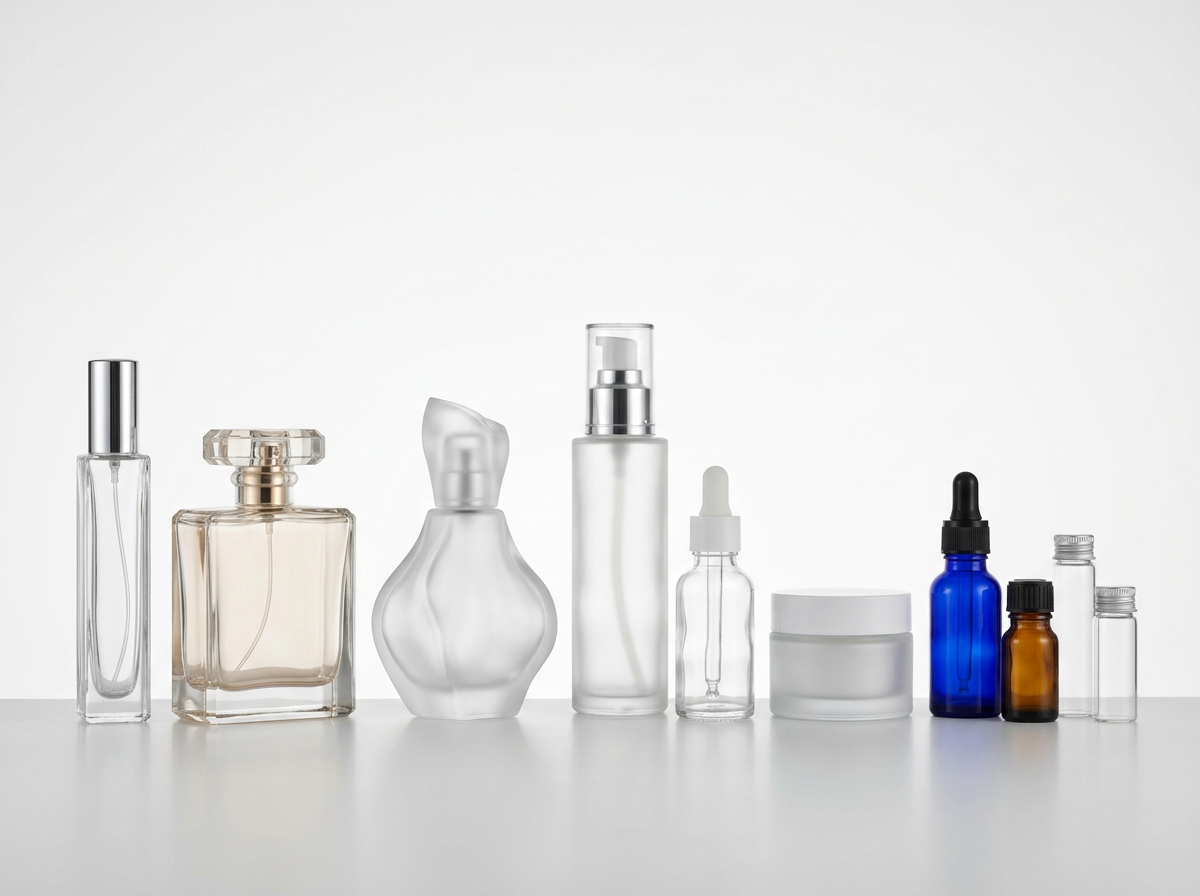
Glass cosmetic containers are the most common route to a premium finish because glass communicates weight, clarity, and product purity. For beauty startups, glass also supports a broad range of decoration methods, including frosting, spraying, silkscreen printing, hot stamping, and metalized accents.
The most important selection criteria are not just aesthetics. Volume accuracy, neck finish, wall thickness, and closure compatibility affect whether the packaging can survive production and shipping without cosmetic defects or leakage.
In practice, the best container choice depends on formula category. Lightweight serums often use smaller bottles, while fragrance and facial oils can justify thicker glass for both stability and visual impact.
| Container type | Common volume | Best for | Premium cue |
|---|---|---|---|
| Dropper bottle | 10 ml to 50 ml | Oils, ampoules, actives | Precision dosing |
| Airless bottle | 15 ml to 50 ml | Retinoids, peptides, sensitive creams | Low-oxygen presentation |
| Fragrance bottle | 30 ml to 100 ml | Perfume and body mist | High visual impact |
| Cream jar | 30 g to 100 g | Face cream, mask, balm | Strong shelf presence |
One useful technical reference point is transport resistance. The International Organization for Standardization publishes packaging test methods such as ISO 4180 for complete, filled transport packages. For a startup, this matters because premium glass packaging should not only look refined on a table; it must also arrive intact after cartonization, palletizing, and overseas freight.
When the formula is sensitive to oxygen or fingertip contamination, airless packaging becomes especially attractive. When the brand story relies on transparency and material honesty, clear glass or lightly frosted glass may be the stronger choice. The decision should always be tied to product behavior, not trend alone.
Beauty startup packaging design: what makes a launch feel high-end
Beauty startup packaging feels luxurious when it is consistent across the whole collection. The strongest premium brands usually repeat the same visual language across bottle shape, cap finish, label spacing, and carton graphics.
In other words, luxury is not created by one expensive element. It comes from alignment. A matte pump, a glossy cap, and a soft-touch carton can work together if the details are controlled at the same visual level.
For new brands, the most common mistake is mixing too many decoration effects. Too many finishes can make the product look crowded rather than premium, especially on small-format skincare.
- Choose one dominant material story, such as clear glass, frosted glass, or opaque coated glass.
- Limit the palette to one accent metal and one core brand color.
- Keep typography readable at retail distance and on mobile screens.
- Match closure finish to the container surface, not just the logo.
- Test the unboxing sequence so the premium feel continues after delivery.
Luxury cosmetic packaging also benefits from tactile consistency. A bottle with a heavy base, a smooth closure, and controlled decoration often reads as more expensive than a visually busy design with weak fit and finish.
For digital-first brands, the unboxing moment is part of the product experience. That makes secondary packaging important, especially if the customer will first encounter the item through e-commerce rather than in a physical store.
Airless bottles, pumps, and caps: the performance layer behind premium beauty packaging
The performance layer is where many startup packaging projects succeed or fail. A luxury image means little if the pump clogs, the cap loosens, or the bottle cannot keep the formula stable during shelf life.
Airless systems are often preferred for high-value skincare because they reduce product exposure to air and can improve dispensing consistency. This is especially useful for formulas containing active ingredients that are sensitive to oxidation.
For lotion, cleanser, mist, and toner lines, the pump architecture should be matched to viscosity and dosage expectations. A fine mist sprayer, for example, is not interchangeable with a lotion pump even if the bottle looks similar.
| Closure or pump | Typical application | Operational benefit | Selection note |
|---|---|---|---|
| Airless pump | Serum, cream, gel | Reduced air exposure | Check fill compatibility |
| Fine mist sprayer | Facial mist, toner, body mist | Uniform spray pattern | Match viscosity and nozzle type |
| Treatment pump | Lotion, cleanser | Controlled dosing | Verify stroke force and output |
| Dropper | Oil, active serum | Precise use | Assess drop consistency |
Engineering matters because packaging failures usually appear at the interface between parts. Closure thread form, liner material, and neck finish must work as a set. A decorative cap that does not align with the pump is a brand risk, not a styling detail.
For technical due diligence, startup teams can use packaging qualification methods associated with industrial shipping and vibration testing, including ASTM D4728 for random vibration testing of shipping containers. That kind of testing is especially valuable for export brands using glass cosmetic containers.
How to build a startup-ready luxury packaging system around one product line
A startup packaging system should be built around a launch story, not around a single component purchase. The most efficient brands define one core format and then extend it into related SKUs.
This approach reduces tooling complexity, makes visual merchandising easier, and helps the buyer understand the range faster. For example, a serum bottle can become the anchor for a cream jar, eye cream, and travel-size treatment bottle.
Series thinking is especially relevant for beauty startup packaging because it lowers design fragmentation. A unified collection often feels more established than a mixed set of unrelated containers.
- Anchor format: one hero bottle or jar.
- Support formats: refill, travel, and retail versions.
- Decoration rules: consistent cap finish and logo placement.
- Channel rules: one pack for DTC, one for wholesale, one for sampling.
For brand owners, the practical question is how far to standardize. The answer is usually as far as the formula allows. Standardization improves sourcing stability, but the consumer still needs a clear reason to perceive the line as elevated.
A useful reference from the materials side is that packaging substrates are often chosen for barrier, recyclability, and stiffness, not just appearance. The U.S. Environmental Protection Agency explains recycling and material recovery guidance on its recycling resources, which is useful when startups want to support sustainability claims without overpromising.
Sustainability and material choice in luxury cosmetic packaging
Sustainability is now part of luxury positioning, not a separate message. Beauty buyers increasingly expect premium packaging to consider recyclability, material reduction, and shipping efficiency.
That does not mean every luxury pack should be minimal. It means the premium story should be backed by a material choice that can be explained clearly and honestly.
For many brands, this means using recyclable glass cosmetic containers, reducing unnecessary inserts, and selecting PCR-compatible plastics where performance allows. High-quality packaging can still feel luxurious while using less material waste.
| Material | Luxury perception | Recyclability note | Best use case |
|---|---|---|---|
| Glass | Very high | Widely recyclable | Serum, fragrance, cream jar |
| PET | Medium to high | Commonly recyclable | Refill bottles, body care |
| PP | Medium | Recyclable in some systems | Caps, inner components |
| Aluminum | High | Highly recyclable | Caps, secondary parts |
On the environmental side, startups should be careful with claims. Recyclable does not always mean recycled in practice, because collection and sorting systems vary by market. A credible sustainability message is specific, measurable, and geographically realistic.
If you want a technical benchmark for packaging design discipline, the ISO framework for quality management and product conformity can help teams define repeatable checks. While not packaging-specific, ISO 9001:2015 is widely used to formalize process consistency, supplier control, and corrective action systems.
What beauty startups should ask suppliers before ordering luxury packaging
The right supplier questions often prevent the most expensive mistakes. A startup should not only ask what a package looks like; it should ask how the package performs in real production.
The supplier conversation should cover product fit, fill-line behavior, decoration method, inspection criteria, and lead-time stability. Those topics matter more than a simple catalog photo.
For cross-border brands, communication speed is also part of quality. Sample approval delays can move a launch by weeks, especially when multiple components must be matched and tested together.
- What is the exact neck finish, and which pumps or caps are compatible?
- What are the decoration methods, and which surfaces hold ink or coating best?
- Can you provide filled-package transit testing or component test records?
- What is the minimum order quantity by color, finish, or decoration?
- How do you control batch-to-batch color consistency?
A supplier that sells only a bottle can still be useful, but a partner that understands bottle, pump, cap, and carton integration is often more valuable for a startup. The reason is simple: fewer handoffs means fewer compatibility problems.
For brands shipping internationally, it also helps to review product safety and transport expectations early, especially for glass cosmetic containers and liquid-filled sets. This reduces claim risk and improves warehouse readiness.
Luxury cosmetic packaging launch checklist for beauty startup products
A launch checklist keeps design decisions tied to execution. It is the fastest way to identify gaps before tooling or mass production starts.
Start with formula, then move to packaging, then move to channel. If the sequence is reversed, teams often end up redesigning components after artwork is already approved.
- Confirm formula compatibility with glass, plastic, or coated surfaces.
- Match bottle volume to fill volume and headspace needs.
- Verify closure fit, torque, and leakage risk.
- Approve decoration samples under daylight and retail lighting.
- Test ship-ready cartons and inner protection for breakage.
- Align carton dimensions with warehouse and e-commerce constraints.
In premium skincare and fragrance, even small process misses are visible. A slightly crooked label or an inconsistent spray can weaken the impression of quality more than many founders expect.
That is why luxury cosmetic packaging should be treated as a product system. A strong system protects the formula, supports the brand, and reduces operational friction after launch.
FAQ: Luxury cosmetic packaging for beauty startup products
What is the best packaging for a premium beauty startup?
The best packaging is the one that fits the formula, supports the brand story, and can be produced consistently. For many premium startups, that means glass cosmetic containers combined with matched closures, pumps, and secondary packaging.
Are glass cosmetic containers always better than plastic?
No. Glass is usually stronger for luxury perception, but plastic can be better for weight, shipping cost, and certain refill or travel formats. The right choice depends on formula sensitivity, channel, and budget.
What makes packaging look luxurious?
Luxury usually comes from consistency: material choice, finish control, proportion, and decoration restraint. A clean bottle with accurate fit and a coherent series often looks more premium than a busy one.
Should a startup use airless bottles?
Airless bottles are a strong option for sensitive skincare, especially when oxidation control and hygienic dispensing are important. They are less suitable if the formula or fill method does not match the pump system.
How many packaging options should a startup launch with?
Most startups should begin with a focused range, often one hero SKU and a small set of supporting formats. A compact launch is easier to test, easier to source, and easier to explain to buyers.
What tests are most important before mass production?
Leakage, drop, vibration, compatibility, and closure fit are the most common high-value tests. Packaging transport validation methods such as ASTM D4169 are useful when products will ship in bulk or across borders.
How do I choose a supplier for beauty startup packaging?
Choose a supplier that can support the full packaging stack: bottle, pump, cap, decoration, and outer pack. The best suppliers reduce coordination risk by making all parts work together before production begins.
Post time: Aug-06-2026


