
- Premium beauty packaging combines appearance, dispensing performance, material selection, and product protection.
- Perfume, skincare, essential-oil, and airless formats require different compatibility and closure decisions.
- Series-level design improves shelf consistency and helps a brand launch multiple products with one visual language.
- Sampling should confirm dimensions, decoration, closure fit, filling performance, and shipping protection before mass production.
- Regulatory responsibility covers both the cosmetic formula and the packaging information presented to the market.
Luxury cosmetic packaging is most effective when it turns a product range into a coherent brand experience while protecting the formula through filling, storage, and distribution. The European Union Cosmetics Regulation is formally identified as Regulation (EC) No 1223/2009, so packaging development should be coordinated with the brand’s wider safety, labeling, and market-compliance process.
What Defines Luxury Cosmetic Packaging?
Luxury packaging is defined by the relationship between visual identity, tactile quality, dispensing behavior, and operational reliability.
A premium bottle is not automatically a premium package. A heavy-looking glass design may fail if the pump leaks, the actuator feels inconsistent, the cap loosens during transit, or the decoration does not align across a collection. High-end packaging therefore has to perform in several environments: on the shelf, in the customer’s hand, on the filling line, inside export cartons, and during repeated use.
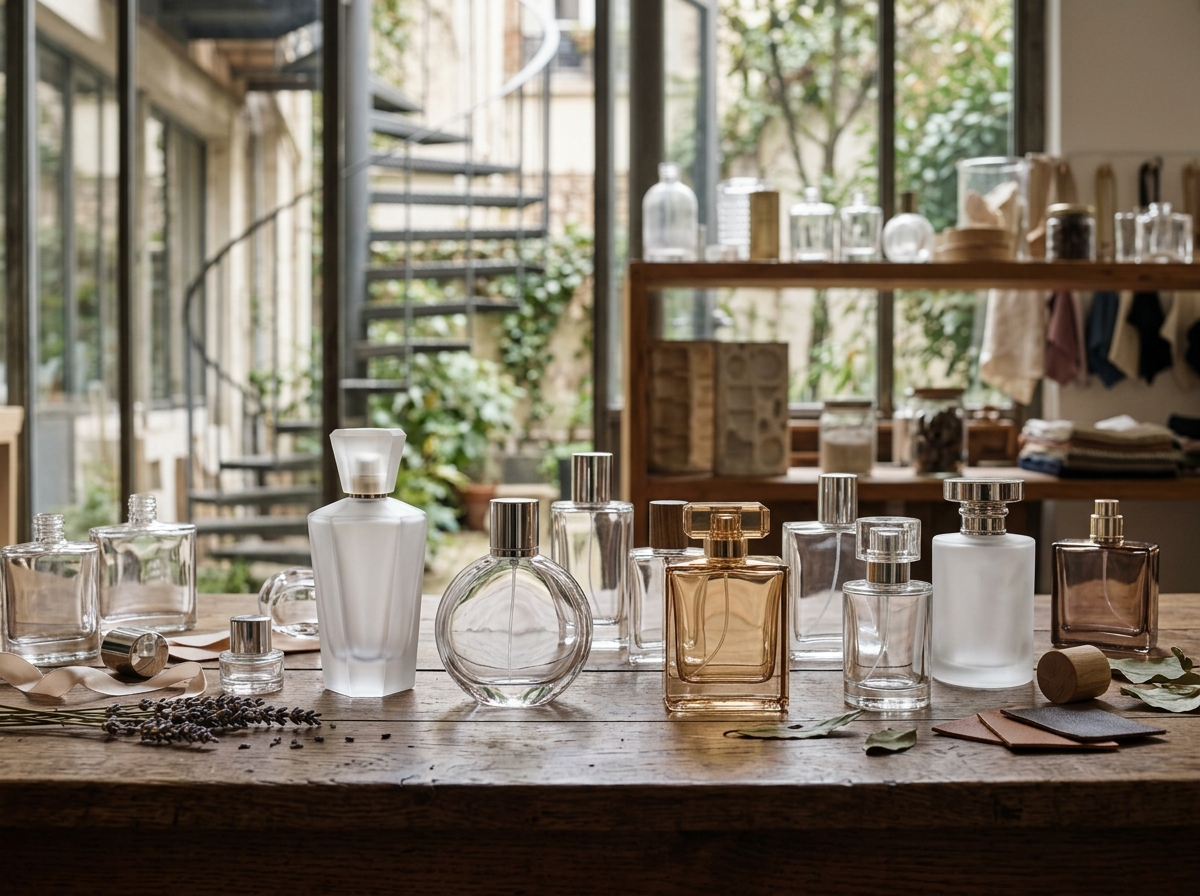
The strongest collections usually coordinate four visible elements: the primary container, the closure, the dispensing component, and the outer presentation. For example, a perfume bottle may combine clear or colored glass with a customized silhouette, a metal or zinc-alloy cap, and a fine-mist sprayer. A skincare range may use matching glass bottles and cream jars with consistent shoulders, closures, colors, and surface finishes.
Luxury Packaging Evaluation Matrix
| Decision area | Premium requirement | Commercial risk if overlooked | Reference or control number |
|---|---|---|---|
| Visual identity | Consistent silhouette, finish, color, and component proportion | Collection appears assembled from unrelated stock items | Brand design brief |
| Dispensing | Suitable pump, sprayer, dropper, or jar opening for the formula | Wrong dose, leakage, poor user experience | Formula and filling-line test plan |
| Market compliance | Packaging information coordinated with the product compliance file | Labeling or market-entry delays | Regulation (EC) No 1223/2009 |
| United States labeling | Packaging claims and declarations reviewed for the intended market | Incorrect or incomplete cosmetic labeling | 21 CFR Parts 701 and 740 |
Brands should treat the package as part of the product-development brief, not as a late-stage decoration decision. The European Union Cosmetics Regulation provides the central legal framework for cosmetic products placed on the EU market, while the United States Food and Drug Administration cosmetics guidance explains the applicable laws and regulations for cosmetics in the United States.
Choosing Premium Beauty Packaging by Product Type
The formula, application method, and brand positioning should determine the packaging architecture before decoration is finalized.
Perfume Bottles
Perfume packaging depends heavily on silhouette, transparency, atomization quality, and cap security.
For a fragrance launch, buyers should review the glass profile, neck finish, sprayer compatibility, dip-tube length, actuator feel, and cap retention. A custom bottle can strengthen recognition, but a well-selected standard bottle with distinctive flocking, velvet treatment, metallic decoration, or a sculptural cap may offer a more practical path for a first collection.
Fragrance brands should also examine how the bottle photographs under studio lighting and how several sizes or scents will appear together. Transparency can communicate color and clarity, while opaque or frosted treatment can create a more private, tactile, or contemporary appearance.
Skincare Bottles and Collection Sets
Skincare packaging works best when multiple formats share a deliberate design system.
A complete range may include a serum bottle, lotion bottle, cream jar, cleanser container, and treatment dispenser. The visual system can be unified through matching glass, cap geometry, surface color, printing, and secondary packaging even when the dispensing mechanisms differ.
When evaluating a skincare set, confirm whether every component is suitable for the formula and filling process. Creams may require a wide-mouth jar or treatment pump, while fluid serums may perform better with a dropper, lotion pump, or airless dispenser. The appearance of the collection should never override the practical needs of the formula.
Brands seeking coordinated components can review skincare packaging collections as a starting point for comparing bottle, jar, and set formats.
Essential-Oil and Dropper Bottles
Small-format liquid products require careful control of closure fit, drop delivery, and material compatibility.
Essential oils, facial oils, concentrated treatments, and aromatherapy products are commonly evaluated through the bottle material, dropper bulb, pipette, insert, and sealing behavior. The important question is not simply whether a bottle looks elegant; it is whether the component delivers a predictable user experience without contaminating or weakening the formula.
For a high-value oil product, request samples filled with the intended formula whenever possible. Water-only testing may not reveal the same interaction between the formula and the elastomer, adhesive, coating, or decoration.
Airless Bottles
Airless packaging is selected when controlled dispensing and reduced product exposure are central to the product concept.
An airless system typically uses a pump mechanism and an internal moving component to dispense product without relying on the same type of open reservoir access found in a conventional jar. The actual suitability depends on viscosity, dosage, priming behavior, fill method, internal dimensions, and the formula’s interaction with the package.
Airless packaging is not a universal guarantee of formula stability. Brands should still conduct compatibility, leakage, actuation, evacuation, and aging tests under conditions relevant to the intended product and distribution route.
For brands comparing protected dispensing formats, the airless bottle range can support an initial shortlist, followed by application-specific sampling.
 Material and Decoration Choices for a High-End Collection
Material selection should balance perceived value, formula protection, manufacturing practicality, and end-of-life considerations.
| Format or material | Useful strength | Questions to confirm | Relevant reference |
|---|---|---|---|
| Glass bottle | Clarity, weight, premium appearance, strong presentation value | Glass color, wall consistency, neck finish, breakage protection | Supplier technical specification |
| PET or PE container | Lightweight handling and broad format flexibility | Formula compatibility, transparency, decoration adhesion, recyclability claim | Material declaration |
| Metal or zinc-alloy cap | Weight, tactility, visual differentiation | Corrosion resistance, fit, coating durability, scratch protection | Component approval sample |
| Flocking or velvet finish | Soft-touch differentiation and sensory impact | Fiber shedding, cleaning, color consistency, abrasion resistance | Surface-finish test record |
| Airless dispenser | Controlled delivery and reduced open exposure | Priming, evacuation, viscosity range, pump dosage, fill compatibility | Formula compatibility test |
Glass often supports a luxurious visual language through clarity, weight, and surface quality, but it also requires stronger transport protection. High-recycled-content or recyclable plastic narratives can support sustainability communication, but brands should substantiate any environmental statement with material documentation and a clear explanation of what is recyclable in the target market.
Decoration should be specified as a production requirement rather than described only with subjective language such as elegant or premium. Ask for the exact finish, color reference, printing method, coating location, logo position, and acceptance criteria. A decoration sample should be reviewed beside the selected closure and outer packaging because metallic tones and surface textures can appear different when viewed as a complete set.
How a Cosmetic Packaging Manufacturer Should Manage Custom Projects
A reliable custom project moves from brand intent to approved production information through controlled stages.
- Define the product architecture: list the formula type, fill volume, dispensing method, intended market, target price position, and launch schedule.
- Build a component shortlist: compare bottle shape, material, neck finish, pump or sprayer, cap, decoration, and secondary packaging.
- Request technical samples: test the actual formula where practical, not only an empty visual sample.
- Approve a master sample: record dimensions, color, decoration, component combination, and approved appearance.
- Confirm production controls: align inspection criteria, packing method, carton protection, shipping marks, and documentation.
- Prepare the launch: reserve time for filling trials, transit evaluation, photography, labeling review, and replacement planning.
The main advantage of an integrated packaging partner is coordination. When the bottle, pump, cap, and set presentation are developed through separate suppliers, small differences in color, tolerance, finish, and lead time can become expensive late in the project. A manufacturer that handles a broader packaging chain can help reduce communication gaps, although the buyer should still retain approval authority for every critical component.
Questions to Ask Before Ordering Wholesale Packaging
- Which components are standard and which require tooling or custom development?
- What formula information is needed for compatibility review?
- Can the pump, sprayer, dropper, and cap be supplied as a matched system?
- How will decoration samples be approved and recorded?
- What packaging method protects glass and decorated parts during export shipment?
- Which documents support material, recycling, labeling, and market-specific claims?
For fragrance-focused projects, buyers can compare perfume bottle packaging options by silhouette, sprayer, cap, finish, and customization route before requesting a coordinated quotation.
Cost, Lead Time, and Risk: A Practical Buyer View
The lowest unit price is rarely the lowest total project cost when packaging is customized.
Tooling, decoration setup, sample revisions, component matching, protective packing, freight volume, and rejected units all affect the commercial result. A standard bottle with a refined finish may be more efficient for a limited launch, while a custom mold may be justified when the distinctive silhouette is central to brand recognition and the projected volume supports development.
| Project route | Best fit | Primary advantage | Primary risk | Commercial reference |
|---|---|---|---|---|
| Stock bottle with decoration | New brands and controlled launch quantities | Faster visual development and lower tooling exposure | Less exclusive shape | Decoration quotation |
| Stock bottle with custom cap | Fragrance and giftable collections | Strong tactile differentiation | Cap tooling and fit complexity | Cap tooling quotation |
| Custom glass mold | Established brands with a signature silhouette | Distinctive long-term recognition | Higher development and approval burden | Mold and sampling plan |
| Coordinated skincare set | Multi-product launches | Unified shelf presentation | More component interfaces to validate | Complete set quotation |
Export planning should begin before production is complete. Glass components need internal separation, suitable carton strength, and clear handling instructions. Decorative parts may require additional protection against abrasion. A buyer should request packaging photos, carton specifications, and shipping assumptions rather than relying on a general statement that the goods are export-ready.
FAQ
What is luxury cosmetic packaging?
Luxury cosmetic packaging is a coordinated system of containers, closures, dispensing components, decoration, and presentation materials designed to deliver premium visual, tactile, and functional performance.
How do I choose between glass and plastic packaging?
Choose glass when weight, transparency, and a substantial hand feel are central to the brand. Consider PET or PE when lower weight, handling efficiency, and format flexibility are more important. The formula and decoration process must be reviewed before approval.
Is airless packaging suitable for every skincare formula?
No. Airless packaging can support controlled dispensing, but suitability depends on viscosity, priming, dosage, evacuation, filling method, and formula compatibility. Product-specific testing remains necessary.
Can a supplier create a complete perfume collection?
Many packaging suppliers can coordinate bottles, sprayers, caps, and decoration for a collection. Ask whether the supplier can match components, manage samples, and document the approved master configuration.
What should I test before mass production?
Test closure fit, leakage, dispensing, formula compatibility, decoration durability, filling-line performance, carton protection, and representative transport conditions. Use an approved master sample as the production reference.
Are recyclable materials automatically more sustainable?
No. Recyclability depends on the material, component combination, local collection system, and separation requirements. Environmental claims should be supported by accurate material information and market-specific evidence.
What information should be included in a packaging inquiry?
Include the product category, formula type, target fill volume, preferred material, dispensing method, decoration requirements, destination market, estimated order quantity, delivery expectations, and whether a complete set is required.
About Lemuel Packaging
Lemuel Packaging develops cosmetic and fragrance packaging systems rather than treating containers as isolated parts. Its portfolio includes perfume bottles, skincare sets, essential-oil bottles, airless bottles, jars, sprayers, pumps, caps, and decorative components. Based in Ningbo, the company supports international buyers with integrated customization, coordinated component sourcing, and export-oriented communication. Explore the product categories or submit a packaging inquiry to discuss a complete collection.
Post time: Sep-07-2026


