
- Luxury packaging should be engineered as a complete system, not bought as a bottle-only item.
- High end beauty packaging decisions usually depend on material clarity, closure fit, decoration durability, and formula compatibility.
- Cosmetic glass bottles are strongest when they support both shelf appeal and operational reliability across filling, shipping, and retail display.
- Quantitative checks such as neck finish, fill volume, and tolerance control reduce rejection risk and launch delays.
Luxury glass packaging for high end beauty collections succeeds when the container does three jobs at once: it protects the formula, communicates premium value, and performs consistently through filling and distribution. That is why many premium brands specify glass, pumps, caps, and secondary boxes as one coordinated system rather than separate parts. For dimensional verification, packaging teams often reference glass-container test methods and dimensional control practices, while final packaging choices should align with product safety and transport requirements described in standards such as ASTM D3475 for packaging terminology and NIST SI Units for measurement consistency. In beauty launches, the difference between ordinary and premium is often measured in details as small as the closure tolerance, not just the visual finish.
What luxury glass packaging means in high end beauty packaging
Luxury glass packaging means a packaging system designed to signal quality before the product is even opened.
In high end beauty packaging, the bottle shape, wall thickness, spray feel, and decoration all contribute to perceived value. A fragrance bottle with a heavy base, a skincare jar with crisp shoulder geometry, or a serum bottle with a precise dropper fit can change how consumers judge the formula inside. That is why cosmetic glass bottles are often selected for premium skincare, fragrance, and treatment products where image and performance must stay aligned.
The best premium packaging also supports brand architecture. A serum, cream jar, and mist bottle can share the same design language while still using different capacities and closures. This makes the collection feel coherent on shelf and in ecommerce photography. For brands building a line extension strategy, that coherence is often more valuable than one standout SKU.
For product discovery, brands with full-system options such as perfume bottles, airless bottle, and cream jar collections can design a packaging family instead of sourcing each component separately.
Why cosmetic glass bottles remain the standard for premium collections
Glass remains one of the clearest signals of premium quality because it combines visual purity with good chemical resistance.
Compared with many plastics, glass offers high surface gloss, stable clarity, and broad compatibility with fragrance oils and many skincare actives. That matters for brands that want the package to look luxurious in-store and stable during storage. Glass also allows heavy-base styling, translucent color effects, frosted finishes, and metallic accents that are difficult to reproduce with the same perceived weight in simpler substrates.
Material selection still needs to be practical. Transparent glass is ideal when product visibility matters, while coated or frosted glass is often better when the brand wants controlled light exposure or a softer visual effect. For sensitive formulas, the packaging conversation should include UV exposure, closure barrier, and potential interaction with active ingredients.
| Packaging choice | Typical premium effect | Operational note | Best-fit category |
|---|---|---|---|
| Clear glass | High transparency and product visibility | Good for color-rich or visually appealing formulas | Serums, creams, fragrance |
| Frosted glass | Soft matte luxury appearance | Helps reduce visual clutter | Skincare, treatment lines |
| Colored glass | Distinctive shelf identity | Can support light-sensitive formulas | Essential oils, fragrance |
| Heavy-base glass | Higher perceived value | Adds shipping weight and freight cost | Prestige fragrance |
How to choose high end beauty packaging by formula type
The formula should determine the packaging format, not the other way around.
High end beauty packaging becomes more effective when the container matches viscosity, air sensitivity, and usage behavior. Airless bottles are well suited to formulas that benefit from reduced oxygen exposure and controlled dispensing. Jars work better for thicker creams, balms, and masks that need fingertip access. Dropper bottles are often chosen for oils and concentrated serums where measured application matters. Spray systems are a better fit for mists, toners, and fragrance use cases where atomization quality affects the user experience.
For brands evaluating custom perfume bottles, essential oil bottle, or spray bottle formats, the critical question is not only what looks premium, but what preserves the formula and supports the intended dosage pattern.
| Formula type | Recommended format | Common capacity range | Key risk if mismatched |
|---|---|---|---|
| Fragrance | Perfume bottle with spray pump | 30 ml to 100 ml | Poor atomization or leakage |
| Serum | Dropper or airless bottle | 15 ml to 50 ml | Oxidation or dosing inconsistency |
| Cream | Cream jar | 30 g to 200 g | Contamination from repeated dipping |
| Essential oil | Amber or colored glass bottle | 5 ml to 30 ml | Light exposure and evaporation |
A practical selection rule is simple: if the product is oxidatively sensitive, favor airless or well-sealed packaging; if the formula is viscous, favor wide-mouth access; if the product is dispensed in small amounts, favor droppers or precision pumps.
Surface decoration options that raise perceived value
Decoration often creates the first premium impression, but it should not be treated as mere ornament.
High end beauty packaging usually relies on decoration that survives handling, transit, and shelf friction. Frosting, silk-screen printing, hot stamping, metallized caps, soft-touch coatings, flocking, and velvet-inspired finishes are widely used because they change both sight and touch. In fragrance packaging, tactile differentiation can matter as much as color because it helps the product feel collectible.
Decoration choice should also be tied to the target channel. A bottle sold through luxury retail may need stronger anti-scratch performance than one sold in a protected gift box. A packaging line for ecommerce may need simpler finishes that still photograph well under bright lighting. In other words, the right finish depends on how the pack will be seen and handled, not just how it looks in a sample room.
- Frosting works well when a brand wants a clean, spa-like look.
- Hot stamping adds visual sharpness for logos and borders.
- Metallic closures increase perceived density and prestige.
- Flocking and velvet effects are useful for limited editions and gift sets.
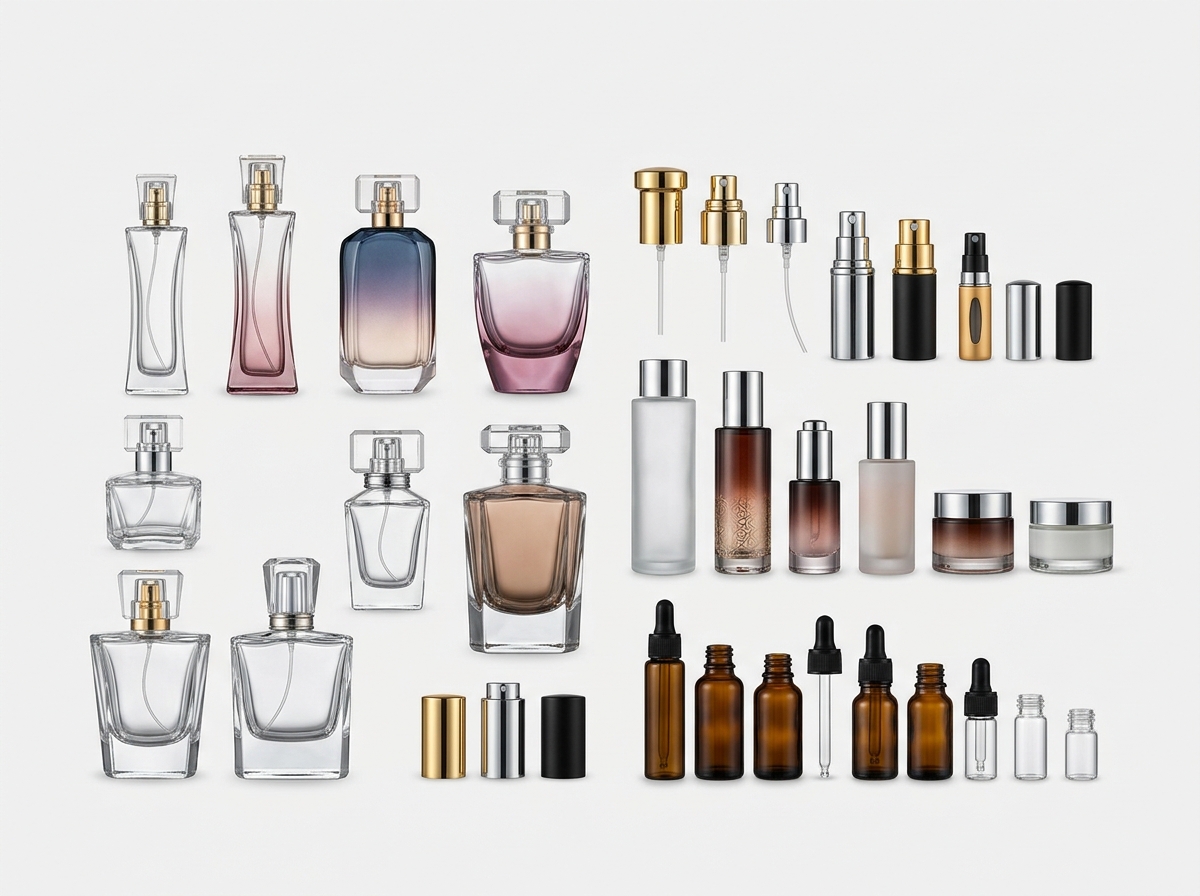 Luxury glass packaging and closure compatibility
Closure compatibility is one of the most common reasons premium packaging fails in production.
A beautiful bottle is not enough if the pump leaks, the cap wobbles, or the neck finish does not match the dispensing component. In cosmetic glass bottles, the neck finish must be selected early because it controls thread engagement, sealing performance, and component sourcing. For airless packaging, the piston system and cartridge design must also align with fill viscosity and intended shelf life. For fragrance, atomizer quality directly affects spray pattern and consumer perception.
Brands sourcing complete packaging systems can reduce friction by evaluating lotion pump, cap, and skincare set options together rather than as isolated parts.
| Component | What to verify | Typical failure if ignored | Launch impact |
|---|---|---|---|
| Neck finish | Thread fit and sealing surface | Leakage or cross-compatibility issues | High |
| Pump | Output consistency and return force | Uneven dose or clogging | Medium to high |
| Cap | Alignment and closure retention | Loose fit during shipping | Medium |
| Dropper | Bulb resilience and tube length | Inaccurate dosing | Medium |
For premium launches, the smartest move is often to request component compatibility testing before decoration is finalized. That prevents a common mistake: approving a visually perfect bottle that cannot be filled efficiently or sealed reliably.
Quality control standards for cosmetic glass bottles
Quality control is what turns luxury packaging from a concept into a repeatable product.
In glass packaging, quality is usually checked through dimensional inspection, surface defect review, closure fit, and transport simulation. For product safety, the packaging industry also references regulations and standards depending on the market and application. If a package must address child access risk, ISO 8317 provides the basis for child-resistant reclosable packages. For performance terminology and material descriptions, ASTM D3475 helps standardize how packaging types are identified. For measurement precision, the use of SI units from NIST helps ensure that tolerance language is consistent across suppliers and buyers.
One practical reason standards matter is repeatability. A premium bottle may look identical in photos but still cause production issues if the neck diameter, fill line, or pump interface drifts between batches. That is why procurement teams should require sample approval based on measurable criteria, not only appearance.
In many beauty programs, a tolerance target of ±0.1 mm on critical fit dimensions is used as an internal control point, though the exact requirement depends on the mold, material, and closure system according to supplier capability and project specification.
Packaging systems that support brand storytelling
The strongest premium packaging systems tell a story without forcing the customer to read it.
When all components share the same design logic, the line feels intentional. A serum, cream jar, and essence bottle can communicate one brand world if they repeat the same shoulder angle, finish family, and color palette. This is why beauty brands increasingly ask for packaging families rather than single containers. A coordinated system also makes launch photography, retail display, and gift-set merchandising easier.
For brands exploring more than one category, it helps to compare a set such as cosmetic jar, airless bottle, and essential oil bottle so the visual language stays consistent across skincare and fragrance.
- Choose one visual signature such as a base shape, cap finish, or print style.
- Map each SKU to the format best suited to its formula and use case.
- Verify that all components can be sourced and assembled at scale.
- Test the package in shipping, retail, and ecommerce conditions.
Common mistakes in luxury glass packaging projects
The most expensive packaging mistake is often a design that cannot be produced at scale.
Brands sometimes over-focus on visual reference images and under-focus on manufacturability. A complex bottle silhouette may require a mold investment that is hard to justify for a small run. A fragile decoration may look impressive in a studio but fail during distribution. A cap that feels luxurious in hand may still loosen under vibration if the thread geometry is weak. These are not minor issues; they can delay a launch or inflate returns.
Another frequent error is treating secondary packaging as an afterthought. Luxury beauty buyers expect the box, insert, and bottle to feel like one experience. Even a well-designed glass bottle can feel underwhelming if it arrives without protection or if the internal fit lets components move during shipping.
- Do not approve a bottle before confirming closure compatibility.
- Do not finalize decoration before checking production feasibility.
- Do not ignore shipping weight when choosing heavy-base glass.
- Do not use a single prototype to judge final production quality.
Cost and lead-time considerations for high end beauty packaging
Premium packaging should be evaluated as a total landed-cost decision.
Luxury glass packaging usually costs more than basic commodity packaging because of mold complexity, decoration, and tighter quality control. Lead time also increases when the project includes custom shapes, special coatings, or coordinated secondary boxes. While exact budgets vary by order size and tooling scope, buyers should plan for sampling, revision cycles, and production validation before launch dates are locked.
A useful way to manage the program is to separate decisions into three layers: the structural container, the functional closure, and the visual finish. This makes it easier to compare options and control risk. It also helps brands decide where to spend more. For example, a fragrance hero product may justify a heavy decorative finish, while a supporting SKU may only need a clean frosted bottle with a standard cap.
| Decision layer | Primary cost driver | Lead-time sensitivity | Risk if rushed |
|---|---|---|---|
| Structural container | Mold and glass forming | High | Fit and shape issues |
| Closure system | Pump or cap compatibility | Medium | Leaks and assembly delays |
| Decoration | Printing, coating, plating | High | Color mismatch or durability loss |
| Secondary packaging | Insert and carton design | Medium | Transit damage and weak presentation |
How to specify a premium packaging brief that suppliers can execute
A strong brief reduces revisions and speeds up sampling.
When writing a sourcing brief for luxury glass packaging, include the target formula, capacity, neck finish, fill method, closure type, decoration method, and shipping expectations. If the collection includes multiple SKUs, define the visual family first and the individual functional differences second. That makes the project easier for manufacturers to quote and for procurement teams to compare fairly.
For best results, ask suppliers to confirm dimensional drawings, closure compatibility, sample approval checkpoints, and inspection criteria. A brief that names the product family but omits the technical fit data usually leads to delays later. By contrast, a brief with measured requirements lets the packaging supplier behave like a development partner instead of only a parts vendor.
Luxury glass packaging FAQs
What is the main advantage of luxury glass packaging for beauty brands?
The main advantage is that glass supports premium perception while offering strong visual clarity and broad formula compatibility.
Are cosmetic glass bottles better than plastic for high end beauty packaging?
Cosmetic glass bottles are usually preferred when the brand wants a heavier, more premium feel and a more refined visual presentation, while plastic may be chosen for weight or impact reasons.
How do I choose the right packaging for a serum or essence?
Choose based on oxidation risk, viscosity, and dosage needs; airless bottles and dropper systems are common for sensitive or concentrated formulas.
Why does closure compatibility matter so much?
Because a luxury bottle loses value immediately if the pump leaks, the cap fits loosely, or the neck finish does not seal correctly.
What decoration methods work best for premium beauty packaging?
Frosting, hot stamping, silk-screen printing, metallic finishes, and tactile surface effects are all common when durability and brand identity both matter.
How can brands reduce launch risk with custom packaging?
By testing the full system early, confirming dimensions, and approving samples against measurable criteria instead of appearance alone.
What should be included in a packaging brief for a supplier?
Capacity, formula type, closure style, decoration requirements, secondary packaging needs, and target launch timing should all be included.
Post time: Aug-25-2026


