
- Private label cosmetic packaging should be evaluated as a system, not as a single container.
- Quality control must cover material choice, decoration, closure fit, and transit performance.
- A credible manufacturer can show samples, specifications, and export logistics readiness.
- Brand consistency depends on series packaging, not just attractive individual SKUs.
- Reliable sourcing reduces launch delays, leakage complaints, and visual inconsistency.
Finding a reliable custom cosmetic packaging partner is a procurement decision with direct brand impact, because packaging affects shelf appeal, formula protection, and repeatable production quality. Industry guidance from NIST manufacturing resources and packaging standards such as ISO 8317:2015 show why closure integrity, child-resistance, and transport performance matter when packaging enters real distribution channels. For private label cosmetic packaging, the right cosmetic packaging manufacturer should be able to support coordinated bottle-and-closure systems, decoration consistency, and stable export delivery. If your brand sells skincare, fragrance, or essential oil products, the packaging supplier you choose can determine whether your launch feels premium or fragmented. For category-specific sourcing, see perfume bottle options, airless bottle systems, skincare packaging sets, and matching accessories.
How to Evaluate a Custom Cosmetic Packaging Manufacturer for Private Label Brands
The best cosmetic packaging partner proves reliability before the first production order.
In private label sourcing, reliability is not a feeling; it is a sequence of testable checkpoints. A credible manufacturer should be able to explain how materials are selected, how closures are matched, how decoration is applied, and how packaging is checked for shipping stress. That is especially important for brands launching in skincare and fragrance, where leakage, contamination, or inconsistent appearance can quickly damage buyer trust. When a supplier works with private label cosmetic packaging at scale, the conversation should move beyond price and toward system compatibility, repeatability, and defect prevention.
1. Start with material fit, not decoration
Material fit is the first filter because it determines compatibility with the formula and the intended brand position.
For cosmetic bottles and jars, common choices include glass, PET, and PE, with each serving a different commercial purpose. Glass is often preferred for fragrance and premium skincare because of its clarity, weight, and premium feel. PET is widely used where impact resistance and lighter shipping weight matter. PE is common in closures, dispensers, and functional components. If your brand uses active formulas, oils, alcohol-based fragrance, or water-based skincare, ask the supplier how the material behaves with the formula, especially under heat, vibration, and long-distance transit. For airless systems, stability and barrier performance matter more than appearance alone, which is why airless bottle systems are often selected for higher-value skincare lines.
| Packaging Type | Typical Material | Best Use Case | Commercial Advantage |
|---|---|---|---|
| Perfume bottle | Glass, zinc alloy accents | Fragrance, luxury gifting | High perceived value |
| Airless bottle | PET, PP, PE components | Serums, creams, active formulas | Reduced air exposure |
| Cream jar | Glass, PET, acrylic | Moisturizers, masks | Wide-mouth usability |
| Dropper bottle | Glass, rubber bulb, cap assembly | Essential oils, ampoules | Controlled dispensing |
A supplier that can explain these differences clearly is usually better positioned to support a private label launch.
2. Check closure compatibility and leak prevention
Closure compatibility is one of the most common failure points in cosmetic packaging sourcing.
Many private label problems start when a bottle looks perfect in a sample photo but fails after filling, capping, transport, or temperature changes. Pumps, sprays, caps, and droppers all need to fit the neck finish and the product formula. For export orders, leak prevention is even more important because cartons may face vibration, pressure changes, and extended handling. A manufacturer should therefore provide closure fit guidance, sample validation, and clear assembly instructions. If a supplier offers spray bottle solutions or fragrance components, ask whether they test spray output consistency, spring performance, and seal integrity before mass production.
| Validation Item | What to Ask For | Why It Matters |
|---|---|---|
| Neck finish compatibility | Matching dimensions and closure type | Prevents misfit and leakage |
| Pump output | Consistent dose per actuation | Supports user experience |
| Seal performance | Leak resistance under transit stress | Reduces claims and returns |
| Assembly consistency | Uniform torque or fitting process | Improves production stability |
For brands scaling into wholesale or export, packaging validation is not optional; it is a cost-control tool.
3. Verify decoration methods and finish consistency
Decoration quality often determines whether a private label package looks premium or generic.
Cosmetic packaging is visual branding in physical form, so printing, frosting, coating, hot stamping, and metallized details must be consistent from sample to final run. In fragrance, design elements such as flocking, velvet-like textures, and metal caps can create a stronger premium signal. In skincare, clear glass and series consistency help buyers recognize the line quickly across multiple SKUs. If a supplier cannot match color, logo placement, or surface finish across repeat orders, the brand will struggle to maintain a coherent retail identity. That is why reliable manufacturers usually provide detailed decoration references and sample confirmation before production.
| Decoration Method | Typical Visual Effect | Best For | Risk if Poorly Controlled |
|---|---|---|---|
| Screen printing | Sharp logo and text | Labels, logos | Smudging or misalignment |
| Hot stamping | Metallic premium effect | Luxury fragrance | Uneven foil transfer |
| Spray coating | Color uniformity | Skincare series | Shade inconsistency |
| Frosting | Soft matte appearance | Premium glass bottles | Patchy finish |
Brands aiming for a premium shelf presence should ask for side-by-side finish samples, not just a single hero sample.
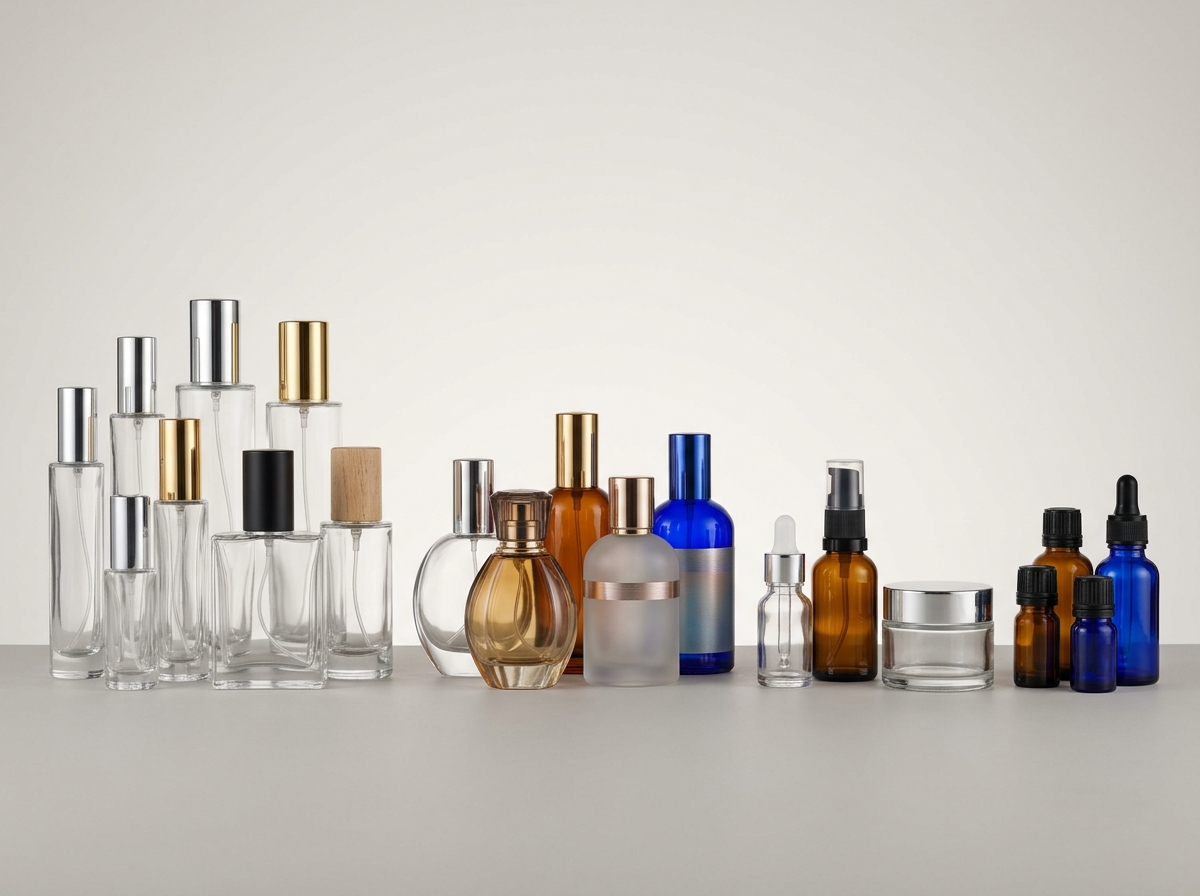 Why Private Label Cosmetic Packaging Needs Series Thinking
Private label packaging works best when the line feels like one family, not a collection of unrelated items.
Many buyers focus on a single bottle or jar and overlook the full system. In reality, a launch usually needs a bottle, pump, cap, jar, and secondary packaging that all share the same visual language. Lemuel Packaging’s emphasis on fragrance bottles, skincare sets, airless bottles, and accessories reflects a market need for coordinated packaging families rather than isolated components. That approach is especially valuable for brands building complete skincare ranges, where a cleanser, serum, and cream must look related on the shelf. A unified system also simplifies sourcing, reduces design drift, and makes replenishment more predictable.
For a brand team, series thinking reduces the risk of inconsistent neck finishes, mismatched materials, or color variation between product tiers. It also helps when you expand from a hero SKU into a full regimen. For example, a skincare launch can begin with a serum in an airless bottle, then expand into toner, cream, and eye-care packaging without abandoning the core identity. If you need a broader line architecture, review skincare packaging sets and compare them with cream jar options to see how a coordinated series is built.
From a commercial standpoint, series packaging also improves order efficiency. Instead of managing five unrelated suppliers, a private label brand can consolidate bottle, cap, and accessory development through one packaging partner. That lowers coordination errors and shortens internal approval cycles.
Quality Standards and Quantitative Checks That Matter
Quantitative checks are the fastest way to separate serious manufacturers from speculative traders.
When evaluating a cosmetic packaging manufacturer, ask for measurable information, not vague claims. Packaging teams should be able to discuss fill capacity, neck size, closure fit, sample tolerance, and shipping test conditions in a way that is easy to verify. The packaging industry also relies on recognized standards. For example, ASTM D999 covers vibration testing of shipping containers, while ISO 8317:2015 addresses child-resistant packaging systems. These standards do not guarantee a perfect product, but they do show that packaging quality can be measured and validated.
One useful benchmark comes from dimensional consistency. In precision packaging and component fitting, small tolerance drift can create cap wobble, pump misalignment, or uneven sealing pressure. If a supplier discusses fit in practical terms, ask for the exact dimensions of the neck finish, closure thread, and gasket structure. For branded skincare and fragrance lines, even small inconsistencies can become visible in retail because buyers compare full sets side by side.
| Check Area | Typical Measurable Item | Reference Source |
|---|---|---|
| Shipping vibration | Container vibration test | ASTM D999 |
| Child resistance | Package design validation | ISO 8317:2015 |
| Transport performance | ISTA test methods | ISTA |
| Material and process traceability | Specification control and documentation | NIST |
Using standards as a supplier filter helps you compare partners on evidence, not on sales language.
How to Assess a Manufacturer’s Reliability Before You Place an Order
Reliable suppliers make the sampling and approval process visible.
Before committing to a production order, ask the manufacturer how they handle sample confirmation, mold development, finish selection, and mass-production approval. A professional process usually includes concept review, sample revision, closure fit testing, color confirmation, and a final pre-production sample. Brands that skip these steps often pay later through delays, rework, or packaging that fails to align with formula and distribution needs. If the supplier serves export clients, confirm whether they support carton configuration, pallet planning, and shipping protection for long-distance freight.
- Request dimensional specifications and finish references for the exact SKU.
- Ask for samples with the same decoration method intended for mass production.
- Test closure fit with actual filling material, not water only.
- Check transit behavior under vibration, pressure, and temperature variation.
- Confirm lead times for sample revision and production scaling.
This process is especially important for custom cosmetic packaging because custom work introduces more variables than stock sourcing.
Private Label Packaging for Skincare, Fragrance, and Essential Oils
Different product categories demand different packaging logic.
Skincare packaging usually prioritizes stability, dispensability, and series coherence. Fragrance packaging emphasizes premium appearance, spray performance, and gifting value. Essential oil packaging requires controlled dosing, amber or protective materials when needed, and secure closure systems. A strong cosmetic packaging manufacturer should understand these differences and guide you toward packaging that supports the formula, price point, and channel strategy. For example, a luxury fragrance line may use glass bottles with metal caps and decorative finishes, while an essential oil line may rely on dropper bottles or compact spray formats for accurate dosing.
If your portfolio includes both skincare and fragrance, the supplier should be able to balance visual differentiation with operational consistency. That is where category breadth becomes valuable. A supplier offering perfume bottles, essential oil bottles, and compatible accessories can often support a broader brand architecture than a single-item vendor.
What Makes a Packaging Supplier Trustworthy in Export Markets
Export reliability depends on communication, documentation, and logistics discipline.
For international private label brands, a supplier is trustworthy when it can support clear communication, predictable sampling, and stable delivery planning. Being located near major shipping routes is a real operational advantage because it can reduce handoff friction between factory and port. But logistics convenience alone is not enough. Ask whether the manufacturer can provide packaging specifications in English, coordinate sample approval efficiently, and align production with freight timelines. When sourcing at scale, the supplier’s ability to manage communication across time zones is often as important as the package itself.
Trust also comes from transparency. If the packaging partner can explain what is included in a set, which components are interchangeable, and which finishes are more sensitive during transit, that is a positive sign. Brands expanding into wholesale should also ask about carton counts, palletization, and breakage mitigation. These details are boring until the first shipment arrives damaged.
Common Mistakes Brands Make When Choosing a Cosmetic Packaging Manufacturer
Most sourcing failures come from comparing the wrong things.
- Choosing the cheapest sample instead of the most stable production method.
- Ignoring closure compatibility until after filling starts.
- Ordering a single hero item without planning the rest of the series.
- Skipping transit testing and discovery samples.
- Overlooking the difference between visual appeal and functional reliability.
These mistakes are easy to avoid when the manufacturer is willing to discuss process, not just price. A good partner should help the brand think through fill method, use environment, shelf life, and channel requirements before mass production begins.
How to Shortlist the Right Supplier
The best supplier shortlist is built from evidence, not just catalog browsing.
Start by screening manufacturers on category fit, then request samples and specifications from the most relevant product lines. If your brand needs fragrance packaging, compare glass bottle options, decorative finishes, and matching caps. If you are developing a skincare range, evaluate airless systems, jars, and coordinated sets. If you need flexible sourcing across multiple SKUs, focus on partners that can manage a system rather than a single container. For a practical starting point, review perfume bottle collections, skincare packaging sets, and airless bottle solutions to compare how each line supports a different launch strategy.
Then compare three signals: sample quality, communication speed, and production clarity. If the same team can answer technical questions, explain decoration options, and discuss shipping protection in clear English, you are likely dealing with a more dependable manufacturer.
FAQ: Custom Cosmetic Packaging and Private Label Sourcing
1. What should I ask a cosmetic packaging manufacturer first?
Ask about material options, closure compatibility, sample process, decoration methods, and lead time. Those five items reveal whether the supplier understands private label production or only sells catalog items.
2. Is airless packaging better for skincare?
Airless packaging is often better for formulas that benefit from reduced air exposure, controlled dispensing, and a more premium user experience. It is commonly used for serums, lotions, and creams.
3. How do I know if packaging will leak during shipping?
Request fit confirmation, seal details, and transit testing aligned with recognized methods such as ASTM D999. Also test with your actual product formula, not only water.
4. Why is series packaging important for private label brands?
Series packaging creates a coherent shelf identity across multiple SKUs. It helps customers recognize the brand more quickly and makes the line feel more premium and complete.
5. What packaging is best for luxury fragrance?
Luxury fragrance usually benefits from glass bottles, premium caps, high-quality decoration, and a strong tactile finish. Decorative details such as metal accents can improve perceived value.
6. What makes a supplier reliable for export orders?
Reliable export suppliers provide clear English communication, stable samples, documentable specifications, and shipping-aware packing methods. Logistics coordination matters as much as the container design.
7. How do I compare two custom cosmetic packaging suppliers?
Compare them by sample accuracy, technical clarity, decoration consistency, closure compatibility, and production responsiveness. The best supplier is the one that reduces launch risk, not just the one with the lowest quote.
Post time: Aug-21-2026


