
- Reliability is demonstrated through repeatable quality controls, not appearance alone.
- Glass, pump, cap, decoration, and fragrance compatibility must be evaluated as one system.
- A documented sample approval process reduces misunderstandings before mass production.
- Packaging protection, export experience, and communication directly affect landed product risk.
- The strongest suppliers support both visual differentiation and scalable brand development.
Reliable glass perfume bottle suppliers combine material knowledge, component compatibility, decoration control, and dependable fulfillment. The U.S. Food and Drug Administration explains that cosmetic packaging and labeling must meet specific regulatory responsibilities, which is why packaging decisions should be assessed beyond shape and price. This guide shows how brands can evaluate a supplier before approving a perfume bottle for launch.
What Reliability Means in Glass Perfume Bottle Suppliers
Supplier reliability means delivering the agreed packaging specification repeatedly across samples, production batches, and replenishment orders.
A perfume bottle supplier may appear reliable because its catalog contains premium-looking designs, but a catalog does not prove production consistency. Brand buyers should examine how the supplier manages glass clarity, wall thickness, neck finish, spray fit, cap retention, decoration, packing, and replacement communication.
The practical test is simple: can the supplier reproduce the approved result when the order is larger, the timeline is tighter, and several components must work together?
| Reliability area | What the buyer should verify | Recommended evidence count |
|---|---|---|
| Product specification | Material, capacity, neck finish, component dimensions, and decoration requirements are recorded. | 1 approved specification sheet |
| Sampling | The physical sample represents the intended glass, pump, cap, color, and surface finish. | 1 signed approval record |
| Quality control | Inspection points cover appearance, assembly, leakage, decoration, and packing. | 5 inspection categories |
| Shipment protection | Cartons, dividers, pallets, and handling instructions are reviewed before dispatch. | 1 packing validation |
The numerical column above is a buyer checklist rather than an industry statistic. Its purpose is to make supplier conversations specific and auditable.
How Glass Quality Affects Perfume Packaging
Glass quality affects the visual impression, safety perception, filling process, and long-term consistency of perfume packaging.
For clear perfume bottles, buyers commonly review transparency, bubbles, stones, scratches, mold marks, seams, base stability, and color consistency. A minor defect may be unacceptable on a clear luxury bottle because the consumer sees the container from every angle. A tinted, flocked, or opaque finish can create a different inspection challenge: color uniformity and surface coverage become more important than transparency.
The bottle must also stand securely and remain compatible with the filling line. An unstable base, inconsistent neck finish, or dimensional variation can create problems during crimping, pump insertion, capping, labeling, and secondary packaging.
Reliable glass perfume bottle suppliers explain which characteristics are controlled by the bottle manufacturer, which are controlled during decoration, and which must be confirmed during assembly. This distinction helps brands avoid treating every defect as the same type of failure.
Material and fragrance compatibility
Fragrance compatibility should be evaluated with the complete packaging system, not with the glass body in isolation.
The fragrance may contact the glass, inner pump components, dip tube, gasket, collar, and cap depending on the design. Alcohol-rich formulas, essential oils, colorants, and concentrated fragrance materials may interact differently with elastomers, coatings, adhesives, or decorative finishes.
Brands should provide the intended formula information under an appropriate confidentiality process and request compatibility guidance for the full assembly. A practical test can include filled samples, storage under the brand’s planned conditions, spray performance checks, odor review, leakage inspection, and decoration observation.
For fragrance safety context, buyers can consult the International Fragrance Association standards library. The source is relevant to fragrance safety management, while packaging compatibility remains a separate technical verification responsibility.
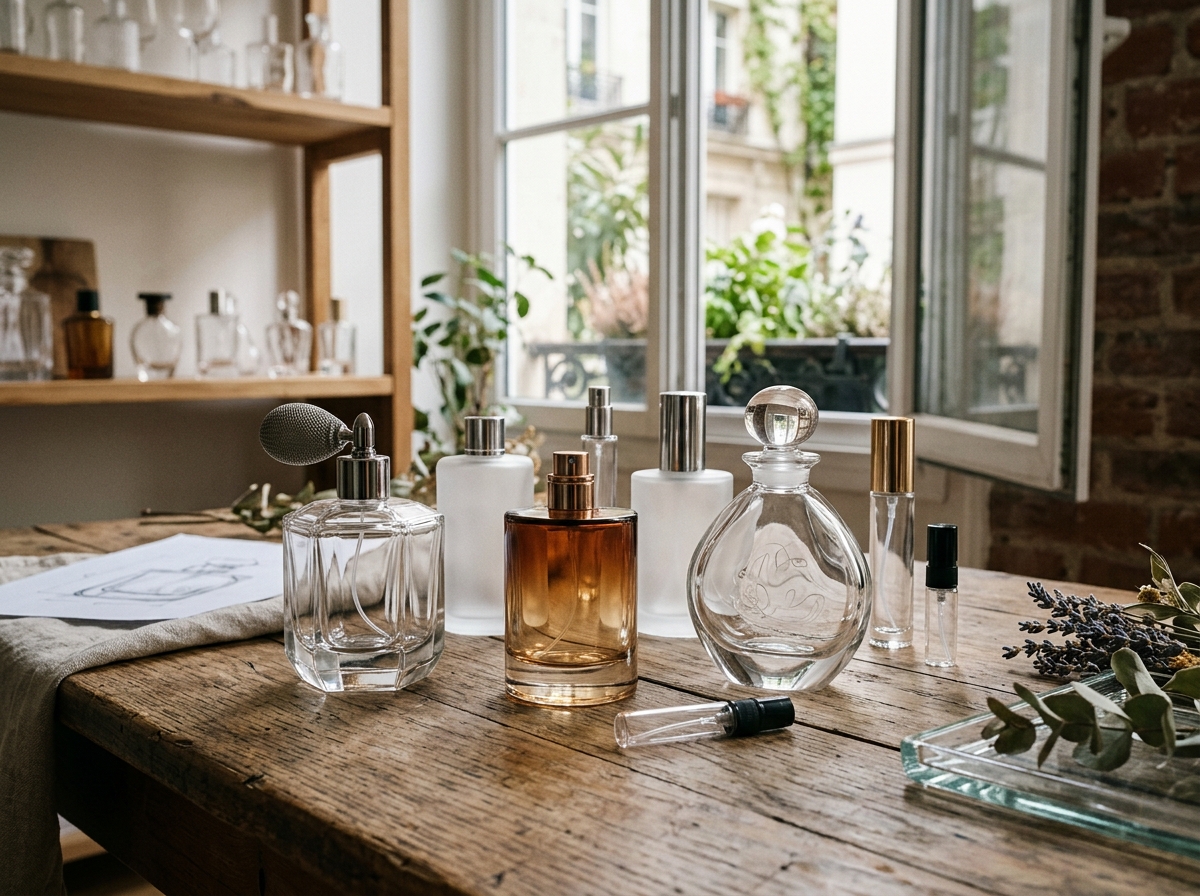 Why Pump, Cap, and Bottle Compatibility Matters
A perfume bottle is a system in which the glass body, pump, collar, cap, and decoration must function together.
A beautiful bottle can still fail commercially if the spray pattern is inconsistent, the actuator feels loose, the cap does not align, or the collar leaves a visible gap. These issues influence consumer perception and can also create filling-line interruptions.
| Component | Buyer concern | Practical verification |
|---|---|---|
| Glass bottle | Shape, clarity, stability, neck finish, and decoration surface | Visual inspection and dimensional review |
| Spray pump | Fit, actuation feel, spray output, crimping or screw compatibility | Filled sample and repeated actuation test |
| Collar | Alignment, gap, finish, and connection with the pump | Assembly inspection from multiple angles |
| Cap | Retention, weight, internal fit, and surface durability | Removal, replacement, and handling test |
| Decoration | Color, adhesion, abrasion resistance, and registration | Approved master sample and finish review |
The most useful supplier response is not simply “compatible.” It should identify the component interface, the proposed assembly method, the sample test, and the conditions that could change the result.
How Customization Demonstrates Supplier Capability
Customization is reliable only when creative design is connected to manufacturable specifications.
Brands often request custom perfume bottles to create a distinctive silhouette, stronger shelf recognition, or a coordinated fragrance collection. The supplier should translate the design into a mold strategy, glass process, finishing plan, component interface, and packing method.
Common differentiation options include unusual profiles, colored glass, frosting, coating, silk-screen printing, metallic effects, flocking, velvet-like surfaces, and metal caps. Each option introduces different risks. Coatings require adhesion and appearance checks. Printing requires registration and color approval. Metal components require dimensional fit and finish consistency. Textured surfaces require careful handling because packaging materials can mark them during transport.
A reliable supplier will also explain trade-offs. A highly complex shape may increase mold cost, inspection difficulty, packing volume, or minimum order requirements. A simpler bottle with a premium cap and controlled decoration may provide stronger repeatability for a growing brand.
Series consistency matters more than isolated beauty
For a fragrance collection, the packaging system should be judged as a family rather than as separate items.
Buyers should compare how several bottle sizes, colors, caps, and labels appear together. The neck, shoulder, base, and decoration zones should create a recognizable visual language. This is especially important when a brand plans future launches, seasonal editions, or extensions into body care and home fragrance.
Series development also benefits from a shared component strategy. A common pump or cap interface may simplify purchasing and improve visual unity, provided that the component is appropriate for each formula and bottle format.
Sampling and Quality Control for Perfume Bottles
A controlled sample process is one of the clearest indicators of a reliable packaging supplier.
The sample should be treated as a technical reference, not only as a design preview. It should record the bottle version, glass color, decoration, component combination, surface finish, artwork, packing method, and approval date. When a brand changes one element, the supplier should identify whether a new sample is required.
- Define the product brief, including formula, target appearance, filling method, required components, and delivery market.
- Review drawings, specifications, decoration files, and component interfaces before physical sampling.
- Test filled samples for assembly, spray behavior, leakage, odor, appearance, and handling.
- Approve a clearly identified reference sample and retain the related documentation.
- Confirm production inspection, packing, shipment records, and the process for handling nonconformities.
Sampling should reflect the real use case. If the perfume will be transported internationally, the evaluation should include the actual carton structure, dividers, cap configuration, and pallet arrangement rather than an isolated bottle.
Export preparation is also part of reliability. The United Nations Economic Commission for Europe publication on dangerous-goods transport requirements provides a relevant regulatory reference for transport planning, although the exact obligations depend on the product, route, carrier, and shipment classification.
Delivery Reliability and International Procurement
Delivery reliability depends on planning capacity, component coordination, packing protection, and communication discipline.
Perfume packaging often includes several synchronized items: bottles, pumps, collars, caps, printed components, cartons, inserts, and sometimes decorative sleeves. If one component is late or fails inspection, the entire product launch may be delayed.
Before placing an order, ask the supplier to clarify the production sequence, approval points, lead-time assumptions, packaging method, inspection responsibility, and escalation contact. The goal is not to demand an artificial promise but to understand the conditions behind the delivery plan.
| Procurement question | Weak response | Reliable response characteristic |
|---|---|---|
| Can the design be reproduced? | “It is a standard product.” | Provides a defined specification and sample reference. |
| When will production ship? | One unqualified date. | Explains approvals, component readiness, inspection, and packing dependencies. |
| What happens after a defect? | Responsibility is unclear. | Defines evidence, review, replacement, and communication steps. |
| Can the line be expanded? | Only one bottle is discussed. | Explores related sizes, finishes, caps, and coordinated packaging. |
For international brands, location and logistics access can support procurement efficiency, but geography alone does not prove service quality. Buyers should still evaluate actual communication, documentation, packaging protection, and previous experience with comparable shipments.
Questions to Ask Before Choosing a Reliable Packaging Supplier
The best supplier evaluation combines technical, commercial, and operational questions.
- Which glass materials, colors, capacities, neck finishes, and surface treatments are available?
- Can the supplier coordinate bottle, pump, cap, collar, and secondary packaging?
- What information is needed to assess formula and component compatibility?
- How are decoration samples approved and recorded?
- Which appearance and assembly characteristics are inspected before shipment?
- How are cartons, dividers, pallets, and fragile components protected?
- Can the supplier support a single launch as well as future series development?
These questions move the discussion from catalog browsing to risk management. They also reveal whether the supplier understands the buyer’s complete route to market.
FAQ
What should brands look for in glass perfume bottle suppliers?
Look for consistent glass quality, compatible pumps and caps, documented samples, clear decoration control, protective packing, responsive communication, and a process for handling quality issues.
Are custom perfume bottles better than standard bottles?
Custom bottles can strengthen brand recognition, but they may involve greater tooling, sampling, inspection, and packing complexity. A standard bottle with distinctive finishing may be more efficient for an early launch.
How can a buyer test perfume bottle compatibility?
Use filled samples with the intended formula and complete assembly. Review leakage, spray behavior, odor, surface changes, cap fit, decoration, and handling under the brand’s planned conditions.
Why are the pump and cap important?
The pump controls the user experience and the cap affects protection, alignment, and perceived quality. Both must fit the bottle neck and remain consistent during filling and use.
What documents should a supplier provide?
Useful documents may include product specifications, drawings, artwork approvals, sample records, packing details, inspection records, and shipment information. The exact package depends on the project and destination market.
How can brands reduce breakage during international shipping?
Validate the actual carton, divider, pallet, and cap configuration with the supplier. Review how bottles are separated, immobilized, labeled, and protected against movement before approving shipment.
Can one supplier support fragrance and skincare packaging?
Some packaging partners can coordinate perfume bottles with skincare bottles, jars, essential-oil containers, airless packaging, and accessory components. Buyers should verify the supplier’s relevant product range and technical capability for each formula.
About the Packaging Partner
Lemuel Packaging focuses on integrated cosmetics and fragrance packaging, combining bottles, pumps, caps, jars, and coordinated sets for brands that need a practical route from concept to launch. Its product scope supports perfume, skincare, essential oils, airless formats, and spray applications, with options for custom shapes, premium finishes, and export-oriented supply. Explore the packaging range through the company website and contact the team to discuss a project brief.
Post time: Sep-14-2026


