
- Glass perfume bottles influence shelf appeal, atomization performance, leakage risk, and perceived value.
- Private label perfume packaging should be specified as a system: bottle, pump, collar, cap, decoration, and secondary box.
- Custom fragrance bottles require measurable decisions on capacity, neck finish, wall thickness, and coating durability.
- Quality control should cover dimensions, spray output, compatibility, and transport resistance before mass production.
Glass perfume bottles are one of the most commercially sensitive parts of private label perfume packaging, because a small change in neck finish, spray fit, or decoration can alter leakage rate, fill efficiency, and the way a consumer perceives the brand. For export-oriented fragrance programs, packaging engineers often work to dimensional tolerances in the low millimeter or sub-millimeter range; for example, perfume bottle neck and closure fit checks commonly use gauge-based inspection, while functional validation may reference standards such as ISO 15378 for primary packaging quality systems. In one practical launch scenario, a brand moves from concept to shelf by aligning the bottle, pump, cap, and gift box as a single unit, which is exactly why suppliers with custom fragrance bottles and matching accessories are often preferred over fragmented sourcing.
What glass perfume bottles do for private label brands
Glass perfume bottles do three jobs at once: they preserve the formula, present the brand, and reduce commercial risk.
From a performance perspective, glass is still the preferred primary material for fine fragrance because it is chemically stable, visually clear, and compatible with ethanol-based formulations. That matters because fragrance oil systems can contain aroma chemicals, solvents, and UV-sensitive ingredients that lose appeal if packaging feels cheap or unstable. A stable bottle also protects fill accuracy and reduces evaporation risk when paired with the right pump and seal.
From a branding perspective, the bottle is the first tactile proof of price positioning. A heavy base, crisp shoulder geometry, frosted or flocked finish, and metal cap all send a stronger luxury signal than a plain utilitarian container. For brands building a retail-ready line, the bottle is not just a vessel; it is part of the visual identity system. That is why suppliers offering luxury bottle options and metal caps are better aligned with premium private label programs.
From a sourcing perspective, the bottle can either simplify or complicate launch execution. If the neck finish is incompatible with the pump, or the cap tolerances are loose, the project can stall during sampling. A private label brand usually wants predictable reorders, not one-off artistic prototypes. That is why packaging planning should start with function and compatibility, then move to aesthetics.
| Decision factor | Why it matters | Typical sourcing check | Impact on launch |
|---|---|---|---|
| Glass thickness | Improves perceived quality and break resistance | Wall consistency and drop-risk review | High |
| Neck finish | Controls pump compatibility and leak risk | Go/no-go fit test with pump supplier | Very high |
| Decoration | Shapes brand differentiation | Frosting, coating, flocking, printing | High |
| Closure system | Protects formula and improves user experience | Torque and seal validation | Very high |
How to choose the right custom fragrance bottles
The right custom fragrance bottles are selected by use case, not by catalog beauty alone.
For a niche eau de parfum, a 30 mL or 50 mL bottle often balances premium feel with retail price flexibility. For discovery sets and travel formats, smaller fills can support trial and gifting strategies. In mass-market programs, the bottle must also respect production realities such as line speed, carton fit, and pallet efficiency. A design that is beautiful but unstable in carton transit will create avoidable claims and replacement costs.
Capacity should always be considered alongside functional tolerances. In export programs, small dimensional deviations can become expensive if they affect pump crimping or cap seating. Many packaging teams therefore require sampling that tests spray function, fill line compatibility, and torque retention before approval. When evaluating spray bottle configurations, brands should also check whether the atomizer delivers a consistent mist pattern and whether the actuator feels smooth under repeated use.
Another key selection factor is neck finish standardization. The most common fragrances use a standard screw or crimp-compatible neck, but the exact finish must match the closure system. If the supplier offers a custom shape without clear closure specifications, the risk of mismatch rises quickly. For private label teams, packaging standardization usually lowers sampling time and simplifies replenishment.
| Common bottle size | Typical use case | Retail logic | Packaging risk |
|---|---|---|---|
| 10 mL | Travel, sampling, gift-with-purchase | Low entry price | Higher leakage sensitivity |
| 30 mL | Niche fragrance, starter SKU | Accessible premium | Moderate |
| 50 mL | Mainline retail SKU | Best value perception | Moderate |
| 100 mL | Hero SKU, gifting | High perceived value | Higher shipping weight |
Private label perfume packaging must be engineered as a system
Private label perfume packaging works best when the bottle, pump, cap, and box are engineered together.
This is where many new brands make a costly mistake: they source a beautiful bottle first and only later ask whether the closure system works. In fragrance packaging, the pump is not a minor accessory. It defines spray distribution, user satisfaction, and the real-world seal that keeps the perfume stable between uses. A weak fit can cause leakage during shipping, especially when a package experiences vibration, pressure change, or temperature swings.
Systems thinking also matters for decoration. A bottle with deep color spraying, frosted texture, or flocked coating looks premium, but the finish should not interfere with readability, barcode placement, or carton protection. If the brand is planning a premium line, the outer box should reflect the same aesthetic language as the bottle. That is why suppliers that can provide velvet bottles and matching packaging accessories tend to fit premium launch programs better than suppliers selling isolated parts.
In practical terms, a system-based approach reduces coordination errors. Instead of managing separate vendors for bottle, pump, cap, and box, the brand can approve one integrated specification. That typically shortens sample iterations and improves color and fit consistency across the full SKU set.
| Component | Primary role | Critical test | Typical failure if ignored |
|---|---|---|---|
| Bottle | Structure and shelf presence | Dimension check | Cap mismatch |
| Pump | Atomization and dosing | Spray cycle test | Clogging or uneven mist |
| Cap | Protection and branding | Retention and torque | Loose fit |
| Outer box | Transit protection | Drop and compression test | Crack or scuff damage |
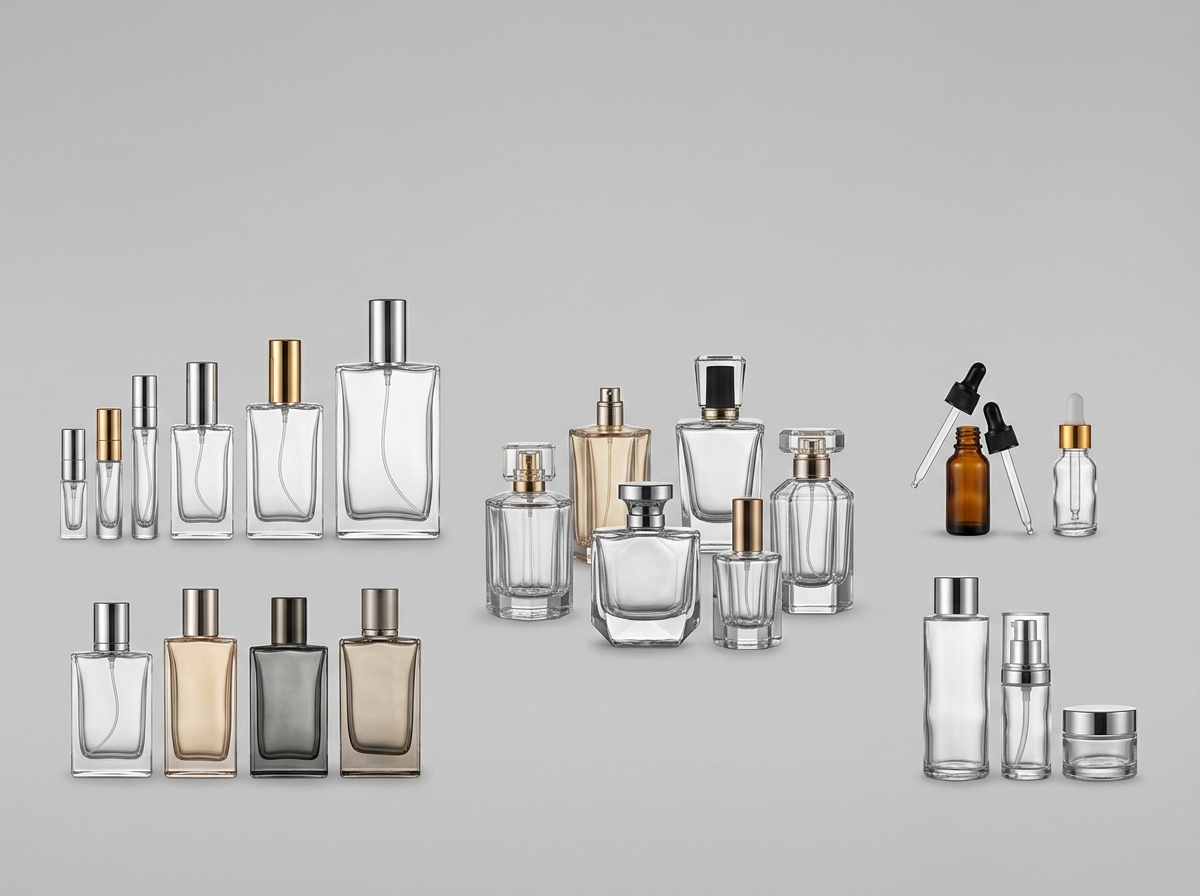 Material, finish, and decoration choices that change brand value
Decoration and surface treatment often determine whether a perfume bottle feels private label or premium.
Clear flint glass is popular because it lets the fragrance color show through, which helps with clean, clinical, or luxurious aesthetics. Frosted glass softens the visual effect and makes labels feel more refined. Colored coating can create a stronger signature look, while flocking and velvet finishes can elevate the tactile experience. Metal collars and zinc alloy caps add weight and perceived durability, but they must be paired with careful corrosion and finish checks.
The key rule is that decoration should support the product story. A soft matte finish works well for calm, minimalist, or skincare-adjacent fragrance concepts. A high-gloss metallic cap may fit a bold evening fragrance. For eco-oriented brand stories, recyclable glass and reduced-material closures can support sustainability claims, but only if those claims can be substantiated by the packaging materials actually used.
For international buyers, decoration consistency matters as much as beauty. Color variation between samples and bulk production can damage trust. That is why pre-production approval should include reference standards, written tolerance limits, and a retained master sample. Brands sourcing custom bottles should request a signed sample board before mass production begins.
One useful benchmark for decoration planning is to think in terms of finish risk. Printing and spraying are flexible but can vary by batch. Electroplating and metalized caps create a premium look but need closer process control. Flocking and velvet textures are visually strong but may not suit every distribution channel because they can attract dust or show abrasion if handled roughly.
Quality control benchmarks for glass perfume bottles
Quality control is what separates a beautiful sample from a reliable sellable SKU.
For fragrance packaging, QC should begin with dimensional inspection and continue through compatibility, leakage, and transport tests. Dimensional checks confirm that the bottle body, neck, and closure surfaces match the agreed specification. Functional checks verify that the pump sprays evenly and the cap stays secure. Transit checks simulate the handling risks the final product will face in warehouses and parcel networks.
Where applicable, brands should consider standards-based validation. Packaging intended for dangerous goods or alcohol-heavy formulas may need to be assessed with transport rules that reference the UN Model Regulations. Quality management for primary packaging can also be aligned with ISO 8317 when child-resistance is relevant, especially in adjacent cosmetic or household fragrance categories. While not every perfume requires the same certification path, a standards-minded supplier is easier to audit and easier to scale.
Realistic acceptance criteria should be written before sampling. For example, the brand can define no visible bubble clusters in critical zones, no cap wobble beyond an agreed fit threshold, and no spray malfunction after repeated actuations. In large-scale production, consistency is more valuable than perfection in a single sample.
| QC test | What it checks | Pass criterion example | Why it matters |
|---|---|---|---|
| Dimensional inspection | Neck, body, and cap fit | Within approved drawing | Prevents assembly issues |
| Spray test | Atomization and output consistency | Uniform mist over repeated cycles | Improves user experience |
| Leak test | Seal integrity | No leakage after inversion and transport simulation | Reduces claims |
| Drop test | Transit resistance | No critical breakage | Protects channel inventory |
Search intent: what buyers really want when they search for glass perfume bottles
Buyers searching for glass perfume bottles usually want sourcing certainty, not just product pictures.
Their visible question is often “Which bottle should I choose?” but the hidden questions are more commercial: Will this bottle work with my pump? Can I scale to 10,000 units without color drift? Will the design survive shipping? Does the supplier understand private label timelines and export documentation? Those are the questions that decide whether a launch succeeds.
That is why content around glass perfume bottles should answer selection, compatibility, customization, and logistics in one place. For many buyers, the ideal supplier is the one that can translate brand direction into a complete packaging structure with fewer handoffs. A supplier based near major shipping infrastructure can also help reduce lead-time uncertainty, especially when replenishment cycles are tight.
In private label fragrance programs, buyers also care about repeatability. The first production run may be small, but if the SKU performs well, the packaging must be reproducible at scale. That is why a supplier’s ability to manage samples, approvals, and bulk consistency matters as much as the initial product design.
How to choose a supplier for private label perfume packaging
The best supplier is the one that reduces execution risk across the full packaging chain.
For private label brands, supplier evaluation should go beyond unit price. Ask whether the supplier can provide bottle, pump, cap, and box coordination, whether it supports sample confirmation, and whether it understands export packing requirements. A lower quote is not a saving if the project later fails on fit, breakage, or missed launch dates.
Practical supplier due diligence should include documentation, responsiveness, and production stability. If the supplier offers a wide range of related formats such as skin care bottle sets and accessories, that is often a sign it can handle coordinated packaging programs rather than only one-off containers. That matters because fragrance launches frequently evolve into adjacent categories such as body mist, lotion, or gift sets.
For global buyers, logistics planning is part of supplier quality. Packaging that looks elegant but arrives damaged is a failed specification. Ask for packing method details, master carton information, and palletization guidance before confirming mass production.
- Request a matched bottle and closure sample, not a bottle alone.
- Ask for decoration references and a retained master sample.
- Confirm carton sizes, pallet counts, and shipping protection early.
- Review compatibility with your filling line before bulk purchase.
Common mistakes private label brands make with fragrance bottles
The most expensive mistakes are usually the simplest ones.
First, many brands choose a bottle before defining the closure system. Second, they approve visual design without testing the filling line. Third, they ignore carton and pallet efficiency until shipping begins. Fourth, they treat decoration as a cosmetic afterthought rather than a manufacturing variable. Each mistake increases the chance of delays, rework, or product claims.
Another common error is over-customization too early. A highly unusual bottle shape can be powerful for branding, but if the brand has not yet validated demand, that design may raise tooling and inventory risk. Many successful launches start with a standard platform bottle, then add differentiation through color, cap, label, and box design. This allows better control of initial investment while keeping the option to expand into custom fragrance bottles later.
A final mistake is underestimating the importance of sampling. A sample that looks right but sprays poorly is not a success. A bottle that fits the cap loosely will become a quality problem after shipping. In perfume packaging, the sample is a technical prototype, not just a visual mockup.
What to ask before ordering glass perfume bottles
The right questions reveal whether the packaging is truly production-ready.
- What neck finish does the bottle use, and which pumps or collars are compatible?
- What are the exact capacity and fill tolerances for the SKU?
- Which decoration methods are available, and how stable are they in transit?
- Can the supplier provide integrated packaging with cap and secondary box?
- What sampling and approval steps are required before bulk production?
- How is breakage prevented during export packing?
These questions are simple, but they expose whether the supplier is thinking like a packaging partner or only a container vendor. For private label brands, that difference matters.
FAQ about glass perfume bottles for private label brands
What size glass perfume bottle is best for a private label launch?
The best size is usually 30 mL or 50 mL because both are easy for retail buyers to understand and easier for brands to price competitively. Smaller sizes can work for discovery sets, while 100 mL suits hero SKUs and gifting.
How do I know if a perfume pump fits the bottle?
Check the neck finish, request a matched sample, and run a spray and seal test before bulk production. Fit should be confirmed with the actual pump and cap, not by visual inspection alone.
Are custom fragrance bottles worth the higher cost?
They are worth it when distinct shelf identity is essential and the launch volume supports the investment. For early-stage brands, a standard platform bottle with custom decoration is often lower risk.
What decoration methods make a bottle look premium?
Frosting, coating, flocking, velvet texture, metal collars, and weighted caps can all increase perceived value. The best choice depends on the brand story and distribution channel.
How important is packaging compatibility in perfume sourcing?
It is critical because the bottle, pump, and cap must work together. A mismatch can cause leakage, poor spray behavior, or production delays.
What should I inspect in a perfume bottle sample?
Inspect dimensions, surface quality, spray performance, cap retention, and carton fit. A sample should be judged as a working prototype, not just a visual object.
Can one supplier handle bottle, cap, and outer box together?
Yes, and that is often the preferred route for private label perfume packaging because it reduces coordination errors and speeds up approvals.
Post time: Aug-04-2026


