
- Luxury perfume bottles influence both brand perception and buying confidence at the shelf.
- Premium fragrance packaging should align bottle, pump, cap, and carton into one system.
- Material choice, decoration, and spray quality are key drivers of luxury positioning.
- Consistent bottle design supports brand recognition across launches and seasonal collections.
- Technical quality matters: fit, leak resistance, and finish consistency protect the brand image.
Luxury perfume bottles are a strategic branding asset, not just a container, because premium fragrance packaging must communicate value in seconds. In precision packaging, even small quality details matter: ISO 286-2 defines dimensional tolerances used in engineering fits, while many high-end cosmetic components are designed around tight closure and alignment control to reduce visible gaps and instability. Brands that treat perfume bottle design as part of the product story usually create stronger shelf impact, clearer positioning, and more consistent consumer trust. For brands building a full packaging system, related solutions such as perfume bottles, airless bottles, and cosmetic jars help keep visual identity unified across fragrance and skincare lines.
Why Luxury Perfume Bottles Shape Premium Fragrance Packaging Perception
Luxury perfume bottles shape perception because consumers judge fragrance quality before they smell the scent.
In premium fragrance packaging, the bottle is the first tactile and visual proof of brand value. Weight, symmetry, glass clarity, pump feel, and cap alignment all contribute to a premium cue set. Research on consumer product perception consistently shows that visual design affects willingness to pay, especially in categories where hedonic value matters. For beauty brands, the package often functions as a short-form brand story: elegant silhouette for sophistication, metallic accents for exclusivity, and frosted or velvet finishes for emotional depth.
This is why perfume bottle design should be treated as a brand architecture decision. A coherent shape language across a mainline fragrance, travel spray, and gift set helps consumers recognize the brand instantly. It also supports premium fragrance packaging consistency when products are sold through ecommerce, retail counters, and duty-free channels. If a bottle feels unstable, looks generic, or has mismatched parts, the perceived product quality drops even when the formula is excellent.
For sourcing teams, the practical takeaway is simple: luxury perfume bottles must balance aesthetics, manufacturability, and logistics. The best designs are visually distinctive but also compatible with standard filling lines, outer cartons, and shipping protection.
What Makes Luxury Perfume Bottles Feel High-End?
Luxury perfume bottles feel high-end when multiple design cues work together instead of relying on one decorative detail.
The strongest premium signals usually come from five elements: glass mass, surface treatment, closure quality, dispenser performance, and packaging coherence. Heavy-walled glass creates a sense of permanence. A metal or zinc alloy cap adds cool-touch tactility. Soft-touch flocking or velvet finishes increase sensory richness. A precise spray pump improves user experience every time the fragrance is used. Together, these features convert perfume bottle design into a measurable premium signal.
| Luxury cue | Typical execution | Brand effect | Risk if poorly executed |
|---|---|---|---|
| Glass weight | Thicker base, stable center of gravity | Perceived value, durability | Looks cheap if too light |
| Closure material | Metal, zinc alloy, coated plastic | Premium tactility | Loose fit, cap wobble |
| Surface finish | Frosted, flocked, glossy, metallic | Distinctive shelf presence | Fingerprints, inconsistency |
| Pump performance | Fine mist, even actuation | User satisfaction | Leakage, weak spray |
| System consistency | Bottle, cap, carton matched | Brand recognition | Fragmented visual identity |
In practical terms, premium fragrance packaging should be evaluated as a system. A beautiful bottle alone cannot compensate for a weak sprayer or an unstable cap. That is why brands with luxury positioning often request complete packaging integration rather than single-item sourcing.
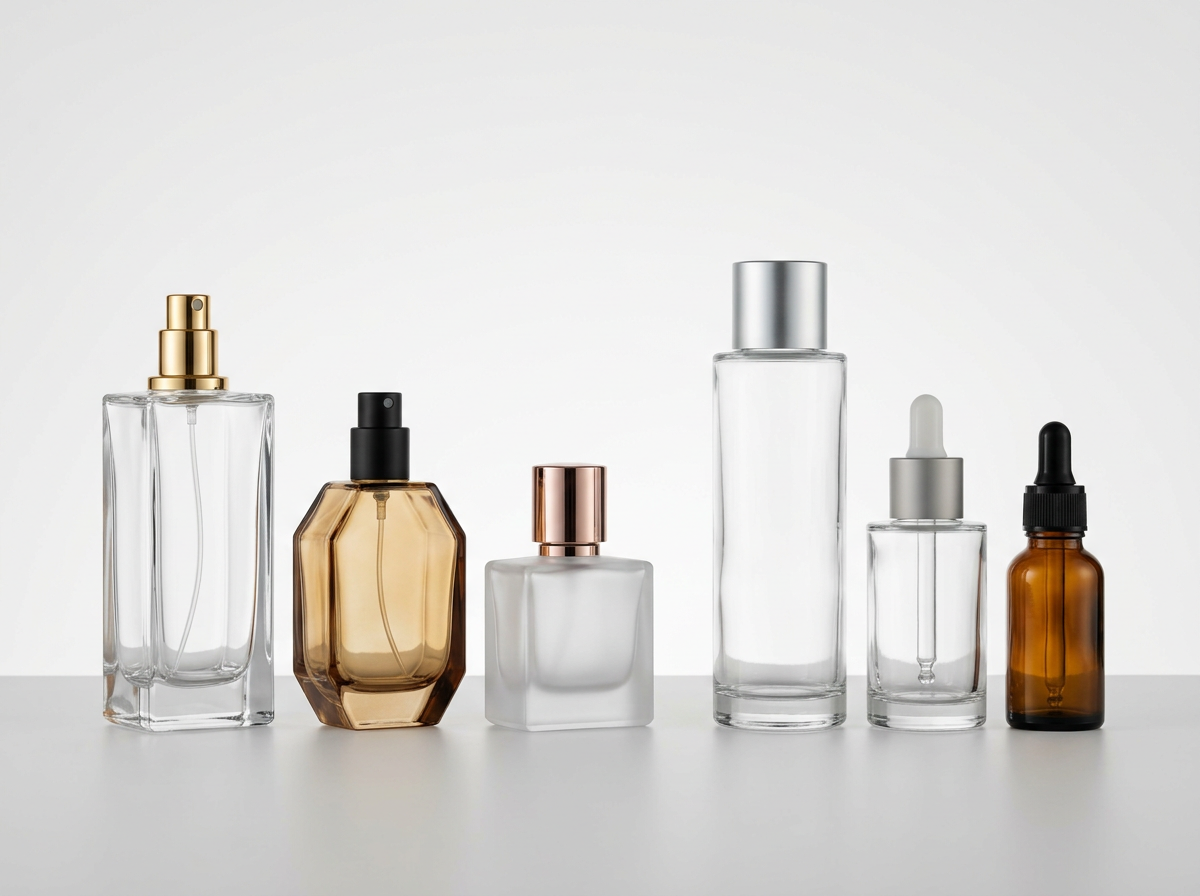 Perfume Bottle Design Elements That Support Brand Image
Perfume bottle design becomes brand image when shape, color, and finishing codes are repeated consistently.
Silhouette is one of the most powerful tools in luxury perfume bottles. Tall, architectural forms communicate elegance; rounded forms feel soft and intimate; geometric forms communicate modernity and control. For fragrance brands, these shape cues are not just cosmetic. They help define whether the line feels classic, youthful, avant-garde, or gender-neutral.
Color also matters because it sets fragrance expectation. Clear glass suggests transparency and freshness. Amber, smoke gray, or deep black suggests richness and mystery. Frosted glass can communicate refinement, while gradient coatings create a more contemporary luxury impression. In premium fragrance packaging, even the label format influences perception: minimal front printing often reads as more upscale than busy decoration.
Surface decoration is equally important. Techniques such as silk screening, hot stamping, UV coating, electroplating, and flocking can elevate perfume bottle design, but only when used with discipline. Over-decoration can make the bottle feel promotional rather than premium. The best luxury bottles usually combine one hero cue with restrained supporting details.
Brands launching a full fragrance range should also consider scale continuity. A 30 ml, 50 ml, and 100 ml bottle family with shared visual language feels more authoritative than three unrelated SKUs. That kind of packaging consistency is what turns a bottle into a recognizably premium fragrance packaging system.
Technical Quality Standards Behind Luxury Perfume Bottles
Technical quality determines whether luxury perfume bottles look premium only in photos or in real use.
Fragrance packaging buyers often focus on aesthetics first, but fit and function decide whether the product survives filling, transport, and repeated consumer handling. ISO 1101 defines geometric tolerancing principles used to control form and positional accuracy in engineered parts, and the same mindset applies to cosmetic packaging interfaces. In practice, premium brands want stable neck finishes, reliable pump engagement, and caps that seat cleanly without uneven gaps.
The liquid side matters too. The U.S. FDA notes that alcohol concentration is a major factor in fragrance formulation and flammability handling, so packaging compatibility is not just a visual issue; it is a safety and stability issue as well. Meanwhile, airless or tight-seal systems are often favored for formulas sensitive to oxidation. For brands that also sell skin and body products, related formats such as skincare packaging set and essential oil bottles can share design logic across categories.
| Technical area | Why it matters | Typical premium expectation | Source reference |
|---|---|---|---|
| Dimensional control | Prevents loose caps and misalignment | Tight, repeatable fits | ISO 1101, ISO 286-2 |
| Spray consistency | Affects user experience and dosage feel | Fine, even mist | Industry packaging QA practice |
| Seal integrity | Reduces leakage in transit | No visible seepage | ISTA transport testing guidance |
| Formula compatibility | Protects fragrance stability | Material resistance to alcohol | FDA cosmetic safety guidance |
For premium fragrance packaging, the hidden hero is not decoration but precision. A bottle that closes cleanly and ships safely protects the brand better than any slogan.
How Luxury Perfume Bottles Improve Shelf Presence and Conversion
Luxury perfume bottles improve shelf presence because they create faster visual recognition and stronger emotional appeal.
Retail environments reward products that communicate status quickly. On a crowded shelf or in a duty-free display, shoppers often make scanning decisions in a few seconds. That means perfume bottle design must work at distance, at arm’s length, and in the hand. A bottle with a recognizable silhouette, coherent cap proportion, and premium finish is easier to notice and easier to remember.
Premium fragrance packaging also supports giftability. Fragrance is frequently purchased as a gift, which means the bottle becomes part of the occasion. The consumer is not just buying scent; they are buying presentation. When a bottle looks collectible, the perceived value rises, and the brand gains pricing flexibility.
In ecommerce, the same logic applies in a different format. Product images and unboxing videos replace the physical shelf, so luxury perfume bottles must photograph well from multiple angles. Clean edges, reflective details, and a stable stand all help the bottle look expensive online. Brands that align bottle design with carton design usually see more coherent launch visuals across their digital and retail channels.
For international suppliers, this is where packaging integration becomes important. A luxury perfume bottle rarely stands alone; it needs a matching pump, cap, and outer packaging. If any one part looks off, the whole premium fragrance packaging story weakens.
Luxury Perfume Bottles and the Role of Packaging Systems
Luxury perfume bottles perform best when they are designed as part of a complete packaging system.
Lemuel’s packaging structure reflects an important industry reality: fragrance brands usually need more than a bottle. They need closures, pumps, matching cartons, and often a secondary set for gifting or seasonal editions. That system-level view matters because the consumer experiences packaging as one object, not as separate components.
This is especially relevant for brands that use perfume packaging as a launch category and then extend into perfume pumps and perfume caps. When the visual language is shared, the brand feels more organized and more intentional. That improves perceived professionalism, particularly for buyers comparing multiple suppliers.
A strong packaging system also helps operationally. Shared component families can reduce artwork complexity, simplify procurement, and make replenishment more predictable. For brands that run limited editions, this is especially useful because new visuals can be introduced without rebuilding the entire technical architecture from scratch.
| System element | Function | Brand value | Operational value |
|---|---|---|---|
| Bottle | Main product vessel | Primary identity | Filling efficiency |
| Pump | Fragrance delivery | User satisfaction | Leak control |
| Cap | Protects and completes look | Luxury tactility | Closure stability |
| Carton | Protection and storytelling | Gift appeal | Transit safety |
When these parts are aligned, premium fragrance packaging feels deliberate rather than assembled.
Choosing Materials for Premium Fragrance Packaging
Material selection is one of the clearest signals of whether a fragrance brand is truly premium.
Glass remains the dominant material for luxury perfume bottles because it conveys clarity, weight, and chemical compatibility. For closures, metalized plastic, zinc alloy, or coated composite materials can create a more upscale feel. For secondary components, recyclable PET and PE are often chosen when brands want lighter logistics or sustainability messaging. That combination allows premium fragrance packaging to balance aesthetics with supply-chain practicality.
Material choice also affects the story a brand can tell. A transparent bottle emphasizes product purity and formulation color. A frosted bottle softens the look and can suggest elegance or privacy. Velvet or flocked surfaces create a tactile cue that feels more collectible, especially for limited editions. For fragrance brands positioned around artistry, these material cues help reinforce creative identity.
On the sustainability side, many beauty buyers are paying more attention to recyclability and material reduction. The U.S. EPA recycling guidance emphasizes that recyclability depends on local collection systems and material type, so brands should avoid making vague environmental claims. Instead, they should explain what can be recycled, what cannot, and how the package is constructed.
That transparency builds trust. In premium fragrance packaging, trust is part of luxury.
How to Evaluate a Luxury Perfume Bottle Supplier
The best supplier is the one that can deliver design consistency, not just a pretty sample.
Brand teams often underestimate how much supplier capability affects final perception. A bottle supplier should be able to discuss mold feasibility, closure compatibility, decoration limits, and transport protection. They should also be able to supply family formats or matching components so the brand can extend a successful design into new launches. This is where a packaging partner with fragrance and skincare breadth can be more valuable than a single-item vendor.
When evaluating suppliers, brands should ask for evidence, not just renderings. A serious supplier can usually provide sample confirmation steps, material options, surface finish references, and packing specifications. For export brands, logistics capability also matters. Proximity to ports and experience with international shipments can reduce lead time risk and improve replenishment planning.
For luxury perfume bottles, a simple due-diligence checklist helps avoid expensive mistakes:
- Verify bottle-neck compatibility with the intended pump and cap.
- Check visual consistency under retail lighting and daylight.
- Ask for leak and transport protection details.
- Confirm decoration durability after handling and rubbing.
- Review whether matching formats exist for gift sets or seasonal editions.
Suppliers that support packaging accessories and related formats such as spray bottles can usually help brands build a more coherent premium fragrance packaging line.
Common Mistakes That Weaken Perfume Bottle Design
The most common mistake is overdecorating the bottle and underengineering the experience.
Many brands assume that more shine, more color, or more embellishment automatically creates luxury. In reality, luxury perfume bottles often feel expensive because they are restrained. If the cap is oversized, the label is busy, or the finish is inconsistent, the design starts to look promotional instead of premium. Another common issue is ignoring the relationship between bottle, pump, and carton, which creates a fragmented brand impression.
There are also technical mistakes. A bottle may look good but fail in production because of unstable tolerances, poor seal integrity, or incompatible decoration. In premium fragrance packaging, those failures show up later as leakage, cap wobble, scratched surfaces, or inconsistent filling performance. Each one erodes confidence.
- Do not choose a bottle shape that cannot be filled efficiently.
- Do not use mixed finishes that compete with the fragrance identity.
- Do not ignore shipping protection for fragile glass formats.
- Do not treat the cap as an afterthought.
- Do not launch before the full packaging set is visually aligned.
Brands that avoid these mistakes build stronger shelf presence and more durable customer trust.
Luxury Perfume Bottles in a Brand-Building Roadmap
Luxury perfume bottles work best when they are part of a repeatable brand system.
For new fragrance brands, the ideal roadmap begins with identity, not packaging. Define the target user, price tier, and emotional positioning first, then design the bottle to express that position. Next, align the closure, pump, label, and carton so the whole set tells one story. Finally, test the design in retail-style viewing conditions, shipping scenarios, and repeat handling. That sequence reduces redesign risk and keeps premium fragrance packaging coherent across launches.
For established brands, the next step is family expansion. Once the main bottle succeeds, adapt the design into travel sizes, sets, refills, or seasonal editions. This keeps brand recognition high while offering new merchandising opportunities. A bottle family also helps purchasing teams standardize components, which can improve planning and reduce variability.
In a crowded market, the brands that win are rarely the ones with the loudest decoration. They are the ones whose bottles feel intentional, stable, and memorable. That is the real value of luxury perfume bottles: they turn fragrance into a visible brand asset.
FAQ
What are luxury perfume bottles?
Luxury perfume bottles are fragrance containers designed to communicate premium value through materials, shape, finish, and functional quality. They usually emphasize visual identity, tactile experience, and system consistency.
Why are luxury perfume bottles important for premium fragrance packaging?
They are important because they influence first impressions, shelf visibility, gift appeal, and perceived product value. In many cases, the bottle affects purchase decisions before the scent is even tested.
What materials are best for perfume bottle design?
Glass is the most common choice for luxury perfume bottles because it feels substantial and works well with fragrance formulas. Metal, zinc alloy, coated plastic, and recyclable PET are often used for caps and supporting packaging components.
How can a perfume bottle make a brand look more premium?
A bottle can make a brand look more premium through balanced proportions, precise closure fit, refined surface decoration, and consistent packaging across the bottle, pump, cap, and carton.
What should brands test before launching luxury perfume bottles?
Brands should test fit, leak resistance, spray performance, decoration durability, and retail appearance under different lighting conditions. Packaging should also be checked in shipping and handling simulations.
How do fragrance brands use perfume bottle design for recognition?
They use repeated silhouette cues, finish codes, and closure details across product lines so consumers can recognize the brand quickly. Consistency is often more effective than complexity.
Can premium fragrance packaging support sustainability goals?
Yes, if brands choose recyclable materials thoughtfully, reduce unnecessary parts, and communicate environmental claims accurately. Sustainability works best when it is verifiable and aligned with local recycling infrastructure.
Post time: Aug-03-2026


