
- The cap is a visual and functional anchor in premium perfume packaging, not a decorative extra.
- Glass perfume bottles create the foundation for clarity, stability, and high-end shelf perception.
- Cap material, fit, and finish affect leakage risk, brand consistency, and perceived luxury.
- Designing the bottle, cap, and secondary packaging together improves launch readiness and brand recall.
Perfume bottles with caps are central to premium perfume packaging because fragrance is one of the few consumer products where the package directly shapes the emotional value of the product, and an ISO 1101 geometric tolerance framework reminds manufacturers that fit and alignment matter as much as appearance. In luxury fragrance, a small visual gap, uneven shoulder line, or poorly matched cap can weaken the entire brand story, while a well-balanced glass perfume bottle can make the product feel more expensive before the scent is even sprayed. For brands planning market entry, a complete packaging system such as perfume bottles, perfume caps, and sprayers helps align design, usability, and supply-chain execution from the start.
Why perfume bottles with caps shape premium fragrance design
The cap is the fastest way to signal whether a fragrance belongs in the mass market or the premium tier.
Luxury fragrance is sold through anticipation as much as scent, and the bottle-and-cap combination creates that anticipation on the shelf, in influencer unboxings, and at the point of purchase. In premium perfume packaging, the cap often carries more visual mass than the bottle neck, which means its silhouette can define the overall perception of elegance, stability, and craftsmanship. A heavy metal-look cap, for example, can suggest permanence and value, while a soft-touch or flocked cap can add a sensory layer that customers remember after the spray test.
This is why glass perfume bottles are rarely evaluated in isolation. Buyers assess how the bottle, cap, atomizer, and outer carton work as one object. A narrow, tall bottle with a short cap can feel modern and minimal; a broad bottle with a sculptural cap can feel niche and artisanal. In both cases, the cap acts as a visual punctuation mark that completes the design language.
For premium brands, this matters because fragrance buyers often make a subconscious quality judgment in under a second. That makes proportion, finish consistency, and tactile feel part of the product strategy, not just industrial design.
Glass perfume bottles and premium perfume packaging: the core design variables
Glass is still the most persuasive material for premium perfume packaging because it communicates purity, stability, and value.
Unlike many polymer containers, glass perfume bottles support crisp transparency, high color fidelity, and strong shelf reflection. That is important when the juice color is part of the story, whether the brand uses clear eau de parfum, tinted extrait, or a natural-looking amber tone. Glass also gives designers more freedom to play with wall thickness, base weight, shoulder geometry, and decoration methods such as frosting, coating, silk screening, hot stamping, and metallization.
The bottle cap then becomes the control point for finish contrast. A transparent bottle paired with a matte cap creates tension and balance. A heavy decorative cap on a minimal bottle creates hierarchy. A fully synchronized system, by contrast, creates calm and consistency, which is often the preferred visual language in prestige fragrance.
From a procurement perspective, the most important technical variables are not only appearance. Buyers should also compare neck finish compatibility, closure torque, pump insertion method, and dimensional repeatability. In packaging engineering, those details determine whether the final assembly feels solid or loose, whether it leaks in transit, and whether the brand can scale repeat orders without rework.
| Design variable | Why it matters | Typical premium target |
|---|---|---|
| Glass clarity | Shows juice color and purity | High-transparency soda-lime or flint glass |
| Cap weight | Shapes perceived value | Heavier than mass-market closures |
| Neck alignment | Supports clean visual line | Consistent centerline fit |
| Surface finish | Builds brand identity | Matte, glossy, flocked, coated, or metallic |
| Closure compatibility | Reduces leakage risk | Matched to pump and neck specification |
For many brands, the difference between ordinary and premium is not a single expensive component. It is the coherent combination of glass quality, closure fit, and decoration discipline.
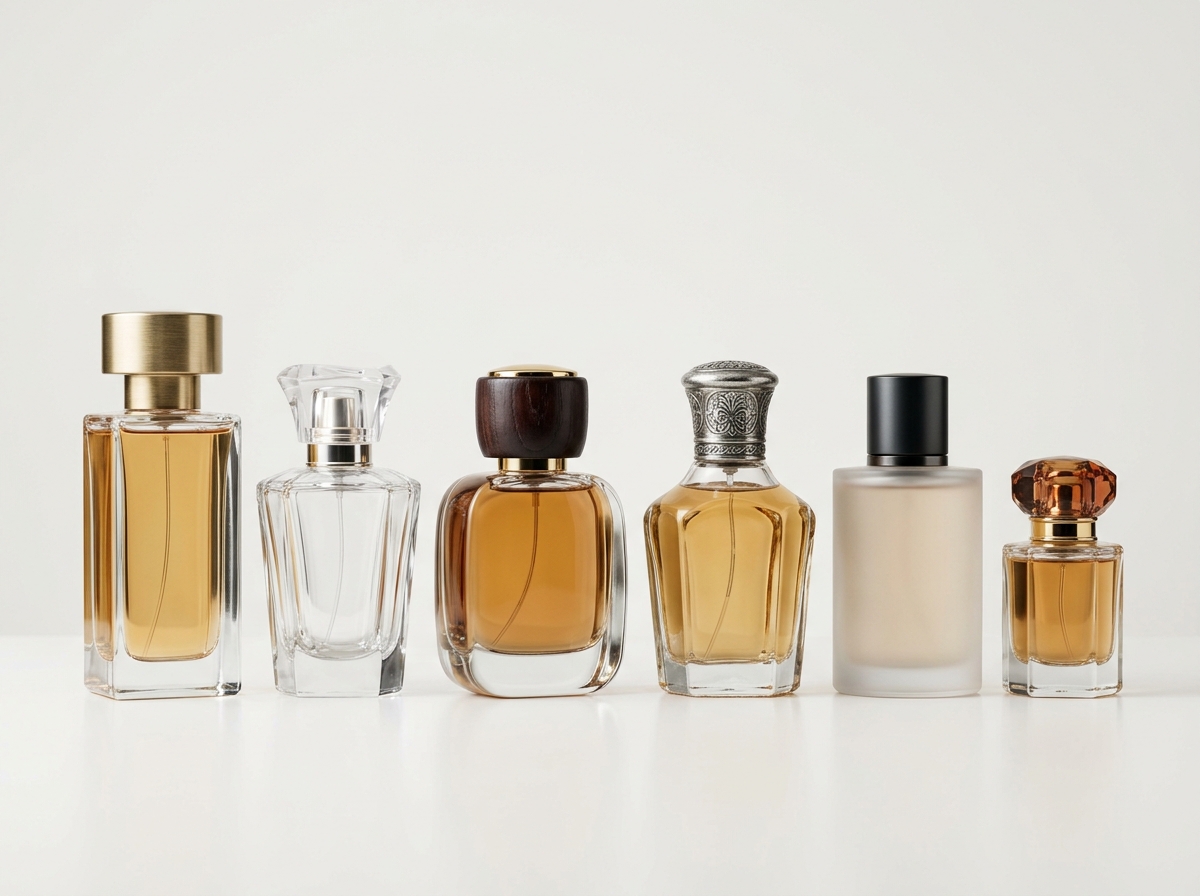 How cap design influences fragrance perception and shelf appeal
Cap geometry changes how customers read the brand before they ever open the bottle.
The most successful perfume bottles with caps use shape, mass, and surface texture to create a recognizable visual signature. A domed cap softens the profile and often feels more classical. A faceted cap catches light and can look more architectural. A cylindrical cap can project modern restraint. Even the gap between cap and shoulder matters, because overly large spacing can make the package feel unstable, while tight visual integration can suggest precision.
Cap finish also matters in premium perfume packaging. Glossy plated caps can communicate glamour, but they may fingerprint easily. Brushed metal effects can feel more technical and restrained. Velvet or flocked finishes can add a tactile layer that suggests warmth and intimacy. Zinc alloy and metal-look structures are often used when the brand wants a denser hand feel, though the real decision should consider cost, corrosion resistance, and compatibility with the fragrance formula.
Design teams should also test the cap in real handling conditions. A cap that looks elegant in a render may be hard to remove with one hand, or it may lose alignment after repeated use. In fragrance packaging, the user ritual matters: lift, uncap, spray, recap. If that sequence feels smooth, the package supports the fragrance; if it feels awkward, the package interrupts the emotional experience.
Common cap styles and their premium signals
| Cap style | Visual signal | Best use case | Design risk |
|---|---|---|---|
| Cylindrical | Minimal and modern | Contemporary fragrance lines | Can feel generic if overused |
| Domed | Classic and soft | Heritage and floral scents | May reduce shelf distinction |
| Faceted | Architectural and sharp | Niche or luxury launches | Complex tooling and finish control |
| Metal-look | Dense and premium | Prestige positioning | Potential fingerprinting and cost increase |
| Flocked | Soft and tactile | Gift sets and couture concepts | Needs strong abrasion testing |
For brands exploring a broader portfolio, a matching set of cosmetic jars, cream jars, and fragrance closures can help maintain visual continuity across product families.
Technical standards that matter for perfume bottles with caps
Premium design fails quickly when the package is beautiful but not measurable.
The best fragrance packaging programs translate aesthetic goals into tolerances, test methods, and pass-fail criteria. For glass perfume bottles, dimensional consistency affects spray performance, cap fit, and repeatability across large runs. For buyers, this is where standards become commercially useful. A cap that fits loosely on one batch and tightly on another can cause customer complaints, while a stable neck specification supports reliable assembly and fewer rejects.
Glass manufacturers often rely on recognized testing and tolerance systems. For example, the ASTM C169 standard covers the dimensional testing of glass containers, while ISO 12870 shows how fit and dimensional control are formalized in eyewear manufacturing, illustrating the broader principle that precision closure systems require repeatable dimensions. For material and chemical safety, fragrance brands frequently review migration, corrosion, and compatibility data in relation to the formula, especially when alcohol, essential oils, or colorants are aggressive toward decorative finishes.
One useful way to think about luxury packaging is that design is the visible layer, but tolerances are the invisible layer that protects the brand promise. When a bottle, pump, and cap are aligned within a controlled system, the package feels intentional every time it is handled.
| Technical area | Why it matters | Typical evaluation method | Commercial impact |
|---|---|---|---|
| Neck finish | Ensures closure fit | Dimensional gauge check | Reduces leakage and returns |
| Cap alignment | Affects shelf appearance | Visual and torque inspection | Improves premium perception |
| Surface durability | Protects decoration | Abrasion and rub testing | Lowers damage during transport |
| Pump performance | Influences spray quality | Actuation and spray pattern testing | Improves user experience |
For brands that export, packaging qualification should also consider transit vibration, temperature swings, and repeated handling across warehouse and retail channels.
Premium perfume packaging choices that increase perceived value
Perceived value rises when the package communicates effort, precision, and restraint.
Premium perfume packaging is not about making every surface shiny. It is about designing contrast. A heavy base can stabilize the silhouette. A clear bottle can show the juice. A cap with a distinct finish can create visual closure. A carton with aligned graphics can frame the bottle as a luxury object rather than a commodity.
Brands often improve the premium effect by combining glass perfume bottles with secondary packaging that protects the reveal. Rigid cartons, inserts, neck collars, and custom trays help control how the bottle appears when the customer opens the box. That unboxing sequence is especially important for e-commerce, where the physical store display is replaced by social media visibility and shipping resilience.
There is also a commercial reason to invest in packaging coherence. When cap, bottle, and carton speak the same visual language, the brand can create a recognizable family across multiple SKUs, which simplifies line extension into body mist, travel spray, or gift set formats. That consistency often improves merchandising efficiency and makes seasonal updates easier to launch.
- Start with the fragrance story and decide whether the brand should feel modern, classical, couture, or niche.
- Choose the bottle architecture first, then match cap mass and finish to that silhouette.
- Validate closure fit, spray performance, and transport durability before final artwork approval.
- Review the package under retail light, daylight, and mobile camera conditions.
- Confirm that all components can be reordered at scale without changing the look.
When these steps are handled together, the package feels intentional rather than assembled.
Comparing cap materials for glass perfume bottles
Material choice affects not only aesthetics but also durability, weight, and buyer perception.
Cap materials are often selected for the same fragrance line based on budget tiers, but the premium tier typically depends on a better balance of appearance and handling. Plastic caps can be lightweight and cost-efficient, yet they may need coatings to achieve a luxury effect. Zinc alloy and metal-finish caps provide more density and can feel more upscale, but they add tooling and procurement complexity. Decorative composite caps can deliver unusual shapes or textured surfaces, especially when the goal is differentiation at scale.
From a technical standpoint, fragrance compatibility is important. Alcohol-based formulas can interact with inks, paints, and low-grade finishes over time. That is why material selection should include aging tests, not just visual approval. If a cap’s coating changes after exposure to fragrance vapor or warehouse heat, the premium effect disappears quickly.
| Cap material | Perceived value | Durability | Typical concern |
|---|---|---|---|
| Plastic | Medium | Good | May need coating for luxury feel |
| Zinc alloy | High | Very good | Higher cost and weight |
| Composite | Medium to high | Good | Finish consistency must be controlled |
| Metal-plated | High | Good | Fingerprints and abrasion risk |
| Flocked or velvet | High tactile appeal | Moderate | Wear resistance must be tested |
In premium fragrance design, the best material is the one that survives real handling while still supporting the brand story.
How to specify perfume bottles with caps for a new fragrance launch
A clean specification sheet saves more time than a perfect mood board.
When launching perfume bottles with caps, buyers should specify size, neck finish, glass color, decoration method, pump type, cap material, and target packaging style before requesting samples. This reduces revision cycles and helps suppliers propose realistic options. If the bottle is intended for high-end retail, the cap should be evaluated together with the sprayer and carton, because each part affects the final unboxing experience.
The practical questions are usually simple: Does the cap seat securely? Does the bottle stand balanced? Does the decoration survive shipping? Does the spray output match the intended usage? Is the line scalable for repeat production? These are the questions that determine whether a premium concept becomes a stable product range.
For international buyers, supply-chain reliability is equally important. Suppliers in export-oriented manufacturing hubs, including coastal regions with direct logistics access, can help reduce lead times and simplify consolidation. But logistics advantage only matters if the packaging specification is already stable. Otherwise, faster shipping simply accelerates the wrong sample.
- Define the target customer and retail context.
- Choose bottle size and silhouette based on volume and shelf display.
- Set cap style, finish, and material before decoration approval.
- Test compatibility with sprayer and neck finish.
- Verify sample performance under transport and temperature stress.
Brands that also need complementary beauty packaging can align launches across categories by reviewing airless bottles and essential oil bottles for adjacent product lines.
Packaging testing that protects premium fragrance design
Testing is what prevents luxury appearance from collapsing in distribution.
Fragrance packaging should be validated for leakage, spray consistency, drop resistance, and cosmetic appearance retention. In premium launches, even small defects become expensive because the customer expectation is higher. A scratched cap, loose collar, or visible offset between cap and bottle can undermine the price position immediately.
A practical test plan usually includes visual inspection, torque or fit checks, closure opening and reseating, and transit simulation. While exact test methods vary by manufacturer, the principle is the same: confirm that the package looks premium after handling, not only at first sight. A fragrance bottle that survives sample approval but fails warehouse handling is not launch-ready.
For brands selling gift sets, the outer box and internal tray deserve the same attention as the bottle itself. Customers often judge premium packaging by how the set feels when opened. If the bottle arrives centered, protected, and intact, the cap and glass finish can do their work. If the tray shifts or the bottle rattles, the product feels less exclusive no matter how expensive the materials were.
| Test focus | What to verify | Why it matters in premium fragrance |
|---|---|---|
| Leakage | Seal integrity during transit | Protects formula and customer experience |
| Drop impact | Bottle and cap resistance to shock | Prevents visible damage |
| Decoration durability | Coating and print retention | Maintains luxury appearance |
| Fit consistency | Cap seating across batches | Supports repeat quality |
Reliable test data turns packaging from a creative risk into a controlled commercial asset.
Frequently asked questions about perfume bottles with caps
What makes perfume bottles with caps look premium?
They look premium when proportion, finish, and fit feel intentional. Heavy visual balance, clean neck alignment, and a cap finish that matches the brand story all increase perceived value.
Why are glass perfume bottles preferred for luxury fragrance?
Glass perfume bottles are preferred because they communicate clarity, stability, and quality. They also support richer decoration options and stronger shelf presence than many lightweight alternatives.
How does the cap affect fragrance packaging performance?
The cap affects appearance, handling, and closure protection. If the fit is unstable or the finish chips easily, the package loses both utility and premium appeal.
What should brands test before approving premium perfume packaging?
Brands should test fit, leakage, spray consistency, decoration durability, and transport resistance. These checks reduce launch risk and protect the customer experience.
Which cap material is best for a luxury fragrance line?
No single material is best for every project. Zinc alloy and metal-finish caps often feel more luxurious, while composite or coated plastic solutions can work well if the finish and durability are controlled.
How do perfume bottles with caps support brand identity?
They create a repeatable visual signature. When the bottle shape, cap silhouette, and decoration system stay consistent, the line becomes easier to recognize across SKUs and marketing channels.
What is the most common mistake in premium perfume packaging?
The most common mistake is treating the cap as a separate accessory instead of part of the design system. That usually leads to weak visual harmony and a less convincing luxury impression.
For fragrance brands building a scalable portfolio, the strongest packaging programs do not ask whether the cap is attractive on its own. They ask whether the whole object feels like a premium fragrance the moment it is picked up, opened, and used. That is the real advantage of perfume bottles with caps in premium fragrance design.
Post time: Aug-04-2026


