
- Glass perfume bottles support premium positioning through clarity, weight, and finish options.
- Boutique fragrance packaging works best when bottle, pump, and cap are engineered as one system.
- Performance details such as neck finish, spray output, and decoration durability affect retail outcomes.
- Compliance and testing matter: packaging should be checked against relevant material and transport standards.
- Series consistency is often more valuable than one-off novelty for boutique fragrance product lines.
Glass perfume bottles are a strong fit for boutique fragrance packaging because luxury fragrance buyers evaluate the package as part of the scent itself, not as a separate accessory; that matters when the bottle must support branding, shelf appeal, and formula stability at the same time. ISO 1161 container design principles and transport-related testing are often used as reference points in packaging engineering, while glass compatibility is especially important for alcohol-based formulas and oils. For procurement teams, the most useful questions are capacity, neck finish, spray atomization, and decoration durability, not simply whether the bottle looks elegant. A coordinated range, such as perfume bottles, spray bottles, and perfume caps, helps boutique brands keep visual continuity across SKU variants.
Why glass perfume bottles support boutique fragrance packaging strategy
Glass perfume bottles are preferred in boutique fragrance packaging because they deliver a premium sensory cue that plastic rarely matches.
In luxury and niche fragrance, the package must immediately communicate price tier, formulation care, and brand story. Glass does this through optical clarity, surface finish, and perceived mass. A heavier package usually feels more substantial in hand, and that physical signal is often read by consumers as higher quality. This is why boutique fragrance product lines often use perfume glass containers even when the total fill volume is small.
Glass also supports better formula presentation. Clear or lightly tinted bottles let buyers see the liquid level and color, which can reinforce transparency and craftsmanship. For boutiques that sell seasonal drops or limited editions, that visual difference becomes part of the collectible appeal. If the line includes variants for travel, retail display, and gift sets, the same visual language can be extended through perfume boxes and coordinated accessories.
How perfume glass containers influence brand perception at shelf level
Perfume glass containers influence conversion because shoppers often decide within seconds whether a fragrance feels exclusive, giftable, or mass market.
Shelf behavior in fragrance is highly visual. A bottle with crisp glass edges, a well-proportioned shoulder, and a clean spray head reads differently from a generic stock container. Boutique brands benefit from that distinction because their commercial advantage is often not scale, but differentiation. Decorative treatment can amplify the effect: frosted glass, coating, silk screening, hot stamping, electroplated caps, and flocked or velvet surfaces all add perceptual value without changing the formula.
For an international buyer, the key point is not simply aesthetics. The bottle, pump, and cap must also be compatible. A visually strong bottle can still fail if the spray pattern is uneven, the closure leaks, or the cap loosens in transit. That is why fragrance packaging is best managed as a system rather than a single SKU.
| Boutique fragrance packaging factor | Why it matters | Typical decision metric | Practical impact |
|---|---|---|---|
| Glass clarity | Shows formula color and fill level | High transparency or controlled tint | Improves premium perception |
| Neck finish | Controls pump and cap fit | Matched closure specification | Reduces leakage risk |
| Surface decoration | Creates brand identity | Frosted, coated, printed, plated | Raises shelf distinction |
| Cap material | Completes the visual system | ABS, zinc alloy, aluminum, wood | Supports luxury positioning |
Technical fit: what makes a glass perfume bottle work with a boutique formula
A glass perfume bottle works best when the container geometry and closure system are chosen for the formula, not only for the design brief.
Most fine fragrance formulas are alcohol-based, which makes glass an attractive primary package because it is chemically stable and visually clean. However, compatibility still depends on decoration layer quality, pump seal performance, and the interaction between the liquid and the closure materials. This is especially important for boutique lines that use essential oils, natural extracts, or high-aroma concentrates, since these formulas can be more demanding than standard eau de parfum blends.
In practical sourcing terms, buyers should evaluate the bottle as a full packaging stack. The bottle may be 30 ml, 50 ml, or 100 ml, but the real question is whether the set functions as intended across filling, transport, and retail use. Boutique fragrance packaging often gains its edge from custom combinations rather than one expensive component.
| Component | Common material choices | Selection concern | Typical buyer question |
|---|---|---|---|
| Bottle body | Soda lime glass, flint glass | Clarity, weight, decoration adhesion | Will it look premium on shelf? |
| Pump | Aluminum, PP, POM | Spray consistency, leak resistance | Does it atomize evenly? |
| Cap | Zinc alloy, ABS, wood, aluminum | Visual finish, closure stability | Does it feel aligned with the brand? |
| Decoration | Coating, silk print, frosting | Scratch resistance, color match | Will it survive shipping and retail handling? |
For product teams, the bottle should also be checked against fill-line requirements and headspace needs. A boutique scent that uses volatile top notes may require more attention to evaporation control than a standard cosmetic liquid. That is why perfume sprayers and perfume accessories matter just as much as the glass container itself.
What specifications matter most in boutique fragrance packaging
The most important specifications in boutique fragrance packaging are the ones that affect filling accuracy, closure fit, and retail durability.
For procurement, the following checklist usually determines whether a design can move into production smoothly:
- Fill volume and usable headspace.
- Neck finish and thread or crimp compatibility.
- Spray output consistency and mist quality.
- Cap alignment and wobble tolerance.
- Decoration durability under abrasion and shipping.
Packaging engineers often test closure fit and leak resistance under vibration and transport stress because shipping damage is one of the most expensive failure points for fragrance brands. The ASTM D4169 distribution testing framework is widely used for transport simulation, while ISO 11607-1 is a useful reference for packaging system integrity principles in regulated contexts. Even though fragrance packaging is not a sterile medical pack, the same discipline of system-level validation helps reduce field failures.
For boutique brands, this matters because a premium bottle that leaks in transit quickly becomes a customer service issue and a reputational loss. The higher the price point, the less forgiving the buyer is about closure inconsistency or decoration wear.
| Test area | Relevant reference | Why it is useful | Common pass/fail concern |
|---|---|---|---|
| Transport simulation | ASTM D4169 | Checks shipping durability | Leakage, breakage, cap loss |
| Package integrity principles | ISO 11607-1 | System-level packaging thinking | Weak closures, poor barrier design |
| Design for contamination control | NIST packaging and measurement resources | Supports repeatable measurement practice | Inconsistent QC decisions |
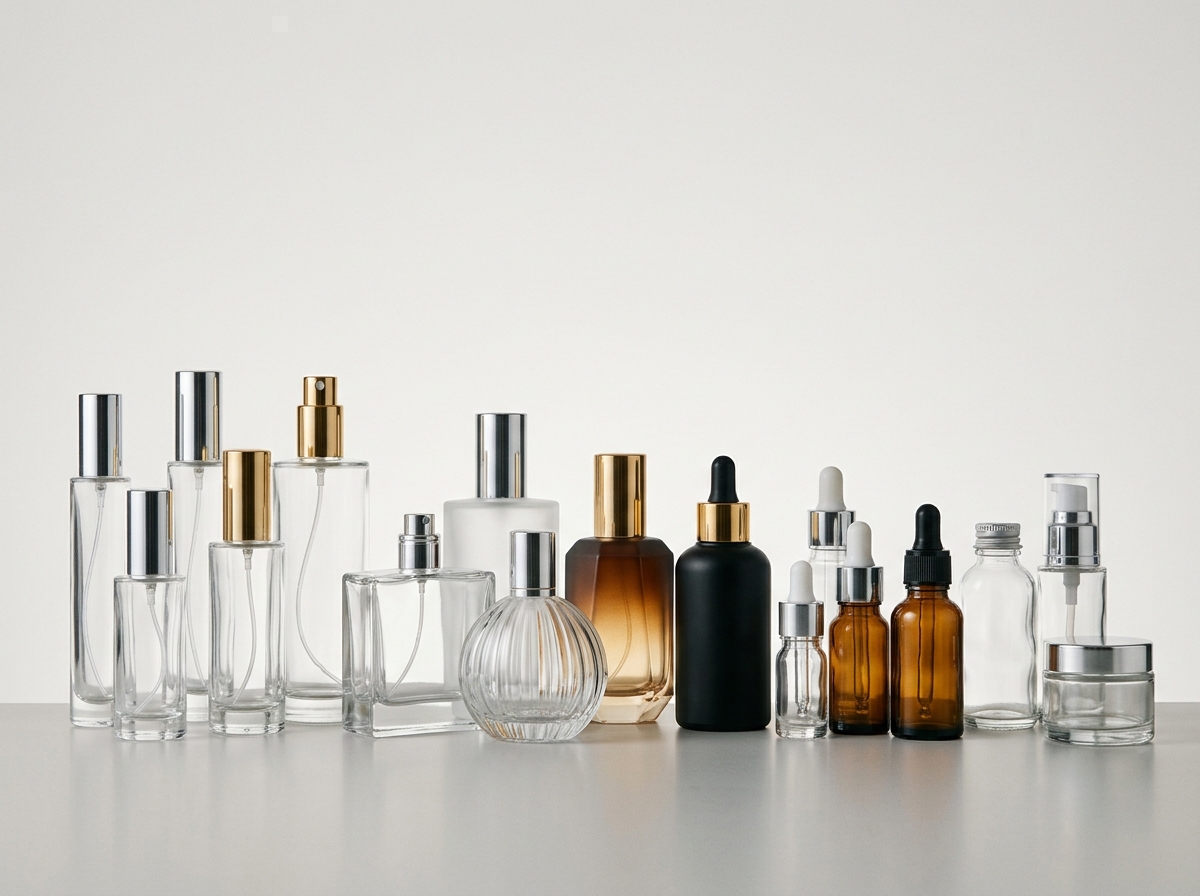
Glass perfume bottles and premium customization options for boutique brands
Glass perfume bottles are ideal for custom branding because the material accepts a wide range of premium finishes.
Boutique fragrance product lines often depend on subtle differentiation. A small change in coating, embossing, or cap shape can shift the perception of the entire collection. Common custom options include frosted glass, gradient spraying, metallic coating, silk screen printing, and tactile treatments such as velvet or flocking. These details are especially effective when the brand wants to build a signature visual system across a family of SKUs.
Luxury packaging also benefits from accessory coordination. A bottle with a zinc alloy cap can communicate a different positioning than one with a light PP closure. Likewise, gift-ready presentation becomes stronger when the bottle and outer box are designed together. For brands that want one supplier to support multiple format families, a structured portfolio such as cosmetic jars, cream jars, and essential oil bottles can simplify line planning across fragrance, skin care, and aromatherapy categories.
Customization should still be evaluated through production reality. A finish that looks excellent in renderings may be harder to reproduce consistently at volume. That is why sample confirmation, color matching, and pre-production approval are essential steps in boutique fragrance packaging development.
How to choose glass perfume bottles for different boutique fragrance product lines
The right glass perfume bottle depends on the product role, the launch budget, and the brand story.
For a hero fragrance, buyers often prioritize a distinctive silhouette and premium decoration. For a discovery set, consistency and cost control may matter more than dramatic visual effects. For a travel-size SKU, the closure must be secure and the bottle compact enough to ship efficiently. The same logic applies across niche fragrance, private label perfume, and seasonal collections.
When evaluating options, use a structured selection process:
- Define the target retail tier and channel.
- Confirm fill volume and usage profile.
- Match bottle neck finish to the chosen pump and cap.
- Review decoration options for durability and color stability.
- Test samples for leakage, spray quality, and shelf presentation.
Brands that plan series launches should also consider whether the bottle family can scale across variants. One design that works for 30 ml may not automatically work for 50 ml and 100 ml unless proportions are managed carefully. That is why collection logic matters as much as individual aesthetics in boutique fragrance packaging.
Table: boutique fragrance packaging selection guide by use case
Different sales channels reward different package priorities.
| Use case | Recommended bottle focus | Typical volume | Primary risk | Best-fit feature |
|---|---|---|---|---|
| Niche retail launch | Strong visual identity | 50 ml | Weak shelf differentiation | Custom shape or finish |
| Discovery set | Cost-efficient consistency | 5 ml to 15 ml | High unit complexity | Simple family design |
| Travel SKU | Leak resistance | 10 ml to 30 ml | Transit failure | Reliable sprayer and cap |
| Gift set | Presentation coherence | 30 ml to 100 ml | Packaging mismatch | Coordinated box and bottle |
Transport, sustainability, and supply-chain considerations for perfume glass containers
Perfume glass containers must be chosen with shipping and sustainability in mind, not only with design intent.
Glass is recyclable, but it is also fragile and heavier than many alternative materials. That means freight efficiency, breakage protection, and carton design are important commercial variables. For export-oriented brands, these factors can influence landed cost and customer satisfaction more than a small difference in unit price.
Packaging sustainability should be treated carefully and honestly. Recyclability depends on local collection and processing systems, not just on material type. The United States EPA recycling guidance explains that recycling outcomes depend on local infrastructure and correct disposal behavior. For brands that want to support a lower-impact story, lightweighting, refillability, and material reduction in secondary packaging may be more practical than claiming that a package is universally recyclable.
In procurement conversations, ask for carton drop protection, palletization logic, and breakage assumptions. A bottle that looks premium but arrives with chips or cracks undermines the entire launch. That is why quality control and packing design should be discussed together from the start.
Why boutique fragrance packaging often performs better as a coordinated system
Boutique fragrance packaging performs best when the bottle, pump, cap, and outer box are developed as a coordinated system.
This matters because fragrance is both a product and a ritual. The consumer does not just spray a scent; they unbox it, display it, carry it, and often gift it. Every touchpoint carries brand meaning. If the bottle is elegant but the sprayer feels cheap, the experience breaks. If the cap is beautiful but unstable, the package feels unfinished. If the outer box is strong but the bottle proportion is awkward, the whole line loses coherence.
That is why product planning should move from component thinking to system thinking. For example, a collection built around skincare set packaging principles can improve visual consistency across adjacent beauty categories, while fragrance-specific components keep the sensory experience intact. In practice, brands that align shapes, finishes, and closures across a line usually achieve better recognition and simpler reorder management.
Common mistakes when sourcing glass perfume bottles
Most sourcing failures come from under-specifying the packaging system, not from choosing glass itself.
- Choosing a bottle before confirming pump and cap compatibility.
- Ignoring shipping stress and breakage risk during testing.
- Overusing decoration that cannot be reproduced consistently.
- Building one-off designs that cannot scale across product variants.
- Focusing on appearance while underweighting filling and assembly efficiency.
These mistakes are avoidable when the buyer asks for samples early, defines the target market clearly, and validates the package under realistic handling conditions. Boutique fragrance packaging is especially sensitive to misalignment because the customer base is buying emotional value as much as function.
FAQ
Why are glass perfume bottles better for boutique fragrance packaging?
Glass perfume bottles are better for many boutique fragrance packaging strategies because they communicate higher value, present the liquid clearly, and support premium decoration options. They also pair well with custom pumps and caps.
What bottle size is most common for boutique fragrance product lines?
Common boutique fragrance sizes include 30 ml, 50 ml, and 100 ml, because these formats balance perceived value, shelf presence, and retail pricing flexibility.
What should buyers test before approving perfume glass containers?
Buyers should test spray performance, leak resistance, cap fit, decoration durability, and shipping resilience. These checks reduce field failures and improve launch reliability.
Can glass perfume bottles be customized for luxury branding?
Yes. Glass perfume bottles can be customized with frosting, coating, printing, plated caps, special shapes, and coordinated boxes, which makes them highly suitable for luxury branding.
Are glass perfume bottles suitable for alcohol-based formulas?
Yes. Glass is generally a strong choice for alcohol-based perfume formulas because it is chemically stable and visually clean, though the full package still needs compatibility testing.
How do perfume glass containers affect consumer perception?
Perfume glass containers affect consumer perception by shaping first impressions of quality, giftability, and exclusivity. A well-designed bottle can strengthen perceived brand value before the scent is even tested.
What makes a fragrance bottle suitable for export?
An export-ready fragrance bottle should have stable closure fit, packaging protection for transit, repeatable decoration quality, and palletized shipping logic that reduces breakage risk.
Post time: Aug-03-2026


